On any active trading day, investors may come across headlines stating that the Sensex moved up while the Nifty declined, or vice versa. These two indices are often viewed as similar indicators of market direction. While they are closely related, they are not interchangeable.
The comparison between Sensex and Nifty matters because both indices are commonly used as indicators of large-cap market performance in India. For investors choosing index funds or exchange-traded funds (ETFs), the benchmark tracked by the product may influence portfolio composition, concentration levels, and return potential over different market periods.
This guide explains what each index represents, highlights the key differences between Nifty and Sensex, and outlines how investors typically take exposure through passive investment products.
Table of Contents:
- What is Sensex?
- What is Nifty?
- Key differences: Nifty vs. Sensex
- How to invest in Nifty?
- How to invest in Sensex?
What is Sensex?
The Sensex – officially called BSE Sensex – is the flagship equity benchmark index of the BSE (formerly Bombay Stock Exchange). It represents a basket of 30 large, widely traded companies selected from the BSE universe based on liquidity, market capitalisation, and sector representation. The index was introduced in 1986 and is among India’s oldest equity benchmarks.
It is important to note that an index itself is not an investment product. An index functions as a market measurement tool. Investors typically take exposure through investment vehicles that aim to replicate index performance, such as index funds offered under the mutual fund structure or ETFs listed on stock exchanges. Index funds and ETFs tracking the Sensex aim to mirror the performance of the benchmark; however, they do not guarantee returns.
Also Read: NSE vs BSE: Key Differences and Which is Better?
What is Nifty?
In common market usage, the term “Nifty” usually refers to the Nifty 50, the flagship benchmark index of the National Stock Exchange (NSE). The Nifty 50 comprises 50 large companies listed on the NSE and is constructed using the free-float market capitalisation methodology.
The Nifty 50 was launched on April 22, 1996, with a base date of November 3, 1995, and a base value of 1,000.
An important clarification is that NSE maintains multiple indices representing different segments of the market. However, when market commentary refers simply to “Nifty”, it typically indicates the Nifty 50 benchmark.
Key differences: Nifty vs. Sensex
The difference between Nifty 50 and BSE Sensex can be understood by viewing them as two benchmark baskets tracking large companies but built from different exchanges and containing different numbers of constituents.
- Exchange and benchmark identity
- BSE Sensex is the benchmark index of BSE.
- Nifty 50 is the benchmark index of NSE.
Operationally, both indices are widely tracked indicators of India’s equity markets, though each is constructed from the respective exchange’s eligible universe.
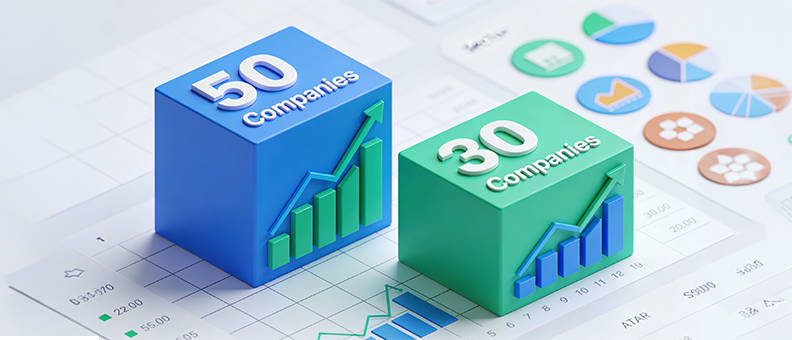
- Number of companies: 30 vs 50
- BSE Sensex tracks 30 companies.
- Nifty 50 tracks 50 companies.
A smaller number of constituents may lead to relatively higher concentration in certain stocks or sectors, which may influence index movements when large constituents experience price changes.
- Construction logic: Both BSE Sensex and Nifty 50 are calculated using the free-float market capitalisation method. This methodology considers only shares available for public trading rather than total outstanding shares. The objective is to reflect the investable market portion more accurately.
- Diversification and sector mix: Although both indices primarily represent large-cap companies, their constituent composition differs. Sector weights and company representation may change over time as periodic reviews lead to inclusions or exclusions. Differences in composition may result in variations in daily or periodic index movements.
- Sensex vs Nifty returns: Comparisons between BSE Sensex and Nifty 50 returns are common but may vary significantly depending on the selected timeframe. For example, a specific one-year period may show one index delivering relatively higher returns than the other, while another period may present a different outcome.
Historical performance represents past market behaviour and does not indicate future performance. Investor experience also depends on the investment product used to track the index, associated costs, and tracking efficiency.
Tracking error refers to the difference between the performance of an index fund or ETF and that of its underlying index. Expenses, cash holdings, and operational factors may influence this difference. Tracking error does not eliminate market risk.
Past performance may or may not be sustained in future
How to invest in Nifty?
The Nifty 50 index cannot be purchased directly because indices are benchmarks rather than investment products. Investors typically gain exposure through passive investment vehicles designed to replicate the index.
- Nifty 50 index fund (mutual fund route): A Nifty 50 index fund is a passive mutual fund that aims to track the Nifty 50 benchmark. Investors can invest through systematic investment plans (SIP) or lump sum investments, and a demat account is typically not required. Factors investors may review before investing include:
- Tracking error relative to the benchmark
- Expense ratio, since costs may affect realised returns
- Suitability based on risk appetite and investment horizon
- Nifty 50 ETF (ETF route): A Nifty 50 ETF trades on stock exchanges similarly to shares. Investors require a demat and trading account to transact. ETF prices are determined by market trading and may differ slightly from the underlying net asset value (NAV), particularly when liquidity is limited. The ETF route may introduce execution-related considerations such as bid-ask spreads and trading timing.
Also Read: What is Stock Exchange? Meaning, Role & Benefits in India
How to invest in Sensex?
Investment routes for BSE Sensex exposure follow a similar structure. The index serves as the benchmark, while index funds and ETFs act as the investment vehicles.
- Sensex index fund (mutual fund route): A Sensex index fund is a passive mutual fund that aims to replicate the performance of the Sensex benchmark. Investments are executed at NAV, which some investors may prefer for operational simplicity.
Key evaluation factors remain similar:
- Sensex ETF (ETF route): Sensex ETFs trade on exchanges and therefore require demat access. Investors buy and sell units at prevailing market prices. Market liquidity conditions may occasionally lead to deviations between trading price and NAV. Some investors may prefer the mutual fund structure for its purchase-at-NAV mechanism, while others may prefer exchange-based execution. Neither approach may be suitable for every investor, and suitability depends on individual preferences and investment approach.
Conclusion
BSE Sensex and Nifty 50 are widely used indicators of large-cap equity market performance in India. The core distinction lies in their composition: BSE Sensex tracks 30 companies listed on the BSE, while Nifty 50 tracks 50 companies listed on the NSE. Both indices follow the free-float market capitalisation methodology. For investors, outcomes may depend less on the index label and more on the passive investment product selected, associated costs, tracking efficiency, investment horizon, and risk tolerance.
FAQs
Which is older, the Sensex or the Nifty?
The BSE Sensex is older. It was introduced in 1986, while the Nifty 50 was launched on April 22, 1996.
How many companies are in Nifty and Sensex?
BSE Sensex consists of 30 companies, whereas Nifty 50 consists of 50 companies.
What does the term “Nifty” mean?
In market usage, “Nifty” generally refers to the Nifty 50, the NSE’s flagship benchmark index representing 50 companies selected using free-float market capitalisation criteria.
Do Sensex and Nifty use the same calculation method?
Yes. Both benchmarks are calculated using the free-float market capitalisation methodology.