
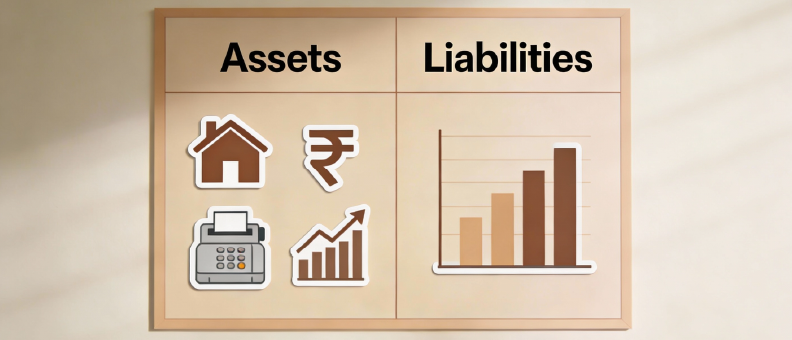
Understanding money goes beyond income and expenses—it also involves knowing what you own and what you owe. Assets and liabilities form the foundation of personal and business finances, influencing net worth, borrowing capacity, and long-term financial planning. This article breaks down these core concepts in a simple, structured way to support financial awareness and informed decision-making.
Table of contents
- Understanding the fundamentals: What are assets?
- Common examples of assets (individual & business)
- Delving deeper: Different types of assets
- All about liabilities: What you owe
- Common examples of liabilities (individual & business)
- The crucial relationship between assets and liabilities for financial health
- Impact on investment decisions and wealth creation potential
- Assets, liabilities, and the balance sheet
- Advanced insights: Financial ratios involving assets and liabilities
- Bajaj Finserv AMC’s tools to help you manage your finances
Understanding the fundamentals: What are assets?
In finance, an asset could be any resource of economic value that you own or control. Assets may generate income, potentially appreciate over time, or be sold for cash. These could be physical/tangible (e.g., cash, stocks, property) or intangible (e.g., trademarks, patents).
Characteristics of an asset
- Owned or controlled: You have the right to use or derive potential benefits from the resource.
- Measurable monetary value: Assets could be valued, either at their purchase cost or fair market value.
- Potential for economic benefit: They may produce income directly (e.g., rental income) or could be converted into cash if required.
Common examples of assets (individual & business)
For individuals, assets might include savings account balance, mutual fund investments, residential property, jewellery etc.
For businesses, assets might include cash, inventory, machinery, real estate, patents/intellectual property, and accounts receivable.
Delving deeper: Different types of assets
When we talk about assets, we usually categorise them into two main types: current and non-current.
Current assets
Current assets are those expected to be converted into cash within one year (or the operating cycle, where applicable).
Non-current assets (fixed assets)
Non-current assets, sometimes referred to as fixed assets, are assets that are not expected to be realised, sold, or consumed within one year and may be held for a longer period.
Another way of classification is tangible vs intangible assets
- Tangible assets: Physical items that you can touch and see like real estate, machinery, jewellery, vehicles, equipment, inventory.
- Intangible assets: Non-physical but have value, examples include patents, copyrights, and trademarks.
Also Read: Asset Allocation: Meaning, Importance and Example
All about liabilities: What you owe
A liability represents an obligation, a debt or commitment that you (or a business) owe to others.
Characteristics of a liability
- Obligation to another party: It creates a duty to repay or fulfil a commitment.
- Settlement in future: The liability may be settled by transferring assets, cash, or services at a future date.
- Little or no discretion to avoid: Once incurred, the liability must be honoured.
Common examples of liabilities (individual & business)
For individuals: home loans (mortgages), car loans, credit-card debt, unpaid bills or personal loans.
For businesses: bank loans, bonds payable, payables to suppliers, outstanding salaries, taxes payable, long-term debt obligations.
Liabilities are broadly classified based on when they are due, and how certain they might be.
Current liabilities
These are obligations due to be settled within one year (or operating cycle). Because these obligations are due in the near term, managing current liabilities may play a role in supporting liquidity and short-term financial health.
Non-current liabilities (long-term liabilities)
These are obligations that become due after one year. They may be used to finance long-term investments or assets, such as expansion of operations or the acquisition of fixed assets.
Contingent liabilities
These are potential obligations that may or may not arise, depending on future events. Since these liabilities are not certain, they may not be recorded as liabilities until they materialise, but they might often require disclosure.
Also Read: What is an asset class?
The crucial relationship between assets and liabilities for financial health
Calculating net worth: Your financial snapshot
Your net worth is the difference between what you own (assets) and what you owe (liabilities).
Net Worth = Total Assets – Total Liabilities
A positive net worth means assets exceed liabilities; a negative net worth suggests obligations outweigh owned resources.
Impact on investment decisions and wealth creation potential
For an investor exploring mutual funds, stocks, or other avenues in India, understanding assets and liabilities could help shape strategy. For instance:
- A robust asset base (cash savings, investments, real estate) might give flexibility to invest in equity or mutual funds without borrowing.
- High liabilities especially high-interest debt like credit-card debt or unsecured loans could erode current or future investment capacity.
- By managing liabilities and growing assets carefully, one could potentially enhance net worth, improve debt-to-asset ratio, and position for long-term potential wealth creation.
Assets, liabilities, and the balance sheet
A balance sheet is a financial statement that shows an entity’s assets, liabilities, and equity together (following Assets = Liabilities + Equity).
It demonstrates that assets may be funded either by borrowing (liabilities) or by the owner’s capital (equity). For a company, the balance sheet might reveal how much of its assets are financed by debts versus by shareholders’ funds.
Also Read: Quick Assets: Meaning, Formula, Example and Calculation
Advanced insights: Financial ratios involving assets and liabilities
Several financial ratios may help assess liquidity, solvency and financial strength, based on the relationship between assets and liabilities:
- Current ratio = Current assets / Current liabilities. Indicates if short-term obligations could be met from short-term assets.
- Debt-to-asset ratio = Total debt (Liabilities)/ Total assets. Shows the proportion of assets financed through debt, a high ratio may indicate higher potential leverage and risk.
- Equity/net worth ratio = (Assets – Liabilities) / Assets. Reflects the proportion of assets owned outright versus those funded by debt.
Bajaj Finserv AMC’s tools to help you manage your finances
Bajaj Finserv AMC offers a variety of calculators that can help you plan your investments, work towards your goals, and monitor progress. These include our SIP calculator, SWP calculator, compound interest calculator and several goal-based calculators. Additionally, Bajaj Finserv AMC provides educational materials to help facilitate management of your income, expenses, and assets.
The calculators are aids, not prediction tools. They may provide only an indicative picture.
FAQs
What is the difference between an asset and an expense?
An asset is something you own that provides potential future value, whereas an expense is a cost incurred for consumption or operations and is not owned as a resource.
Can something be both an asset and a liability?
No, the same item cannot be both an asset and a liability for one person at the same time; however, one person’s asset could be another’s liability––for example, a loan is an asset for the lender but a liability for the borrower.
Why should you track your assets and liabilities?
It shows your net worth and may help you avoid taking on too much potential debt. Knowing what you own versus what you owe might keep you aware of your financial health and could aid in budgeting and planning.
If assets exceed liabilities, is that always good?
If your assets exceed your liabilities, you have a positive net worth, which is often viewed as a sign of financial stability.
Are mutual funds considered assets?
Mutual funds are financial assets (investments) you own––if their potential value rises, your assets (and potential net worth) increase.
Can a loan ever be an asset?
Loans you take out are always liabilities (debts) to you, not assets. Loans could be assets for the lenders.