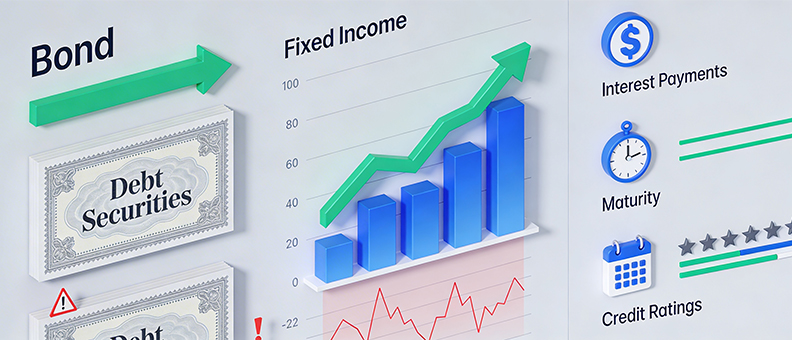
In India’s financial landscape, debt securities typically occupy a middle position in the risk-return spectrum between bank deposits and equity shares. These instruments allow investors to lend money to governments, state entities or corporations, in return for periodic interest payments and eventual principal repayment (subject to risks).
The market for such securities continues to evolve; for instance, the combined debt market in India has grown rapidly, providing both large institutions and individual investors access to a variety of offerings.
In this article you will learn what debt securities mean, how they work, the key features that determine their behaviour, and the main types available in India. We will also discuss the advantages debt securities may bring to a portfolio, how they compare with equity securities, and some of the typical risks involved.
Table of contents
- What do debt securities mean?
- Primary features of debt securities
- Types of debt securities
- Investment benefits of debt securities
- Comparison of debt securities with equity securities
- Common risks involved in debt securities
What do debt securities mean?
In simple terms, a debt security is a tradeable instrument that acknowledges a borrower’s obligation to repay money to investors, usually with periodic interest and principal at maturity, subject to the terms of the issue. Debt securities are issued in the “debt market”, where a wide range of fixed-income instruments by central and state governments, municipal bodies, banks, public sector units and companies are issued and traded. While they are considered relatively stable, it’s important to note that debt securities are not risk free and income. Key risks include credit risk (income and principal repayment depend on the issuer’s ability to meet obligations; market risk (changing interest rates and market conditions can affect security values; and liquidity risk (the ability to sell securities at fair value may vary).
Read Also: Debt Market: Meaning, Benefits, Types and How it Works?
Primary features of debt securities
Some of the characteristic features of debt securities are:
- Face value, coupon, and maturity: Most debt securities specify a face (par) value, a coupon (interest) that may be paid at set intervals, and a maturity date when principal is repaid.
- Credit rating disclosure: Public offerings have a credit rating from an agency registered with SEBI. All ratings are in the offer document, to help investors check the credit risk.
- Price sensitivity to interest rates: Bond prices and prevailing interest rates in the economy go in opposite directions. When interest rates rise, the prices of existing bonds fall, and vice versa. Longer-term bonds tend to react more to rate changes.
- Secured vs. unsecured debt and options: Corporate debt may be secured (backed by assets) or unsecured. Some bonds let the issuer repay early (call option) or let you ask for your money back early (put option), which might change what you earn and how you reinvest.
Types of debt securities
Here’s a rundown of the main types of debt securities you might come across:
- Government securities (G-Secs) and State Development Loans (SDLs): These are ways for the national and state governments to borrow money. G-Secs are a big, easy-to-trade part of the Indian debt market. They usually pay interest regularly and repay your money when they mature.
- Corporate bonds/debentures, including non-convertible debentures (NCDs): Companies issue these to get cash for their operations or projects. They come with credit ratings, which indicates a company’s creditworthiness at the time of rating.
- Commercial Paper (CP): These are short-term, unsecured negotiable money market instruments with maturities up to 365 days that companies issue to meet working capital requirements.
- Certificates of Deposit (CDs): These are short-term deposits you can get from banks and some financial institutions.
You might also see products made by bundling many loans together—called securitised debt instruments and other structured issues in the market. These have their own unique risks, potential returns, and rules about what has to be disclosed.
Investment benefits of debt securities
Let us look at some of the benefits an investor might get while investing in debt securities:
- Income visibility: Coupon payments (interest payments) where applicable, offer periodic cash flows that might help align with predictable expenses.
- Risk management: Debt securities often move differently from equities, which could help reduce overall volatility and may make the return potential relatively stable over time.
- Choice across maturities and issuers: Investors might pick short, medium, or longer maturities, and choose among government and corporate issuers, based on tolerance for price swings and credit risk.
- Transparency and ratings: Mandatory credit rating disclosure for many public corporate issues gives a quick view of credit quality before investing.
Read Also: Investing Vs. Clearing Debt: Making an Informed Decision?
Comparison of debt securities with equity securities
- Structure: Equity represents ownership in a company and a claim on its profits. Debt represents a loan, where repayment is supposed to follow agreed-upon terms. You get paid back based on a contract subject to the issuer’s ability to repay.
- How the money flows: With debt, you usually receive regular interest payments and get your invested amount back at maturity as per the terms of issue. In equity, the potential returns could be volatile. It all depends on how well the company is doing and what the market thinks it is worth.
- Risk and reward: Debt involves receiving regular payments according to a set agreement. The price depends mostly on interest rates and how likely the borrower is to pay back the loan. Equity may be riskier because future earnings and value are unpredictable.
Common risks involved in debt securities
Here are some of the risks involved while investing in debt securities:
- Interest rate risk: When market rates rise, existing bond prices typically fall. Conversely, when rates drop, existing bond prices may tend to rise. The longer a bond’s duration, the higher the interest rate risk.
- Credit risk: This refers to the possibility that the issuer may miss or default on interest or principal payments. Assessments such as probability of default and credit ratings might be used to gauge this risk.
- Liquidity risk: Some securities may not trade often. Wider gaps between buying and selling prices, or trouble finding buyers during stressed markets might reduce the price you actually get.
- Reinvestment and call risk: If a bond is callable (where the issuer has the option to redeem the bond early) and the issuer redeems when interest rates are low, reinvesting the proceeds at comparable yields may be difficult.
- Concentration risk: Relying on a single issuer, sector, or rating bucket increases exposure to unexpected events. Diversifying across maturities and issuers may help in reducing such exposure.
Read Also: Overnight Funds vs. Short Term Debt Funds: Which is Better?
Conclusion
Debt securities may help build a diversified portfolio by offering potential for regular income and relative stability of capital. It is advised to understand the basic features, read offer documents carefully, and pay attention to interest rate, credit, and liquidity risks before investing.
FAQs
What are the major risks associated with investing in debt securities?
Key risks include interest rate risk (prices move inversely to market rates), credit risk (issuer’s ability to pay), and liquidity risk (ease of buying/selling).
What is the significance of the issuer’s creditworthiness in debt securities?
Higher credit quality might indicate a stronger capacity to meet obligations, which may potentially translate into a lower probability of default. However, it’s important to note that ratings are not guarantees of future performance. Indian regulations require ratings to be disclosed in offer documents to inform investors.
How does interest rate risk affect debt securities?
If interest rates go up, existing bonds become less attractive because their interest is now lower than new market rates. As a result, their prices fall. When rates go down, existing bonds become get more investor interest, and their prices rise. Bonds with longer durations tend to move more when rates change.
What role does liquidity play in the risk profile of a debt security?
Low trading volumes may lead to wider price gaps and difficulties in selling during market stress, which could affect realised returns, despite the issuer’s good credit health.
How does maturity or term affect the characteristics of a debt security?
Longer maturity bonds are more sensitive to interest rate changes than shorter ones, which might make their prices fluctuate relatively more than shorter-term bonds when interest rates change. This also means longer maturity bonds typically offer higher yields than shorter term bonds to compensate for higher duration risk.