
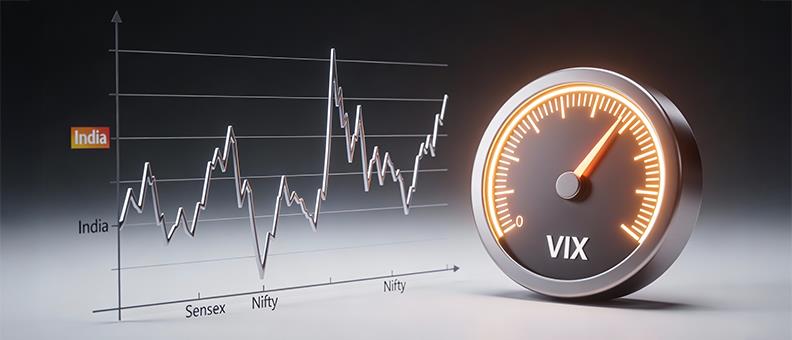
India VIX, also known as the India Volatility Index, measures the market’s expectation of volatility in the Nifty 50 over the next 30 calendar days. It is often called the market’s “fear gauge” because it tends to rise when uncertainty increases and fall when market conditions are calmer.
However, India VIX does not predict whether the market will go up or down. It only indicates the expected size of price movements. A higher India VIX suggests that market participants expect wider price swings, while a lower India VIX suggests expectations of relatively stable movement.
On this page, you will learn what India VIX means, how it is calculated, how to read high and low VIX levels, how it relates to Nifty, and how investors can use it as a market-risk indicator.
Table of Contents
What is India VIX?
India VIX is an index published by NSE that reflects expected volatility in the Nifty 50 over the next 30 calendar days. It is calculated using Nifty option prices. A high India VIX means the market expects larger price swings, while a low India VIX means the market expects relatively smaller price swings.
India VIX is expressed as an annualised percentage. For example, if India VIX is 15, it means the market is pricing in annualised volatility of around 15% for the Nifty 50, based on current option prices.
The figures shown are for illustrative purpose only
Key Takeaways
- India VIX is an NSE-published index that reflects the market’s expected volatility in the Nifty 50 over the next 30 calendar days.
- India VIX is an NSE-published index that reflects the market’s expected volatility in the Nifty 50 over the next 30 calendar days.
- A higher India VIX indicates that the market expects larger price swings, while a lower reading suggests relatively calmer conditions.
- India VIX measures the expected magnitude of market movement but does not predict whether the Nifty 50 will rise or fall.
- Investors can use India VIX to assess market uncertainty and risk sentiment, but it should be considered alongside other indicators and investment fundamentals.
India VIX quick summary
- Meaning: India VIX measures expected Nifty 50 volatility.
- Time frame: It reflects expected volatility over the next 30 calendar days.
- High VIX: A high India VIX indicates higher expected volatility and greater market uncertainty.
- Low VIX: A low India VIX indicates lower expected volatility and relatively calmer market conditions.
- Important: India VIX does not predict market direction or indicate whether the Nifty 50 will move up or down.
- Best used for: India VIX is best used for understanding market uncertainty, expected volatility and risk sentiment.
Looking for the current India VIX value? India VIX updates during market hours because it is based on Nifty option prices, and investors can check live values on NSE or financial market platforms that provide live index data.
What is India VIX in the stock market?
India VIX is a volatility index that shows how much volatility the market expects in the Nifty 50 over the near term. Unlike the Nifty 50, which tracks the price movement of 50 large listed companies, India VIX tracks expected volatility based on option prices.
In simple terms:
- Nifty tells you the market direction.
- India VIX tells you the expected intensity of market movement.
For example, if the Nifty is rising but India VIX is also rising, it may indicate that market participants still expect uncertainty or sharper movements. If Nifty is stable and India VIX is falling, it may suggest that the market expects calmer conditions.
India VIX can help investors observe how much uncertainty may be getting priced into the market.
Please note that the reference to any industry/sector/stock is provided for illustrative purposes only. This should not be construed as a research report or a recommendation to buy or sell any security or sector.
What does India VIX indicate?
India VIX indicates the market’s expectation of future volatility. It does not indicate market direction.
A rising India VIX usually means that market participants expect larger price movements. This may happen during periods of uncertainty, such as election results, policy decisions, global market stress, inflation concerns, geopolitical tensions, or sharp market corrections.
A falling India VIX usually means that market participants expect relatively calmer market conditions. This may happen when uncertainty reduces, markets stabilise, or investors become more confident.
High vs low India VIX
| India VIX movement | What it generally indicates | What it does not mean |
| India VIX rises | Expected volatility is increasing | The market will definitely fall |
| India VIX falls | Expected volatility is reducing | The market will definitely rise |
| India VIX is high | Market uncertainty is elevated | A crash is certain |
| India VIX is low | Market conditions appear calmer | Risk has disappeared |
Past performance may or may not be sustained in future
How to read India VIX levels
India VIX should be read as an expectation of volatility, not as a buy or sell signal. There is no fixed “good” or “bad” India VIX level because market regimes change over time. However, the following framework can help investors interpret the number:
| India VIX range | Broad interpretation |
| Below 12 | Very calm market conditions |
| 12 to 15 | Relatively stable volatility environment |
| 15 to 20 | Normal to moderately volatile market conditions |
| 20 to 30 | Higher uncertainty and sharper expected movement |
| Above 30 | Elevated volatility and heightened market stress |
These ranges are only broad reference points. Investors should compare India VIX with recent market conditions, historical levels, and the broader economic environment before drawing conclusions.
Past performance may or may not be sustained in future. The figures shown are for illustrative purpose only.
How to convert India VIX into expected monthly and daily movement
India VIX is quoted as an annualised volatility number. To understand what it may imply over shorter periods, investors may use it to estimate approximate monthly or daily expected movement.
Expected monthly movement
Formula:
Expected monthly movement = India VIX ÷ √12
Example:
If India VIX is 15:
15 ÷ √12 = approximately 4.3%
This means the market is roughly pricing in a possible monthly movement of around 4.3% on either side, not a guaranteed move and not a direction forecast.
Expected daily movement
Formula:
Expected daily movement = India VIX ÷ √252
Example:
If India VIX is 15:
15 ÷ √252 = approximately 0.94%
If Nifty is at 25,000, then 0.94% is about 235 points. This means the market may be pricing in a daily movement of roughly 235 points on either side. These are estimates based on volatility assumptions. Actual market movement can be higher or lower.
The figures shown are for illustrative purpose only
How is India VIX calculated?
India VIX is calculated using the order book of Nifty options. It considers the best bid and ask quotes of near-month and next-month Nifty option contracts traded in the F&O segment.
The calculation uses out-of-the-money call and put options to estimate expected volatility. These option prices reflect how much traders are willing to pay for protection or exposure to future market movement.
When uncertainty increases, option premiums generally rise. Higher option premiums can push India VIX higher. When uncertainty reduces, option premiums generally fall, which can pull India VIX lower.
India VIX is based on a methodology adapted from the CBOE VIX framework and customised for the Indian market.
India VIX formula explained simply
The simplified way to understand the India VIX formula is:
India VIX = 100 × √ expected 30-day variance
Another way to represent the India VIX formula is:
India VIX = √ (Weighted Average of 30-day Implied Variances) × 100
In simple terms, India VIX measures the market’s expectation of volatility in the Nifty 50 over the next 30 calendar days. It is derived from Nifty option prices and expressed as an annualised percentage.
The India VIX calculation uses multiple Nifty option strike prices, bid-ask quotes, time to expiry, risk-free interest rates and forward index levels to estimate expected volatility over a constant 30-day period.
A simple way to understand the process is:
- Relevant Nifty call and put options are selected.
- Their prices are analysed to derive implied volatility.
- Expected variance for the next 30 days is calculated.
- The variance is converted into volatility and annualised.
- The final figure is published as India VIX.
For example, if India VIX is 15, it means the market is pricing in annualised expected volatility of around 15% for the Nifty 50 based on current option prices. It does not predict whether the market will move up or down.
In essence, India VIX converts option market expectations into one number that represents expected Nifty volatility.
The figures shown are for illustrative purpose only
Key inputs used in India VIX calculation
The India VIX calculation uses several market inputs to estimate expected volatility in the Nifty 50 over a constant 30-day period:
Time to expiry
Time to expiry refers to the time remaining for selected Nifty option contracts to expire, and it is measured precisely because even small changes in expiry time can affect volatility estimates.
Risk-free interest rate
The risk-free interest rate is used to adjust the value of future cash flows in the India VIX calculation for the relevant expiry period.
Forward index level
The forward index level of the Nifty 50 helps identify the at-the-money strike price, which is then used to select suitable out-of-the-money call and put options.
Strike prices
Strike prices across selected out-of-the-money Nifty call and put options are used to capture how the options market is pricing expected volatility at different levels.
Bid-ask quotes
Bid-ask quotes of selected Nifty options are used because they reflect the prices at which market participants are currently willing to buy and sell those options.
Interpolation
Interpolation is used where required to estimate a constant 30-day expected volatility from near-month and next-month option contracts.
Why does India VIX rise or fall?
India VIX rises when the market expects higher volatility. This usually happens when there is greater demand for options, especially protective options, because traders and investors are trying to manage uncertainty.
India VIX may rise due to:
- Sharp market corrections
- Global market weakness
- Geopolitical events
- Election-related uncertainty
- Major policy announcements
- Inflation or interest-rate concerns
- Weak corporate earnings expectations
- Sudden increase in option premiums
India VIX may fall due to:
- Stable market conditions
- Reduced uncertainty after a major event
- Lower demand for hedging
- Declining option premiums
- Improved investor confidence
- Sustained market trend with lower uncertainty
India VIX and Nifty: What is the relationship?
India VIX and Nifty often have an inverse relationship. When Nifty falls sharply, India VIX tends to rise because uncertainty and demand for protection increase. When Nifty rises steadily or remains stable, India VIX may fall because market participants expect lower volatility.
However, this inverse relationship is not perfect. India VIX can rise even when Nifty is not falling, especially before major events. It can also remain low during rising markets until a new risk emerges.
| Factor | Nifty 50 | India VIX |
| What it measures | Market price movement | Expected volatility |
| Directional? | Yes | No |
| Based on | Stock prices of Nifty 50 companies | Nifty option prices |
| Rises when | Nifty stocks move higher | Expected volatility increases |
| Falls when | Nifty stocks move lower | Expected volatility decreases |
| Main use | Market performance tracking | Risk and sentiment tracking |
India VIX for investors, traders and mutual fund investors
Different market participants use India VIX differently.
For long-term investors
Long-term investors can use India VIX as a broad risk indicator. A sudden spike in VIX may suggest that uncertainty has increased, but it should not automatically lead to panic selling. Instead, investors can use it to review asset allocation, risk appetite and investment horizon.
For mutual fund investors
Mutual fund investors can use India VIX to understand the market environment. High volatility may lead to sharper short-term NAV movements, especially in equity-oriented schemes. However, SIP investors should avoid reacting to short-term VIX movements alone.
For traders
Traders use India VIX more actively because volatility affects stop-loss placement, position sizing and option premiums. Higher VIX can mean wider price swings, while lower VIX can indicate narrower movement.
For options traders
India VIX is especially relevant for options traders because volatility is a major driver of option premiums. When VIX rises, option premiums usually become more expensive. When VIX falls, option premiums may become cheaper.
How investors can use India VIX sensibly
India VIX can help investors understand market uncertainty better, but it should be used as a context indicator rather than a standalone decision-making tool:
- Investors can use India VIX to understand whether market uncertainty and expected volatility in the Nifty 50 are rising or falling.
- A sharp rise in India VIX can indicate higher fear or uncertainty in the market, helping investors avoid emotional reactions to short-term fluctuations.
- During high-volatility periods, India VIX can help investors assess whether their portfolio risk remains aligned with their investment horizon and risk appetite.
- Long-term investors can use India VIX as a reminder to stay disciplined with SIPs and investment plans rather than attempting to time the market.
- Reading India VIX alongside Nifty movement can provide additional insight into changing market sentiment and risk perception.
- For mutual fund investors, India VIX can offer useful context for short-term NAV movements, particularly in equity-oriented schemes.
- A high India VIX does not necessarily signal an exit from the market, while a low India VIX does not mean the market is risk-free.
- India VIX is most effective when used alongside market trends, investment goals, time horizon and risk tolerance.
What should investors do when India VIX is high?
When India VIX is high, markets may see wider and faster price movements. Long-term investors should avoid making impulsive decisions based only on VIX and may consider the following:
- Reviewing whether their asset allocation remains aligned with their risk profile.
- Avoiding unnecessary leverage during high-volatility periods.
- Reviewing whether existing SIPs remain aligned with their long-term investment horizon and risk appetite.
- Checking whether short-term goals are exposed to high-risk assets.
- Maintaining adequate emergency funds based on their financial needs.
- Avoiding panic-led exits during temporary market stress.
A high India VIX does not automatically mean investors need to change their investment approach, but it does indicate that the market is expecting higher volatility.
What should investors do when India VIX is low?
A low India VIX can indicate calmer market conditions, but investors should still remain disciplined and aware of risk:
- Investors should avoid assuming that a low India VIX means the market is risk-free or that volatility cannot increase unexpectedly.
- Investors can use periods of low market uncertainty to review whether their asset allocation remains aligned with their financial goals and risk appetite.
- If equity exposure has increased significantly during a rising market, investors may consider rebalancing their portfolios to maintain their desired asset mix.
- Long-term investors should continue disciplined investing through SIPs or planned investments instead of trying to time short-term market movements.
- Low India VIX should be interpreted alongside Nifty movement, valuations, earnings trends and broader market sentiment for a more balanced view of market conditions.
- Mutual fund investors can use low India VIX as context for relatively stable short-term NAV movements, particularly in equity-oriented schemes.
- Investors with near-term financial goals should avoid taking excessive equity risk solely because expected volatility appears low.
- Overall, a low India VIX reflects lower expected volatility, but investors should continue to focus on portfolio risk, diversification and long-term objectives.
Limitations of India VIX
India VIX is a useful indicator of expected volatility, but investors should understand its limitations before using it to assess market conditions:
It does not predict market direction
India VIX measures expected volatility in the Nifty 50, but it does not indicate whether the market will move up or down.
It can change suddenly
India VIX can rise or fall quickly due to news events, global market movements, policy decisions, election-related uncertainty or sudden changes in market sentiment.
Low India VIX does not guarantee safety
A low India VIX may indicate calmer market conditions, but it does not mean the market is risk-free or that volatility cannot increase unexpectedly.
High India VIX does not guarantee a market crash
A high India VIX indicates higher expected volatility and uncertainty, but the market may still stabilise or recover once the event-driven risk reduces.
It should not be used as a standalone indicator
India VIX should be read along with market trends, Nifty movement, valuations, macroeconomic data, earnings, liquidity conditions and investor goals.
It reflects expectations, not certainty
India VIX is based on option prices and reflects market expectations of volatility, but actual market movement can be higher or lower than what the index suggests.
It may be more useful in context than in isolation
India VIX becomes more meaningful when investors compare it with recent volatility levels, broader market sentiment and their own investment horizon.
India VIX vs NIFTY vs CBOE VIX
India VIX, Nifty 50 and CBOE VIX serve different purposes, so comparing them helps investors understand market direction, expected volatility and risk sentiment more clearly:
| Parameter | India VIX | Nifty 50 | CBOE VIX |
| Market | India | India | United States |
| Asset type | Volatility index | Benchmark equity index | Volatility index |
| Underlying asset | Nifty 50 options | 50 large Indian companies | S&P 500 options |
| Published by | NSE | NSE | CBOE |
| What it tracks | Expected Nifty volatility | Indian equity market performance | Expected S&P 500 volatility |
| Based on | Nifty option prices | Stock prices | S&P 500 option prices |
| Directional indicator | No | Yes | No |
| Common use | Market sentiment and risk reading | Market benchmarking | US market volatility reading |
| Common interpretation | Fear gauge for Indian markets | Direction of Indian markets | Fear gauge for US markets |
India VIX is similar in concept to the CBOE VIX, but it is based on Nifty option prices and reflects expected volatility in the Indian market.
Where can you check current India VIX?
India VIX changes during market hours because it is calculated using Nifty option prices and reflects the market’s changing expectation of volatility. Investors can check the current India VIX value on the NSE website or through financial market platforms that provide live index data. Since the index moves with changes in option prices, it is useful to view the latest value alongside Nifty movement, market sentiment and major events that may be influencing expected volatility.
Common myths about India VIX
India VIX is often misunderstood, so it is important to separate what the index actually indicates from what investors may assume:
Myth 1: High India VIX means the market will fall
A high India VIX means expected volatility is elevated, but the market can move sharply in either direction.
Myth 2: Low India VIX means there is no market risk
A low India VIX indicates lower expected volatility, but it does not mean the market is risk-free or protected from sudden events.
Myth 3: India VIX is useful only for traders
While traders use India VIX actively, long-term investors and mutual fund investors can also use it to understand market sentiment and volatility conditions.
Myth 4: India VIX gives direct buy and sell signals
India VIX is not a standalone buy or sell signal and should be interpreted along with Nifty movement, market trends, risk appetite and investment goals.
Myth 5: India VIX predicts market crashes
India VIX may rise during periods of fear or uncertainty, but it does not predict market crashes with certainty.
Myth 6: India VIX always moves opposite to Nifty
India VIX and Nifty often have an inverse relationship, but this relationship is not guaranteed in every market situation.
Myth 7: A falling India VIX always means the market will rise
A falling India VIX usually reflects reducing expected volatility, but it does not confirm that the Nifty 50 will move higher.
Conclusion
India VIX is an important market indicator that reflects expected volatility in the Nifty 50 over the next 30 calendar days. It helps investors understand whether the market expects calmer conditions or sharper price movements.
A high India VIX suggests higher uncertainty, while a low India VIX suggests relatively stable market expectations. However, India VIX does not predict market direction. It should be used as a supporting indicator along with broader market analysis, investment horizon, risk appetite and financial goals.
For long-term investors, India VIX may be used to stay aware of changing risk conditions rather than trying to time the market.
FAQs
What is India VIX?
India VIX, or the India Volatility Index, measures the market’s expected volatility in the Nifty 50 over the next 30 calendar days based on Nifty option prices.
What is the full form of India VIX?
The full form of India VIX is India Volatility Index.
What does India VIX indicate?
India VIX indicates expected volatility in the Nifty 50, with a higher India VIX reflecting higher expected volatility and a lower India VIX reflecting relatively calmer market expectations.
Does India VIX predict market direction?
No, India VIX does not predict whether the market will rise or fall because it only indicates the expected size of market movement.
What does high India VIX mean?
A high India VIX means the market is expecting higher volatility and wider price movements, often during periods of uncertainty, fear or major market events.
What does low India VIX mean?
A low India VIX means the market is expecting lower volatility and relatively stable price movement, but it does not mean the market is risk-free.
How is India VIX calculated?
India VIX is calculated using Nifty option prices, especially out-of-the-money call and put options, along with bid-ask quotes, strike prices, time to expiry, risk-free rate and forward index level.
What is the India VIX formula?
A simplified India VIX formula is: India VIX = 100 × square root of expected 30-day variance, while the actual calculation uses multiple Nifty option prices and statistical adjustments.
How do you read India VIX?
India VIX is read as an annualised expected volatility percentage, so a VIX of 15 means the market is pricing in annualised expected volatility of around 15% for the Nifty 50.
What is the relationship between India VIX and Nifty?
India VIX and Nifty often have an inverse relationship, where India VIX may rise when Nifty falls sharply and may fall when market conditions are relatively stable.
Can investors buy India VIX?
India VIX is an index and cannot be bought like a stock or mutual fund, although certain advanced volatility-linked instruments may be available for eligible market participants.
Is high India VIX good or bad?
High India VIX is neither automatically favourable nor unfavourable because it only indicates higher expected volatility, which investors and traders may interpret differently based on their strategy, time horizon and risk appetite.
What happens when India VIX goes down?
When India VIX goes down, it usually means expected volatility is reducing and market conditions may be perceived as relatively calmer.
Why does India VIX increase?
India VIX may increase due to market uncertainty, global events, economic announcements, political developments, sharp corrections or rising demand for Nifty options.
Where can I check India VIX live?
The latest India VIX live value can be checked on the NSE website or on financial market platforms that provide live index data.
Related Searches


































