The stock market can be unpredictable, and while no tool can forecast its movements with certainty, there are ways to measure these uncertainties, one of which is India VIX. VIX India is an index that reflects the expected volatility in the market over the near term and provides an indication of overall market sentiment and risk levels. Understanding the meaning of India VIX can help investors assess market uncertainty and make more informed decisions. In this article, we will understand what India VIX means, its importance, its calculation, and the factors influencing it, while also learning how to use it and comparing it with Nifty.
What is India VIX index in stock market?
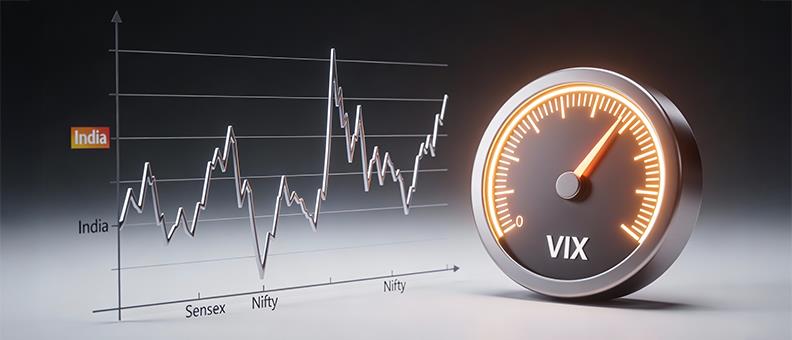
India VIX, or the Volatility Index, is a real-time indicator that reflects the level of volatility the market is expected to experience over the next 30 days. In simple terms, India VIX index means a measure of expected market volatility based on Nifty 50 option prices. It is often referred to as a measure of market sentiment, as it indicates how participants perceive risk and uncertainty.
A high India VIX generally suggests higher expected volatility and uncertainty, while a low VIX points to relatively stable market conditions. While VIX India does not predict market direction or reliably identify market tops and bottoms, it can still help investors and traders better understand overall market risk and sentiment.
Importance of India VIX index
Understanding the importance of India VIX can help investors better interpret market conditions and anticipate changes in expected volatility:
- India VIX reflects the level of volatility expected in the market over the near term.
- A low India VIX generally indicates relatively stable market conditions with smaller price fluctuations.
- A high India VIX suggests increased uncertainty and expectations of higher volatility.
- Higher VIX India levels are often associated with larger and more frequent price movements in the market.
- Changes in India VIX can help investors gauge shifts in market sentiment and better understand evolving risk conditions.
How is India VIX calculated
India VIX is calculated by the National Stock Exchange using the order book of Nifty options. It is based on the best bid and ask quotes of near-month and next-month Nifty option contracts traded in the F&O segment, and it reflects the expected market volatility over the next 30 calendar days.
The calculation follows the CBOE VIX methodology, with suitable adjustments for the Nifty options market. While the actual formula is technical, the main inputs are easier to understand:
- Time to expiry: The time left for an option to expire is measured in minutes rather than days for greater accuracy.
- Interest rate: The relevant tenure rate is used as the risk-free rate for the respective Nifty option expiries.
- Forward index level: This helps identify the at-the-money strike, which is then used to select the relevant option contracts.
- Bid-ask prices: The best available buying and selling quotes of selected Nifty options are used in the calculation.
- Strike price: India VIX mainly uses out-of-the-money call and put options around the forward index level.
- Interpolation: When quotes are not available for certain strikes, statistical methods such as natural cubic spline interpolation may be used.
India VIX formula
In simple terms, India VIX is calculated as 100 multiplied by the square root of the expected variance over the next 30 days, derived from Nifty option prices.
India VIX = 100 × √(30-day expected variance)
While the actual calculation involves multiple option prices across different strike levels, the core idea is to estimate how much the market expects prices to fluctuate in the near term. To understand this better, let’s look at a simplified example.
Suppose the market is observing the following:
- Near-month Nifty options suggest relatively lower volatility
- Next-month options indicate slightly higher volatility
- A range of out-of-the-money call and put options are considered, and their prices are combined using a weighted variance approach
In this simplified example, the expected 30-day volatility comes out to around 14.2%. This means the India VIX index would be approximately 14.2.
In practical terms, a VIX level like this suggests that the market is expecting relatively moderate price fluctuations over the next 30 days. Rather than sharp or sudden movements, it indicates a more measured level of volatility, although actual market behaviour can still vary.
The figures shown are for illustrative purpose only
Factors considered while calculating the India VIX
Understanding the key factors behind India VIX can help you better interpret how market expectations of volatility are formed:
Strike Prices
Out-of-the-money Nifty call and put options are used to capture how the market is pricing expected volatility across different levels.
Forward Index Level
The forward index level, derived from Nifty futures prices, helps identify the at-the-money strike used as a reference point.
Time to Expiry
The time remaining for option expiry is measured in minutes to improve the precision of volatility estimates.
Risk-Free Rate
Government security yields for the relevant tenure are used as the risk-free rate in the calculation.
Bid-Ask Prices
The best available buying and selling prices from the options order book are used to reflect real-time market expectations.
Factors influencing India VIX
Understanding what drives changes in India VIX index can help you better interpret shifts in market volatility and sentiment:
- Higher market uncertainty often leads to an increase in India VIX levels.
- Increased demand for options can push up implied volatility and raise India VIX.
- Periods of market stress or sharp price movements may result in a higher India VIX.
- Global events and cues can influence domestic market volatility expectations.
- Changes in market liquidity can impact how volatility is priced in the options market.
How to use India VIX for trading – Volatility index India market applications
Understanding how India VIX is interpreted can help you better contextualise market volatility and sentiment alongside other indicators:
Sudden Spikes
A sharp rise in India VIX generally reflects heightened uncertainty and increased volatility expectations in the market.
Use with Index Levels
India VIX is often interpreted alongside broader market indicators to provide better context.
Low VIX Levels
Lower India VIX levels typically indicate stable conditions but may sometimes precede changes in volatility.
Global Cues
India VIX can be influenced by global market developments that impact overall risk sentiment.
Trend in VIX
A rising India VIX reflects increasing uncertainty, while a falling VIX suggests relatively calmer market conditions.
India VIX vs Nifty
Understanding the differences between India VIX and Nifty 50 can help you better interpret market behaviour and volatility alongside overall market performance:
| Aspect | India VIX | Nifty 50 |
| Meaning | Reflects expected market volatility and overall risk perception | Represents the performance of 50 large-cap companies listed on the NSE |
| Purpose | Helps indicate market sentiment and expected volatility levels | Tracks overall market performance and broad trends |
| Calculation | Derived from prices of NIFTY option contracts | Calculated using the free-float market capitalisation of its constituent stocks |
| Usage by investors | Used to understand volatility expectations and assess market risk | Used as a benchmark to track market performance |
| Market indication | Higher values suggest increased uncertainty and expected volatility | Movements indicate overall market direction and performance trends |
Benefits of India VIX
Understanding the benefits of India VIX can help different types of market participants better interpret volatility and risk conditions:
For traders
India VIX can help short-term and intraday traders better understand expected volatility in the market.
For long-term investors
India VIX may not influence day-to-day decisions but can provide useful context on broader market risk trends.
For institutional and options traders
India VIX is often used to understand volatility expectations and hedging-related market conditions.
Conclusion
India VIX is a useful indicator that reflects the market’s expectations of volatility over the near term. Rather than indicating direction, it highlights the level of uncertainty and potential price fluctuations in the market. By understanding how India VIX works and what influences it, investors can better interpret market sentiment and view overall market conditions with greater clarity.
FAQs
What is India VIX index?
India VIX is a volatility index that reflects the market’s expectation of price fluctuations over the next 30 days, based on NIFTY option prices.
What is the difference between India VIX and Nifty?
India VIX measures expected market volatility, while the Nifty 50 index represents the performance of 50 large companies listed on the NSE.
What does it mean when VIX goes down?
A falling India VIX generally indicates relatively stable market conditions with lower expected volatility.
What does a high VIX mean?
A higher India VIX suggests increased uncertainty in the market and expectations of larger price movements.
How to read VIX in India?
India VIX is expressed as an annualised percentage, where higher values indicate higher expected volatility and lower values indicate relatively calmer conditions.
What is the full form of VIX?
The full form of VIX is Volatility Index.
What does India VIX indicate?
India VIX indicates the market’s expectation of future volatility and does not provide information about market direction.
How often is India VIX updated?
India VIX is updated in real time during market hours based on live NIFTY options data.
Can India VIX predict market crashes?
India VIX does not predict market crashes but may reflect rising uncertainty during periods of heightened market volatility.
How can retail investors use India VIX effectively?
Retail investors can use India VIX to better understand market volatility and interpret overall risk conditions alongside other indicators.
What is the difference between India VIX and Nifty VIX Futures?
India VIX represents current expected volatility, while VIX futures are derivative contracts based on the expected future value of the index.
Does India VIX impact option premiums?
Yes, expected volatility is a key factor in option pricing, so changes in India VIX can influence option premiums.