
In the past year, equity markets have been marked by turbulence and unpredictability, witnessing periods of strong momentum followed by sharp corrections. Shifting global cues, interest rate expectations, and intermittent geopolitical developments have led sentiment to move faster than underlying fundamentals.
In such an environment, investing should be viewed not just by headline returns but also the processes driving them. This is reflected in the journey of the Bajaj Finserv Large and Mid Cap Fund, which has focused on fundamentals, quality, and disciplined risk management, while aiming to generate alpha.
The fund, which was launched on February 27, 2024, has delivered a return of 4.04% since inception, compared to 2.84% by its benchmark, the Nifty Large Midcap 250 TRI. This performance has been driven by the fund’s unique moat investing strategy.
Data as on March 31, 2026, under Regular-Growth plan. Past performance may or may not be sustained in future. Source: MFI Explorer and Internal Analysis.
The role of a moat-based approach
Economic moats are distinct and durable competitive advantages that can help companies create market leadership and defend their position over time. These advantages can arise from various sources, such as strong brands, efficient scale, customer stickiness, or pricing power.
The moat investing approach is what sets the Bajaj Finserv Large and Mid Cap Fund apart. While the large and mid cap category has largely focused on identifying current and emerging market leaders, the Bajaj Finserv Large and Mid Cap Fund seeks out companies that not only lead today but have the potential to sustain their competitive edges and maintain their market position over time.
This emphasis on the potential for resilience and consistent performance is increasingly relevant in today’s environment, marked by heightened volatility, return dispersion and rapidly evolving global dynamics. Companies with strong moats may be better positioned to absorb shocks and protect their margins.
Looking at returns through risk-adjusted metrics
Returns, when viewed in isolation, can sometimes present an incomplete picture. Two funds may generate similar returns, but the experience of investors can differ depending on volatility and downside behaviour.
In this context, risk-adjusted metrics – measures that evaluate returns in relation to the level of risk taken – provide additional insight.
A standard deviation of 13.39% versus 15.69% for the benchmark indicates that the scheme has delivered favourable risk-adjusted returns at relatively lower volatility.
The fund’s beta (which indicates sensitivity to overall market movements) of around 0.82 further reflects a relatively lower responsiveness to market fluctuations.
In addition, a positive Jensen’s alpha of about 0.45% indicates that returns have exceeded what may typically be expected given the level of market exposure.
Taken together, these indicators provide a comprehensive view of a balanced investment approach that combines opportunities with risk management.
Risk Free Rate of Return: 6.98% | Data as on 31st March, 2026; calculated since inception | Source: Internal Analysis, MFI360, Bloomberg | Past performance may or may not be sustained in future.
Focus on process
Behind the fund’s performance is a consistent focus on following a well-defined investment process, especially during periods when markets can be unpredictable. Rather than reacting to short-term shifts in sentiment, the approach has been to stay aligned with clearly defined selection criteria and portfolio construction principles.
To identify sustainable moats, fund managers look at factors such as Returns on Capital Employed, Return on Assets, Return on Equity, efficient capital allocation, scalability and more. This is supplemented by a deep evaluation of how businesses operate within their industries. This helps ensure that portfolio decisions are not driven by momentum, but by the underlying strength and sustainability of businesses.
Equally important is ongoing review. As market conditions evolve, each holding is reassessed to understand whether its competitive position and return potential remain intact. This continuous evaluation helps in managing downside risks while retaining exposure to long-term opportunities.
Over time, this disciplined approach has helped the fund navigate changing market phases with greater consistency, contributing to returns that reflect participation in growth phases, as well as agile risk management.
Looking ahead
As markets continue to evolve, uncertainty is likely to come up from time to time. In such a setting, approaches that focus on business quality, capital allocation discipline, and long-term potential will play a role in portfolio construction.
For investors, the experience of the past two years highlights that outcomes in equity investing are often shaped by both returns and the path taken to achieve them. A focus on risk-adjusted performance, rather than returns alone, may offer a more balanced perspective.
Investors seeking a structured, process-driven approach to equity investing may consider the Bajaj Finserv Large and Mid Cap Fund as part of their investment portfolio. As always, investors may consider their own risk appetite, investment horizon, and financial objectives before making any investment decisions.
To read more about the scheme and to invest, click here.
Bajaj Finserv Large and Mid Cap Fund
| Value of investment of Rs 10,000 | |||||||
| Plan | Period | Fund Returns | Benchmark Returns | Additional Benchmark | Fund (Rs.) | Benchmark (Rs.) | Additional Benchmark (Rs.) |
| Bajaj Finserv Large and Mid Cap Fund: Regular – Growth | 1 Yr | -3.09% | -0.82% | -3.99% | 9,691 | 9,918 | 9,601 |
| Since Inception | 4.04% | 2.84% | 1.42% | 10,862 | 10,602 | 10,299 | |
| Bajaj Finserv Large and Mid Cap Fund: Direct – Growth | 1 Yr | -1.72% | -0.82% | -3.99% | 9,828 | 9,918 | 9,601 |
| Since Inception | 5.57% | 2.84% | 1.42% | 11,198 | 10,602 | 10,299 | |
Returns as on 30th March, 2026. Past performance may or may not be sustained in future. Different Plans i.e. Regular Plan and Direct Plan under the scheme have different expense structure. Benchmark Nifty Large Midcap 250 TRI Additional Benchmark: Nifty 50 TRI Inception Date: 27th February 2024
Period for which scheme’s performance has been provided is computed basis last day of the previous month preceding the date of this material. Returns greater than 1 year are compounded annualized.
Face Value per unit: Rs. 10.
The Fund Managers of the scheme: Mr. Nimesh Chandan (Equity Portion), Mr. Sorbh Gupta (Equity Portion) and Mr. Siddharth Chaudhary (Debt Portion). For the performance of other schemes managed by the Fund Managers which have completed 1 year or more than 1 year since inception, see the link below.
Mr. Nimesh Chandan manages equity portion of Bajaj Finserv Small Cap Fund and Bajaj Finserv Banking and Financial Services Fund. He also manages Bajaj Finserv Low Duration Fund.
Mr. Siddharth Chaudhary manages debt portion of Bajaj Finserv Small Cap Fund, Bajaj Finserv Equity Savings Fund and Bajaj Finserv Banking and Financial Services Fund. He also manages Bajaj Finserv Low Duration Fund.
Mr. Sarth Gupta manages equity portion of Bajaj Finserv Small Cap Fund, Bajaj Finserv Equity Savings Fund and Bajaj Finserv Banking and Financial Services Fund.
However, since these funds have not completed 1 year, the performance is not disclosed.
Other Schemes Managed by Fund Managers
Names of Fund Managers: Mr. Nimesh Chandan, Mr. Sorbh Gupta and Mr. Siddharth Choudhary
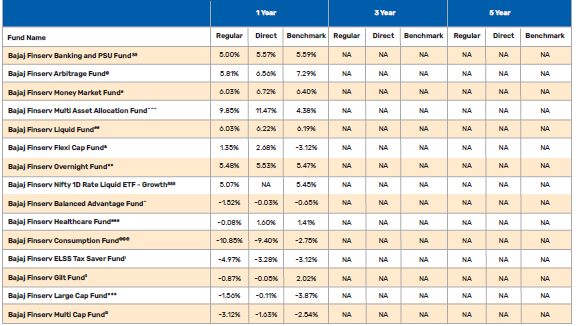
Returns as on 31st March 2026 (for Bajaj Finserv Liquid Fund, Bajaj Finserv Overnight Fund and Bajaj Finserv Nifty 1D Rate Liquid ETF – Growth) and 30th March 2026 (for other schemes).
Inception Date: Bajaj Finserv Money Market Fund – 24th Jul 2023, Bajaj Finserv Liquid Fund – 5th Jul 2023, Bajaj Finserv Overnight Fund – 5th Jul 2023, Bajaj Finserv Flexi Cap Fund – 14th Aug 2023, Bajaj Finserv Banking and PSU Fund – 13th Nov 2023, Bajaj Finserv Balanced Advantage Fund – 15th Dec 2023, Bajaj Finserv Nifty 1D Rate Liquid ETF – Growth –28th May 2024, Bajaj Finserv Multi Asset Allocation Fund – 3rd June 2024, Bajaj Finserv Healthcare Fund – 27th Dec 2024, Bajaj Finserv Consumption Fund – 29th Nov 2025, Bajaj Finserv ELSS Tax Saver Fund – 29th Jan 2025, Bajaj Finserv Gilt Fund – 15thJan 2025, Bajaj Finserv Arbitrage Fund – 15th Sep 2023, Bajaj Finserv Large Cap Fund – 20th Aug 2024 and Bajaj Finserv Multi Cap Fund – 27th February 2025.
Disclaimer: Past performance may or may not be sustained in future. Different plans have different expense structure. Period for which scheme’s performance has been provided is computed basis last day of the previous month preceding the date of this material. Returns are compounded annualized.
Benchmark: #Nifty Money Market Index A-I, ##Nifty Liquid Index A-I, **CRISIL Liquid Overnight Index, $BSE 500 TRI, $$Nifty Banking & PSU Debt Index A-II, ^NIFTY 50 Hybrid Composite debt 50:50 Index, $$$Nifty 1D
Rate Index, ^^^65% Nifty 50 TRI + 25% Nifty Short Duration Debt Index + 10% Domestic Prices of Gold, ###BSE Healthcare Total Return Index (TRI), @@@Nifty India Consumption Total Return Index (TRI), !BSE 500 Total
Return Index (TRI), !!CRISIL Dynamic Gilt Index, @Nifty 50 Arbitrage Index (TRI), ***Nifty 100 Total Return Index (TRI) and !!!NIFTY 500 Multicap 50:25:25 TRI.