
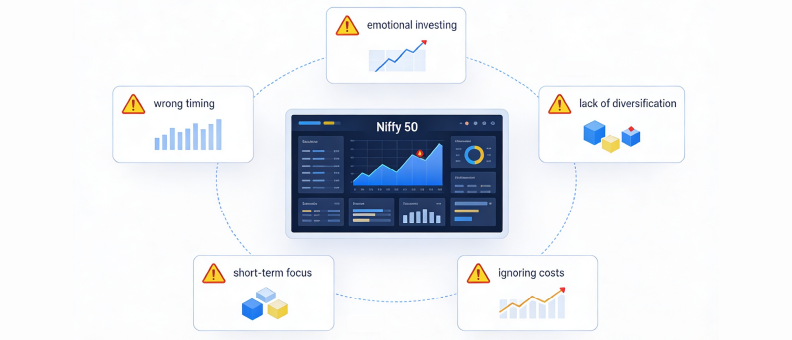
For many investors, the Nifty 50 is often viewed as a reflection of the Indian equity market. It is frequently monitored during the day and used as a quick indicator of market sentiment. However, meaningful tracking of the Nifty 50 may require more than simply observing the live index level.
Why tracking the Nifty 50 correctly matters
The Nifty 50 is a free-float market capitalisation weighted benchmark index comprising 50 large, listed companies. It is widely used as a reference point by retail investors seeking to understand the direction of the equity market. However, a benchmark is not the same as a complete investment framework.
The index moves based on changes in its constituents and their weights, and not every stock, sector, or portfolio may move in the same manner. Therefore, the way investors track the Nifty 50 may be just as relevant as the frequency with which it is monitored.
Table of Contents
Mistake 1: Treating Nifty 50 as a short-term indicator
A common approach is to interpret short-term movements in the index as signals for immediate action. A one-day rise or fall may be influenced by earnings announcements, global developments, sector-specific movements, or price changes in a few large constituents.
However, such movements may not always be relevant for short-term decision-making. The Nifty 50 may help investors identify broader trends over time, but using it as a short-term decision trigger may lead to noise rather than clarity.
In practice, investment decisions linked to the Nifty 50 often require a broader perspective than that of a single trading session.
Mistake 2: Ignoring the sector composition of Nifty 50
The Nifty 50 is not evenly distributed across all sectors of the economy. Its performance is influenced by sector weights and the behaviour of large companies within those sectors.
The index includes representation from financial services, information technology, healthcare, energy, capital goods, and consumer-oriented businesses, among others, but not in equal proportion. As a result, if a sector with a relatively higher weight experiences pressure, the index may appear weak even when other sectors are relatively steady.
A more informed view may come from assessing the underlying drivers of index movement rather than focusing only on whether the index has increased or declined.
Mistake 3: Confusing Nifty 50 returns with mutual fund returns
Investors may sometimes assume that if the index delivers a certain return, a mutual fund associated with that segment of the market may generate similar outcomes. In practice, Nifty 50 returns and mutual fund returns may differ for several reasons.
- First, an index is a benchmark and does not account for operating costs. Mutual funds have expenses, and these costs may affect realised returns over time.
- Second, index funds and exchange-traded funds (ETFs) aim to replicate their benchmark, but they may exhibit some variation due to tracking error and tracking difference. The Securities and Exchange Board of India (SEBI) defines tracking error as the difference between portfolio returns and benchmark returns, and the Association of Mutual Funds in India (AMFI) publishes such data for investor review.
- Third, not all equity mutual funds that are associated with large-cap segments are designed to replicate the Nifty 50. Some may follow active strategies, maintain temporary cash positions, or use broader or different benchmarks.
Therefore, comparing a mutual fund with the index without evaluating its mandate, expenses, and tracking behaviour may lead to incomplete conclusions.
Mistake 4: Reacting emotionally to daily Nifty movements
Daily fluctuations in the Nifty 50 may influence investor behaviour. A sharp decline may lead to concern, while a rapid increase may lead to overconfidence. Real-time access to index data may be useful for information, but frequent monitoring may also lead to decisions without adequate context.
Live data may be more useful for informational purposes rather than emotional reactions. Investors may benefit from observing such movements, understanding the reasons behind them, and then assessing whether any material change has occurred in their overall allocation.
Mistake 5: Not using Nifty 50 data to rebalance a portfolio
The Nifty 50 is not only an indicator to observe but may also serve as a reference point for reviewing portfolio allocation. If a portfolio deviates from its intended equity mix following a market movement, index behaviour may help indicate the need for a review aligned with asset allocation and risk tolerance.
This does not imply replicating the benchmark, but rather using it as a reference. Rebalancing may be more effective when guided by allocation discipline and risk considerations, rather than recent index movements.
Conclusion
Tracking the Nifty 50 effectively may require context, patience, and a degree of separation from daily fluctuations. The index is a useful benchmark, but it represents only one perspective. When considered alongside sector composition, fund mandate, tracking differences, and individual allocation plans, it may provide a more meaningful understanding of market movements and portfolio positioning.
FAQs
How do I track the Nifty 50 index live?
Investors can track the Nifty 50 through financial news platforms and market websites that provide real-time index updates. These platforms typically display the current index level, constituent movements, sector performance, and intraday changes.
Is it safe to invest based on Nifty 50 movements?
Relying only on index movements for investment decisions may be incomplete. The Nifty 50 is a benchmark for market direction, but investment decisions also involve factors such as risk appetite, time horizon, asset allocation, and product structure.
What is a good Nifty 50 return for the year?
There is no fixed annual return that can be considered suitable in all scenarios. Index returns vary based on valuations, earnings, liquidity, and broader market conditions. Evaluating returns over longer periods and aligning them with financial goals may provide better context.
How often does the Nifty 50 composition change?
The Nifty 50 is reviewed semi-annually based on six months of data ending January and July. Any changes are typically implemented from the last trading day of March and September. Even when constituents remain unchanged, weight adjustments may influence index behaviour.
Does Nifty 50 performance predict mutual fund returns?
The Nifty 50 may serve as a benchmark, but mutual fund returns may not always align closely with it. Differences may arise due to expense ratios, cash holdings, portfolio strategies, benchmark selection, and tracking error in passive funds.


































