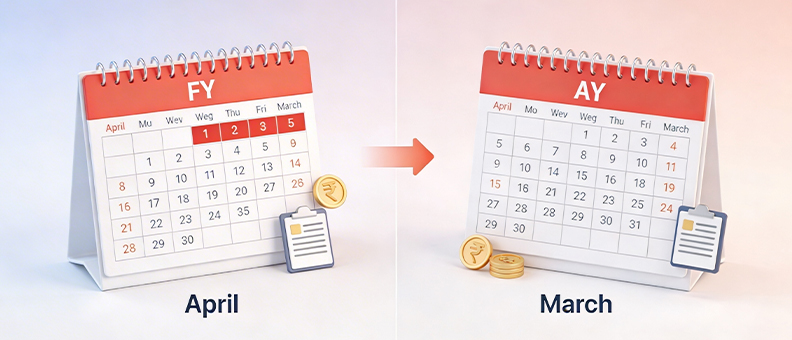
If you are someone earning taxable income in India, you may have come across the terms financial year (FY) and assessment year (AY). While they sound similar, they refer to two different stages in the tax process. The financial year is the period in which income is earned, while the assessment year is the following year in which that income is assessed.
From April 1, 2026, this framework has changed. The Income Tax Act, 2025 has removed the separate concept of an assessment year and now uses the term tax year for the period in which income is earned.
This article explains how FY and AY worked, what has changed with the introduction of the tax year, and what these terms mean for tax filing and investments.
Key Takeaways
- A financial year in India runs from April 1 to March 31.
- Under the Income Tax Act, 1961, income earned in a financial year was assessed in the following assessment year.
- This means that for income earned in financial year 2024-25, the assessment year would be 2025-26.
- From April 1, 2026, the Income Tax Act, 2025 uses ‘tax year’ instead of the earlier assessment year framework.
- FY 2026-27 is therefore referred to as Tax Year 2026-27 under the new Act.
Understanding the financial year (FY) in India
In India, a financial year (FY) is a 12-month period that begins from April 1 of every calendar year and lasts till March 31 of the following year. It is basically the time frame during which individuals, businesses or any entity earns income. All incomes like salary, rent, interest, business income, capital gains, etc, earned during this period become taxable.
Read Also: Tax on Equity Mutual Fund: Capital Gains & 80C Benefits
What is an assessment year?
Under the Income Tax Act, 1961, the financial year was the year in which you earned your income, while the assessment year (AY) was the following year, when that income was reported and assessed for tax purposes.
For example, if you earned salary, interest or investment income between April 1, 2025, and March 31, 2026, that period was FY 2025-26. The assessment year was the following year, AY 2026-27, when this income would be reported and the applicable tax would be calculated.
This is why the financial year always came before the assessment year under the earlier income tax framework.
What is a tax year?
From April 1, 2026, the Income Tax Act, 2025 came into effect and replaced the 1961 Act. It did away with the concept of an assessment year and introduced the term ‘tax year’ to describe the period in which income is earned for tax purposes.
In most cases, the tax year follows the same April-to-March cycle as the financial year. So, income earned between April 1, 2026, and March 31, 2027, falls under financial year 2026-27 as well as tax year 2026-27.
In summary:
FY 2025-26 → AY 2026-27 under the Income Tax Act, 1961
FY 2026-27 → Tax Year 2026-27 under the Income Tax Act, 2025
Income for a Tax Year will still be assessed after that Tax Year ends. The change primarily removes the need to refer to two different year labels for earning income and assessing it.
Financial year, assessment year and tax year: How they differ
| CRITERIA | FINANCIAL YEAR | ASSESSMENT YEAR | TAX YEAR |
| What it means | Period in which income is earned | Following year in which that income was assessed under the earlier framework | Period in which income is earned for income tax purposes under the new Act |
| When it applies | Continues to be used | FY 2025-26 and earlier | FY 2026-27 onwards |
| Example | FY 2025-26 | AY 2026-27 | Tax year 2026-27 |
| Relationship | FY 2025-26 was followed by AY 2026-27 | Came after the relevant FY | Generally, covers the same period as the financial year |
Illustrative examples of FY, AY and tax year
Example 1: Salary income under the earlier FY and AY framework
- If a salaried person earned income from April 1, 2024, to March 31, 2025, that period would be FY 2024-25.
- The income would be reported and assessed in AY 2025-26.
Example 2: Mutual fund capital gains under the earlier framework
- Suppose an investor redeemed units of a mutual fund in December 2024, the redemption would fall under FY 2024-25.
- Any applicable capital gains would be reported and assessed in AY 2025-26.
Example 3: Salary income under the new tax year framework
- If a salaried person earns income from April 1, 2026, to March 31, 2027, that period is FY 2026-27.
- For income tax purposes, it is also tax year 2026-27.
- There is no separate assessment year for this income under the Income Tax Act, 2025.
FY, AY and tax year for recent years
The table below shows which year reference applies across the transition from the earlier system to the new tax year framework.
| Financial year | Assessment year | Tax year |
| 2023-24 | 2024-25 | Not applicable |
| 2024-25 | 2025-26 | Not applicable |
| 2025-26 | 2026-27 | Not applicable |
| 2026-27 | Not applicable | 2026-27 |
| 2027-28 | Not applicable | 2027-28 |
The figures shown are for illustrative purposes only.
Why this distinction matters for income tax filing
Under the earlier framework, mixing up the financial year (FY) and assessment year (AY) could lead to incorrect reporting while filing income tax returns. This could result in mismatches in reported income, tax deducted at source (TDS), capital gains or other tax records. It could also mean that the return was filed for the wrong period and needed to be corrected later.
The introduction of the tax year for income earned from FY 2026-27 onwards simplifies this framework. However, the distinction between FY and AY remains important when dealing with older filings, revised returns or tax notices pertaining to FY 2025-26 or earlier, where the relevant assessment year may still apply.
This is why it is useful to understand which framework applies to the period for which you are filing your return.
Also Read: ITR Filing 2026: How to File ITR Online for AY 2026-27
Why were FY and AY separate in the earlier system?
Under the earlier system, having separate FY and AY labels helped distinguish the period in which income was earned from the period in which it was assessed. However, it also meant taxpayers had to keep track of two different year references for the same income.
From April 1, 2026, the Income Tax Act, 2025 simplifies this by using a single tax year reference.
How FY, AY and tax year affect mutual fund investments
For both capital gains and Income Distribution cum Capital Withdrawal (IDCW) payments, mutual fund taxation is linked to the year in which the income arises. Here is how FY, AY and tax year app
Capital gains
Capital gains from mutual funds arise on redemption. The date of redemption determines the relevant financial year.
Example under the earlier framework:
Redemption date: January 2025
Falls in FY 2024-25
Tax filing happens in AY 2025-26
Example under the new framework:
Redemption date: January 2027
Falls in FY 2026-27
For income tax purposes, it falls under tax year 2026-27
IDCW payment
If an investor receives income from mutual funds (earlier called dividends and now called IDCW), the amount is taxed as per an investor’s prevailing income tax slab rates.
Example under the earlier framework:
IDCW dates: April 2024 – March 2025
Falls in FY 2024-25
Tax filing happens in AY 2025-26
Example under the new framework:
IDCW dates: April 2026 – March 2027
Falls in FY 2026-27
For income tax purposes, it falls under tax year 2026-27
ELSS (Equity linked savings scheme) investments
Investments in ELSS may qualify for a tax deduction, subject to the applicable tax regime and other conditions. Under the Income Tax Act, 1961, this deduction was available under Section 80C. Taxpayers under the old tax regime could claim a deduction of up to Rs. 1.5 lakh in a financial year from their taxable income, as part of the overall limit for eligible investments and payments under Section 80C. From tax year 2026-27 onwards, the corresponding deduction is covered under Section 123 of the Income Tax Act, 2025.
Under the earlier framework, an eligible ELSS investment made in FY 2025-26 would be considered for AY 2026-27. Under the new system, an eligible ELSS investment made in FY 2026-27 will fall under tax year 2026-27 while filing returns and calculating taxes.
Things to remember while filing ITR
Even though the concept of AY will no longer apply to income earned from FY 2026-27 onwards, it will continue to remain relevant for earlier periods. You may still come across AY while filing or revising older returns, dealing with tax notices, rectifications, refunds or other proceedings linked to FY 2025-26 or earlier.
During this transition, a few checks can help avoid confusion:
- Check whether the income relates to FY 2025-26 or an earlier period, or to tax year 2026-27 onwards.
- For FY 2025-26, the corresponding assessment year is AY 2026-27 and the Income Tax Act, 1961 continues to apply.
- Do not use assessment year and tax year interchangeably. They refer to different tax frameworks.
- Make sure income, TDS, capital gains and other tax information are matched to the correct period.
- If you are revising an older return or responding to a notice, check which Act and year reference apply to that case.
Why does India follow an April-March financial year?
India follows an April-March financial year instead of the January-December calendar year mainly because of the accounting and budgeting system introduced during British rule. The April-March cycle has been followed since 1867 and eventually became the standard period for government finances, taxation and business reporting.
Over time, this common cycle helped align budgets, income, expenditure and tax reporting across the economy. So, while the calendar year runs from January to December, India continues to use a separate April-to-March period for financial and accounting purposes.
Importance of the financial year for accounting & planning
The role of the financial year extends beyond tax filing and is also important for businesses and government accounting. Here’s how:
1. Reporting income and calculating taxes
All forms of income, salary, business profits, investment returns or rental earnings must be reported for the financial year. This fixed period helps the government compute your taxable income, apply relevant deductions and determine your total tax liability accurately.
2. Importance of filing deadlines
Once the relevant financial or tax year ends, taxpayers are required to file their Income Tax Return (ITR) within the applicable due date. The due date can vary depending on the category of taxpayer and other factors. Late filing may result in applicable fees, interest or other consequences.
3. Claiming deductions and tax planning
Eligible tax-saving investments and deductions generally need to be made or incurred within the relevant financial or tax year, subject to the applicable tax regime and prevailing tax laws.
4. Role in budgeting and government planning
The financial year serves as the foundation for the government’s annual budget, which influences tax rates, public expenditure and policy decisions. Businesses also follow this period to prepare financial statements, plan cash flows and make strategic investments.
Read Also: Short-Term Capital Gains Tax Rate on Mutual Fund
FAQs
Is the financial year the same for all entities in India?
For most individuals and businesses in India, the financial year runs from April 1 to March 31. Companies also generally follow this April-to-March period for accounting and reporting. In limited cases, certain companies connected with foreign entities may be permitted to follow a different financial year for consolidation purposes.
What is the current financial year and its corresponding assessment year?
The current financial year is FY 2026-27. Under the Income Tax Act, 2025, there is no corresponding assessment year for this period, as the assessment year system has been discontinued for income earned from FY 2026-27 onwards.
Why did income tax forms ask for the assessment year and not the financial year?
Under the Income Tax Act, 1961, income earned in a financial year was reported and assessed in the following assessment year, so ITR forms asked taxpayers to select the relevant AY. From FY 2026-27 onwards, the Income Tax Act, 2025 uses the term tax year instead. In most cases, the tax year and financial year cover the same period.
What happens if I accidentally mention the wrong AY while filing my ITR?
If an incorrect AY is selected, the income details may not match pre-filled information or TDS records. This may require revising the return or responding to notices from the Income Tax Department.
What is the difference between assessment year and previous year?
Under the Income Tax Act, 1961, previous year referred to the period in which income was earned. The assessment year was the following year, when that income was reported and assessed for tax purposes. The Income Tax Act, 2025 replaces the concept of previous year with the term ‘tax year’ and removes the separate assessment year label.
Is the financial year the same as the previous year?
For periods governed by the Income Tax Act, 1961, the previous year generally referred to the financial year in which income was earned. Under the Income Tax Act, 2025, the term previous year has been replaced by tax year.
How many quarters does a financial year have?
A financial year has four quarters of three months each: April-June, July-September, October-December and January-March.
What is the assessment year for FY 2025-26?
The assessment year for FY 2025-26 is AY 2026-27. This period continues to be governed by the Income Tax Act, 1961.
Is assessment year the same as tax year?
No. assessment year is a concept under the Income Tax Act, 1961. Tax Year is the terminology used under the Income Tax Act, 2025 from FY 2026-27 onwards. There is no concept of assessment year under the new Act.
Read Also