When investors compare exchange-traded funds vs mutual funds, they are usually trying to answer a practical question: “Which route fits their way of investing?” Both instruments provide diversified market exposure, but they differ in how they are bought, priced, and managed. This guide explains exchange-traded funds vs mutual fund schemes across structure, returns, costs, and taxation, so you can evaluate them in a consistent way.
What are exchange-traded funds(ETFs)?
The full form of ETF is Exchange Traded Fund. These are pooled investment vehicles that trade on stock exchanges like shares. They typically track a stock market index by replicating its portfolio. So, when you buy units of an ETF, you are indirectly investing in the constituents of an index, such as the Nifty 50, BSE Sensex etc. ETFs seek to mirror the performance of the index they track (subject to tracking error).
What are mutual funds?
Mutual funds are investment vehicles that collect and pool money from various investors and invest it in different types of securities. The investment portfolio is managed by an Asset Management Company (AMC). Investors buy and redeem units through the fund at the declared price (NAV) as per applicable cut-offs and rules. ETFs are, in fact, a type of mutual fund, but differ from regular mutual funds in several fundamental ways.
Difference between ETF and mutual fund: Key points to know
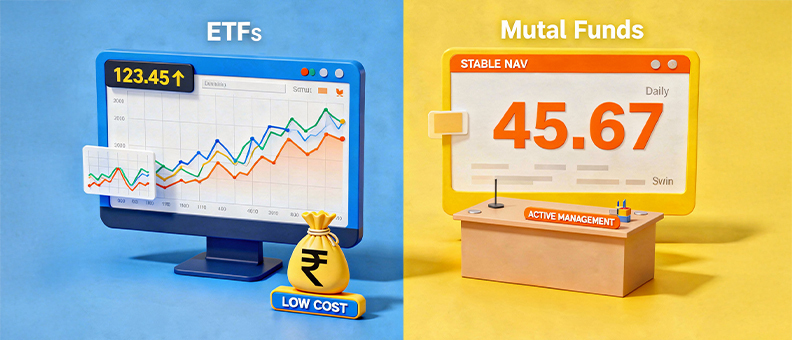
A simple way to approach exchange traded funds vs mutual funds is to divide the differences into how you access them, how pricing works, and what you pay.
Core differences:
- Where you buy
- ETFs: Exchange route (market hours).
- Mutual funds: Fund route (processed at end-of-day NAV).
- Pricing reference
- ETFs: Trade at market price; may differ from the underlying portfolio value (NAV).
- Mutual funds: Purchases/redemptions happen at Net Asset Value.
- Management style
- ETFs: Largely passive in India (index-tracking), but some international ETFs also follow active management styles.
- Mutual funds: Can be active or passive.
- Granularity of exposure
- ETFs may be suitable for targeted exposures (broad index, sector, commodity, fixed income).
- Mutual funds can cover similar exposures, but are more commonly used for diversified active mandates and allocation strategies.
- Investor experience
- ETFs can involve trading frictions (spreads, premium/discount) that may show up at execution.
- Mutual funds generally remove exchange spread issues because transactions are processed at NAV.
ETF vs mutual fund — Detailed comparison table
Comparing these features can help you align the choice with your investment approach, cost sensitivity, and how you prefer to transact. Here is a side-by-side view of ETFs and mutual funds across transactions, pricing, costs, and usage:
| Parameter | ETFs | Mutual funds |
| How you transact | On exchange during market hours | Via fund purchase/redemption process |
| Pricing | Market price; additional trading costs may apply | NAV-based allotment/redemption price |
| Product style | Often index-tracking in India (passive approach) | Active funds as well as passive funds available |
| Costs you notice | Brokerage/transaction costs + TER (fund level) | TER (fund level); exit load where applicable |
| Liquidity driver | Exchange liquidity and market depth | Fund liquidity via purchase/redemption mechanism |
| Use cases | Tactical allocation, index exposure, targeted segments | Goal-based investing, active management, allocation strategies |
ETF vs mutual fund returns: What investors should know
ETF vs mutual fund returns are influenced less by the investment structure and more by the underlying assets held by the product.
- Index-tracking ETFs vs active mutual funds
- An index ETF aims to track index performance (minus costs and tracking difference).
- An active mutual fund seeks to outperform its benchmark index over time through the fund manager’s portfolio decisions.
- Market-cap exposure matters
- Large cap vs mid/small cap exposure can show different volatility patterns linked to market capitalisation behaviour.
Comparisons become clearer when you compare like-for-like exposures (for example, an ETF vs an active fund following the same benchmark).
Costs and fees: ETFs vs mutual funds
Costs are a central part of exchange-traded funds vs mutual funds, because fees reduce net outcomes over time.
ETF cost layers
- Expense ratio / TER: Ongoing fund-level cost.
- Brokerage and transaction charges: Incurred when buying/selling on exchange.
- Bid–ask spread / trading friction: Execution-related costs can matter in ETFs.
- Premium/discount context: ETF market price can behave differently from the underlying value (NAV) in certain conditions.
Mutual fund cost layers
- Expense ratio / TER: Ongoing scheme-level cost.
- Exit load (where applicable): Charged based on scheme rules and holding period.
- Transaction rules and cut-offs: Operational framework differs from exchange execution.
Taxation: ETFs vs mutual funds in India
Taxation in exchange-traded funds vs mutual funds depends primarily on the underlying asset class (equity, debt, or other categories) and the holding period, rather than the investment structure itself.
Equity-oriented ETFs and equity mutual funds generally follow similar capital gains tax rules when they meet the equity classification criteria, while debt-oriented products are taxed as per applicable debt taxation norms.
Equity mutual funds and ETFs are taxed as follows:
- Long-term capital gains tax (for holdings >1 year): 12.5% after an exemption on gains of up to Rs. 1.25 lakh in a financial year
- Short-term capital gains tax: 20%
Debt mutual funds and ETFs:
Taxed at the individual’s applicable slab rate regardless of the holding period.
Gold/silver ETFs:
- Long-term capital gains tax: 12.5% for holdings of a year or more
- Short-term capital gains tax: As per slab rates
Practical considerations:
- Classification matters: Tax treatment varies based on whether the fund is equity-oriented or debt-oriented, so understanding the category is important.
- Holding period impact: Short-term and long-term capital gains are taxed differently depending on the duration of investment and prevailing tax rules.
- Income components: Dividends, if declared, are taxed as per applicable income tax regulations.
Benefits of ETFs
ETFs may suit investors who prefer exchange-based execution and index-like exposures. Commonly cited benefits include:
- Intraday tradability: Ability to buy and sell during market hours.
- Index exposure clarity: ETFs track defined benchmarks.
- Portfolio building blocks: Can be used to construct targeted exposure sleeves (broad market, sector, fixed income).
- Cost-efficiency: ETFs generally have lower expense ratios compared to active mutual funds.
- Easy buying and selling: Trade on the exchange like stocks, providing flexibility and liquidity.
- Diversification: Exposure to a mix of securities within a single instrument, which may help reduce risk.
Benefits of mutual funds
Mutual funds may suit investors who prefer NAV-based investing and structured goal-led planning. Commonly cited benefits:
- Professional active management: Active strategies differ from benchmarks by design, offering potential to outperform the market.
- Convenience of systematic investing: Many invest in an SIP to automate contributions over time.
- Operational simplicity: Execution at NAV can remove exchange-related execution variables.
Similarities between ETFs and mutual funds
The exchange traded funds vs mutual funds comparison also includes overlaps:
- Both are pooled investment products with diversified holdings.
- Both disclose portfolios and risk-related information through mandated disclosures (format may vary).
- Both carry market-linked risk; outcomes depend on underlying assets and market conditions.
ETF vs mutual fund — which may suit you?
A practical framework to decide between exchange-traded funds vs mutual funds is to match product mechanics to investor behaviour.
Questions that may offer some insight:
- Do you want exchange-based execution and the ability to trade during market hours? (ETFs may be suitable)
- Do you prefer NAV-based investing and fewer execution variables? (Mutual funds may be suitable)
- Is the exposure passive index-like, or do you want active positioning? (Those seeking a passive approach may lean towards ETFs or index funds; those seeking active management may opt for active mutual funds)
Tools used by investors (planning aids):
- An SIP calculator is often used to model contributions and accumulation scenarios.
- An SWP calculator is often used to stress-test withdrawal scenarios in later phases.
The calculator is an aid, not a prediction tool. It may provide only an indicative picture.
When should you choose ETFs?
ETFs may be considered when:
- The investor wants index exposure with exchange execution.
- The investor prefers targeted allocation sleeves (broad market, sector, fixed income).
- The investor is comfortable monitoring execution variables and transaction costs.
When should you choose mutual funds?
Mutual funds may be considered when:
- The investor wants NAV-based investing and operational simplicity.
- The investor prefers systematic investing via SIPs and long-horizon, goal-led planning.
- The investor wants access to active management strategies (where applicable).
Conclusion
The exchange-traded funds vs mutual funds decision is about aligning the product mechanics with your investing method. ETFs provide exchange tradability and are often used for index or targeted exposures, while mutual funds offer NAV-based investing and a broad range of active and passive strategies. For many investors, the clearer comparison is like-to-like: similar exposure, similar risk level, and a transparent view of fees and execution costs.
Frequently Asked Questions
Are exchange-traded funds safer than mutual funds?
Both ETFs and mutual funds carry market-linked risk because their outcomes depend on underlying holdings. The risk profile depends more on the asset category (equity, debt, sector, etc.) than on the investment type.
Which is better: ETF or mutual fund in India?
The fit depends on preferences: exchange execution vs NAV-based investing, passive vs active exposure, and personal risk tolerance.
Do exchange traded-funds have lower fees than mutual funds?
Some passive ETFs can have lower TERs than active mutual funds, but total investor cost also includes transaction costs at buy/sell for ETFs.
Can I invest in both exchange-traded funds and mutual funds?
Some investors use both, depending on portfolio design and exposure needs.
How are exchange-traded funds and mutual funds taxed in India?
Taxation depends on product classification and holding period, and rules can change.
Are exchange-traded funds suitable for long-term investing?
They can be used for long-term index exposure, but suitability depends on the ETF category and the investor’s risk appetite and ability to stay invested through market cycles.
Can I invest in ETFs through SIP?
Many investors use an SIP-like approach in ETFs by placing periodic buy orders; the experience can differ from mutual fund SIPs due to transaction costs at each purchase.
Is ETF better than mutual fund?
In exchange-traded funds vs mutual funds, outcomes depend on exposure, costs, and how the product is used in a portfolio.
How to decide between ETF vs mutual fund?
Start with the exposure you want, then compare access methods (exchange vs NAV), cost layers, and whether the approach matches your investing behaviour and time horizon.