
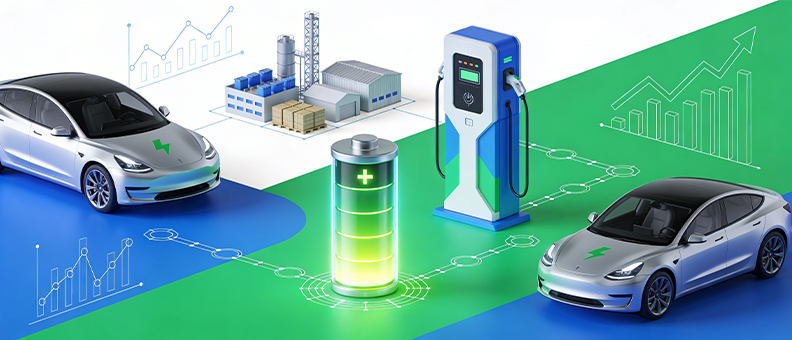
Electric vehicles are becoming an important part of the transition towards cleaner transportation. As this segment evolves, it has also created thematic investment opportunities in the mutual fund space. One such theme is EV mutual funds, which invest in companies linked to the electric vehicle ecosystem, including automobile manufacturers, battery producers, component suppliers, and related businesses.
For investors, understanding what EV mutual funds are, how they operate, and the risks involved is important when evaluating whether this thematic exposure fits within an overall mutual fund investment strategy.
Table of Contents
What are EV mutual funds?
EV mutual funds are schemes that invest in companies connected to electric vehicles and related industries, such as vehicle manufacturers, battery producers, component suppliers, raw material providers, and technology firms.
In India, EV mutual funds are typically structured as thematic equity funds. Under SEBI regulations, sectoral or thematic equity schemes are required to invest at least 80% of their total assets in equity and equity-related instruments of a particular sector or theme.
Key Takeaways
- EV mutual funds invest in businesses across the electric vehicle ecosystem.
- They spread money across several EV-related companies instead of relying on one stock.
- In India, such funds are mainly in the form of ETFs, index funds and fund-of-funds.
- They help investors participate in the long-term shift towards electric mobility without selecting individual stocks.
- However, the narrow focus of such funds can lead to sharper ups and downs than diversified equity funds.
Currently, EV-linked exposure in India is available mainly through ETFs, index funds, and fund-of-funds (FoF) structures tracking indices such as the Nifty EV & New Age Automotive Index. These portfolios may focus on the electric mobility value chain, including vehicle manufacturers, battery and component suppliers, charging infrastructure-related businesses, and supporting technologies.
Because these funds invest predominantly in equities and follow a narrow theme, they are generally considered to be very high risk investments and may experience significant volatility.
Also Read: What Are Thematic Funds – Meaning and Benefits
How do EV mutual funds work?
Like other mutual funds, EV-themed schemes pool money from multiple investors and invest according to a defined investment objective.
EV-themed exposure is generally offered in three formats:
- Active thematic funds: The fund manager selects companies within the EV ecosystem based on research and the scheme’s mandate.
- Passive index funds or ETFs: These aim to replicate an EV-related index, such as the Nifty EV & New Age Automotive Index, by holding securities in similar proportions.
- Fund of funds (FoF): These schemes typically invest in underlying ETFs or index funds that track the EV theme.
How to choose EV mutual funds before investing
Investors may evaluate the following factors before investing in EV-themed schemes:
- Structure: ETFs trade on stock exchanges, while FoF units are purchased and redeemed at NAV-based prices, similar to regular mutual funds.
- Investment objective: Review whether the scheme focuses specifically on EV-related companies or a broader mobility or manufacturing theme.
- Theme coverage: Some funds may include the entire EV ecosystem rather than only vehicle manufacturers.
- Costs: Compare expense ratios, tracking differences (for passive funds) and transaction costs.
- Risk profile: Review the scheme’s Riskometer, benchmark index, and degree of portfolio concentration.
Investors may also assess whether the scheme’s exposure aligns with their overall asset allocation and investment horizon.
Why investors consider EV mutual funds
The transition towards electric mobility has drawn attention from investors seeking exposure to industries influenced by technological change and policy support.
Government initiatives promoting cleaner transportation, advancements in battery technology, and increasing adoption of electric vehicles may contribute to interest in the broader EV ecosystem.
EV mutual funds may offer a way to gain exposure to this theme without selecting individual stocks, though outcomes remain subject to market risks and sector developments.
Benefits of investing in EV mutual funds
Potential characteristics often associated with EV-themed funds include:
- Exposure across the electric mobility value chain rather than a single company
- Access to a professionally managed or rules-based portfolio
- Potential participation in long-term structural changes in transportation
Investments can typically be made through lump sum contributions or Systematic Investment Plans (SIPs), which allow periodic investing over time. A SIP calculator may help investors estimate potential outcomes under different contribution scenarios.
Risks of investing in EV mutual funds
EV-focused funds may carry several risks due to their thematic concentration:
- Concentration risk: A narrow theme may result in sharper price fluctuations compared to diversified equity funds.
- Policy risk: Changes in government incentives, regulations, or environmental policies may affect the sector.
- Technology risk: Rapid innovation may benefit certain companies while potentially making others less competitive.
- Valuation risk: High growth expectations may lead to elevated valuations, which may increase sensitivity to market corrections.
- Supply chain risk: Availability and pricing of key raw materials, such as battery components, may influence company performance.
Also Read: What are consumption funds and who should invest in them?
Taxation on EV mutual funds
Taxation depends on the structure of the scheme. Most EV-themed funds in India are equity-oriented mutual funds because they typically invest predominantly in listed equities.
- Short-term capital gains (STCG): If units are redeemed within 12 months, gains are taxed at 20%.
- Long-term capital gains (LTCG): If units are redeemed after 12 months, gains exceeding ₹1.25 lakh in a financial year are taxed at 12.5%.
Investors should verify the scheme classification, as tax treatment depends on equity exposure and prevailing tax laws.
*The tax information in this article is based on current laws and is subject to change. Please consult a tax professional or refer to the latest regulations for up-to-date information.
How to invest in EV mutual funds in India
Investors may follow these general steps:
- Complete KYC: Provide PAN, Aadhaar, and other required identity documents.
- Choose a platform: Investments may be made through asset management company websites, online mutual fund platforms, AMFI-registered distributors, banks, or stockbroking applications.
- Select the fund: Review the investment objective, portfolio composition, benchmark, and expense ratio.
- Choose investment mode: Investments may be made through lump sum contributions or SIPs.
- Monitor investment: Periodic review of portfolio alignment, risk level, and financial goals may be helpful.
Conclusion
EV mutual funds may provide exposure to companies involved in the electric vehicle ecosystem through a single investment vehicle. However, due to their thematic concentration and high equity allocation, these funds are generally considered to be very high risk and may exhibit significant volatility. Investors may consider evaluating the scheme’s objective, portfolio characteristics, costs, and risks, and may view EV exposure as one component of a diversified portfolio.
FAQs
What are EV mutual funds and how do they work?
EV mutual funds are thematic or index-based schemes that invest in companies linked to the electric mobility ecosystem. They pool investor funds and may either track an index or invest in an underlying ETF, depending on the scheme structure.
Are EV mutual funds available in India?
EV-themed exposure in India is available primarily through ETFs, index funds and fund-of-funds products linked to EV ecosystem through indices such as the Nifty EV & New Age Automotive Index.
How can investors invest in EV mutual funds?
Investments may be made through AMC websites, AMFI-registered distributors, or mutual fund platforms after completing KYC. ETF units can be bought or sold on stock exchanges, while FoF units are typically transacted at NAV-based prices, similar to regular mutual funds.
Are EV mutual funds suitable for long-term investment?
These schemes may be considered by investors with a long-term horizon and very high risk appetite, as thematic funds can experience significant volatility and are generally classified as very high risk.
What are the risks of investing in EV mutual funds?
Key risks include theme concentration, valuation fluctuations, policy changes, raw material price volatility, slower adoption of electric vehicles, and liquidity or tracking differences in ETF structures.
What factors affect EV mutual fund performance?
Performance may be influenced by EV adoption trends, automobile demand, battery costs, regulatory policies, company earnings, index rebalancing, expense ratios, and theme concentration.
Is it good to invest in EV ETFs?
EV ETFs can be suitable if you want long-term exposure to electric mobility and can handle sharp price swings. However, they invest in a narrow theme, so returns can be uneven. Check the tracked index, holdings, costs and trading volumes before investing.
What are the advantages of investing in EV mutual funds?
EV mutual funds let you invest in several EV-linked businesses through one fund. Their portfolios may include vehicle makers, battery companies, component suppliers and technology firms. This provides broader exposure to the EV ecosystem without requiring you to choose individual stocks.
Who should look to invest in EV mutual funds?
EV mutual funds may be considered experienced investors with a long investment horizon and a very high tolerance for risk. They are suitable as a small part of a diversified portfolio, rather than its main equity investment.