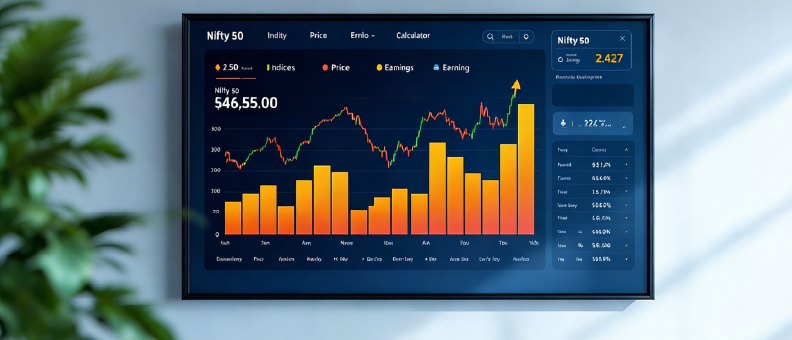
The Nifty 50 is often seen as a snapshot of Indian market sentiment. It reflects how market participants may respond to growth, inflation, liquidity, company results, policy signals and global risk. Hence, Nifty 50 daily moves are rarely caused by one headline alone. For retail investors asking what affects Nifty 50, the answer may often lie in a mix of domestic and international triggers.
What is the Nifty 50 and why does it move?
Nifty 50 is NSE’s flagship equity index of 50 large, liquid and listed companies. It is calculated using the free-float market capitalisation method. Because it is weighted by free-float value, larger constituents may influence the index more than smaller ones. Changes in earnings expectations, interest rates, fund flows and risk appetite can therefore affect Nifty 50 performance.
Table of Contents
Top drivers of Nifty 50
These drivers are closely linked to earnings, liquidity and valuation. The ten drivers below are commonly associated with medium-term movements, although their influence may overlap during periods of market volatility.
1. Macroeconomic indicators
Growth, inflation, industrial output, tax collections and consumption data shape the market’s view of future earnings potential. In its April 2026 policy, the RBI projected real GDP growth for 2026–27 at 6.9% and CPI inflation at 4.6%, while noting risks from energy prices and global disruptions.
When macroeconomic data support growth without significantly increasing inflationary pressures, equities may witness changes in valuation expectations.
Source: RBI Monetary Policy Statement, April 2026.
Key Takeaways
- Nifty 50 movements are influenced by a mix of domestic and global factors rather than a single trigger.
- Macroeconomic indicators and RBI policies can affect growth expectations, liquidity and market valuations.
- FII and DII flows, corporate earnings and global market cues can significantly influence market sentiment.
- India VIX, government policies, index composition and currency movements can contribute to Nifty 50 volatility.
- Crude oil prices can affect inflation, currency movements, sector performance and overall equity market sentiment.
2. RBI monetary policy and interest rates
Interest rates affect borrowing costs, deposit returns and valuation multiples. On April 8, 2026, the RBI kept the policy repo rate unchanged at 5.25% and retained a neutral stance.
Lower rates may influence liquidity conditions and rate-sensitive sectors, while tighter policy may affect overall market sentiment. As a result, RBI communication and forward guidance are often closely tracked by market participants.
Source: RBI Monetary Policy Statement, April 2026.
3. FII and DII flows
Foreign Institutional Investors (FIIs) and Domestic Institutional Investors (DIIs) play an important role in market liquidity. Large FII selling may influence the index when global investors reduce exposure to emerging markets, while DII buying may partly offset that impact in certain periods.
Flow data should not be viewed in isolation. Valuations, earnings, currency movements and global interest rates may also influence market direction. However, FII and DII activity remains one of the commonly tracked indicators when analysing factors affecting Nifty 50.
Source: RBI Monetary Policy Statement, April 2026.
4. Corporate earnings and quarterly results
Quarterly results affect stock prices because markets may respond to earnings expectations rather than only current numbers. Revenue growth, margins, loan growth, asset quality, management commentary and capital expenditure plans can influence expectations for the index.
When a high-weight constituent reports earnings that differ significantly from market expectations, the index may react quickly. Investors may also look beyond short-term performance to assess whether growth trends are supported by underlying business fundamentals.
5. Global market cues and geopolitical events
Indian equities are connected with global markets through trade, capital flows, commodities and currencies. US Federal Reserve policy, US bond yields, global equity trends, geopolitical conflicts and supply disruptions may influence Indian market sentiment.
Tighter global liquidity conditions may reduce foreign investment flows into emerging markets. Similarly, geopolitical tensions may increase uncertainty and influence commodity prices, which can affect Nifty 50 performance even when domestic conditions remain stable.
6. India VIX and the fear gauge
India VIX measures expected market volatility over the next 30 calendar days using Nifty option prices. Higher India VIX values indicate higher expected volatility.
When India VIX rises sharply, market participants may reduce leverage, hedge portfolios or limit fresh exposure. While a rise in India VIX does not necessarily indicate a market decline, it is often associated with higher uncertainty and sharper short-term market swings.
7. Government policy, Union Budget and regulations
Budget announcements, tax proposals, production-linked incentives, disinvestment plans and sector regulations may influence earnings expectations and market sentiment. The Union Budget is often closely tracked for signals related to fiscal discipline, capital expenditure and policy direction.
Regulations introduced by SEBI, stock exchanges and other authorities may also influence market behaviour. SEBI’s Investor Charter outlines investor rights, responsibilities and grievance redressal mechanisms aimed at improving market transparency and awareness.
8.Free-float market capitalisation and index composition
Nifty 50 is not an equal-weight index. Stocks with larger free-float weights may influence the benchmark more significantly, which means leadership within the index may narrow during certain rallies or corrections.
NSE uses the free-float market capitalisation methodology, and index reviews are conducted periodically. Additions, exclusions and weight changes may result in passive fund buying or selling linked to index tracking.
9. Currency INR and USD movements
Currency movements can affect Nifty 50 in different ways. A weaker rupee may influence rupee-denominated earnings for export-oriented sectors such as information technology.
At the same time, rupee depreciation may increase the cost of imports such as crude oil and may reduce dollar-adjusted returns for overseas investors. Currency volatility may therefore influence inflation expectations, foreign investment flows and sector-level performance.
10. Crude oil prices
Crude oil prices are among the important global variables influencing Indian markets. India imports a significant portion of its crude oil requirements, making the economy sensitive to changes in global oil prices.
Sharp increases in oil prices may raise import costs, inflationary pressures and currency-related concerns. This may influence market sentiment, sector-level performance and broader risk appetite within equity markets.
How these insights may support market understanding
This framework may help explain short-term market volatility without encouraging excessive trading activity. It may also help explain market movements during periods of uncertainty.
In broader financial planning discussions, factors such as asset allocation, risk suitability and investment horizon may remain important considerations alongside market developments.
FAQs
What are the main factors affecting Nifty 50?
Nifty 50 movements may be influenced by factors such as economic growth, RBI policy, institutional investment flows, corporate earnings, global market trends, currency movements, crude oil prices and market volatility indicators like India VIX.
How does RBI policy affect Nifty 50?
RBI policy may influence borrowing costs, liquidity conditions, interest rates and market sentiment. Investors also closely track the RBI’s inflation outlook, growth projections and policy stance.
Does the US Federal Reserve impact Nifty 50?
Yes. US Federal Reserve decisions may affect global liquidity, bond yields, currency movements and foreign investment flows, which may influence Indian equity markets, including Nifty 50.
How do FII flows influence Nifty 50?
Foreign Institutional Investor (FII) activity may influence Nifty 50 because FIIs commonly invest in large-cap and liquid stocks that form a major part of the index.
What is India VIX and its relation to Nifty 50?
India VIX is NSE’s volatility index based on Nifty option prices. Higher India VIX levels are commonly associated with higher expected market volatility and uncertainty.
Past performance may or may not be sustained in future
Please note that the reference to any industry/sector/stock is provided for illustrative purposes only. This should not be construed as a research report or a recommendation to buy or sell any security or sector.