
Systematic Investment Plans remain a widely used route for Indian retail investors. However, market volatility often raises an important question: should one continue with a fixed contribution or adjust investments based on market conditions and changing financial situations?
This brings the comparison of flexi SIP and fixed SIP into focus. Both approaches have their own characteristics, advantages and limitations, especially during periods of market volatility. Understanding how each works may help investors align their SIP approach with their financial goals and risk appetite.
Table of Contents
What is a fixed SIP?
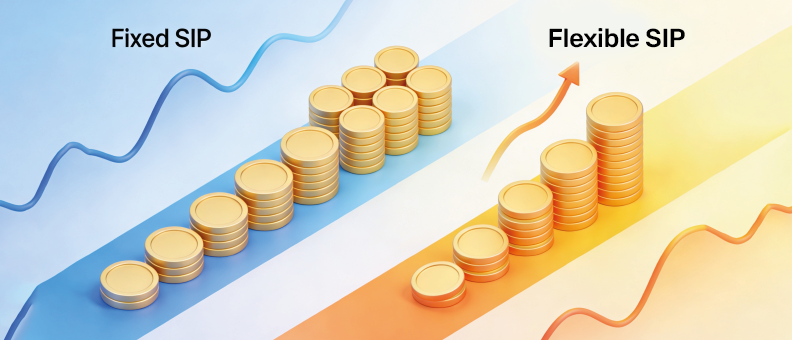
A fixed SIP is the standard structure where a predetermined amount is invested at regular intervals, such as monthly or quarterly. One of its key features is consistency and disciplined investing.
Since the contribution remains constant, investors purchase more units when NAVs are lower and fewer units when NAVs are higher. This reflects the concept of rupee cost averaging. SIP investing also reduces the need to time market entries, which may be particularly relevant during volatile market conditions.
What is a flexi SIP?
A flexi SIP allows investors to vary their SIP amount based on predefined rules, market conditions or personal financial circumstances.
For example, an investor may choose to increase contributions during market declines, reduce contributions during market highs or adjust instalments based on income variability. In many cases, these adjustments follow predefined rules rather than discretionary decisions.
Flexi SIP vs fixed SIP: Head-to-head comparison
Understanding the differences between flexi SIP and fixed SIP may help investors choose an approach that aligns with their financial situation and investment style:
| Aspect | Fixed SIP | Flexi SIP |
| Contribution amount | Remains fixed throughout the tenure | Can increase or decrease based on predefined rules |
| Investment approach | Focuses on consistency and automation | Focuses on flexibility in contributions |
| Investor involvement | Requires minimal monitoring | May require active monitoring or rule-based adjustments |
| Suitability | May suit investors with stable income and predictable cash flows | May suit investors with variable income or changing financial needs |
| Volatile market approach | Uses rupee cost averaging through fixed investments | May allow contribution adjustments during market fluctuations |
| Key consideration | Supports investing discipline and budgeting | Depends on consistency in following the chosen strategy |
How volatile markets affect your SIP returns
Volatility influences SIP outcomes in two ways. In the short term, portfolio value may fluctuate with changes in NAV. Over time, volatility may lead to the accumulation of more units when prices are lower.
This averaging effect may help moderate the purchase cost over longer periods. However, it does not remove market risks or ensure any specific outcome.
When to use flexi SIP vs fixed SIP
A fixed SIP may be considered when an investor prefers a stable periodic outflow, automated investing and minimal intervention. A flexi SIP may be considered when income is variable or when the investor prefers a rule-based mechanism to adjust contributions within defined limits. The choice depends on factors such as cash flow stability, investor behaviour and product availability rather than market predictions alone.
Which is better for salaried vs self-employed investors?
For salaried investors, a regular income may align with a fixed SIP structure. For self-employed individuals or those with variable cash flows, a flexi SIP may offer more adaptability. However, this is not a strict classification. Investor preference, discipline and financial planning approach may influence the choice more than income type alone.
Which SIP strategy may perform differently in volatile markets?
There is no universal outcome. A flexi SIP may lead to different investment outcomes if higher contributions are consistently made during market declines based on a predefined approach. At the same time, a fixed SIP already incorporates rupee cost averaging and disciplined participation, which may help manage market timing concerns. The outcome of either approach depends on consistency, investor behaviour and adherence to the chosen strategy rather than the structure alone.
Benefits of flexi SIP vs fixed SIP
Understanding the strengths of both SIP approaches may help investors choose a structure that better aligns with their financial habits and investment preferences:
Consistent investing
A fixed SIP helps maintain investment discipline through regular contributions.
Easier budgeting
A fixed SIP offers predictable cash outflows that may support monthly financial planning.
Reduced decision-making
A fixed SIP minimises the need for frequent investment adjustments during market fluctuations.
Flexible contributions
A flexi SIP allows investors to adjust contribution amounts based on predefined rules or changing cash flows.
Adaptability during changing financial situations
A flexi SIP may provide more flexibility when income or financial priorities change over time.
Strategy suitability
The suitability of either approach depends on factors such as investor behaviour, financial discipline and cash flow stability.
Conclusion
In volatile markets, the choice between flexi SIP and fixed SIP depends on how well the structure aligns with investor behaviour, income patterns and financial discipline. A fixed SIP may be suitable for investors who prefer consistency and a hands-off approach. A flexi SIP may be relevant when contributions need to adjust with cash flow or follow a predefined strategy. In both cases, factors such as scheme selection, investment horizon and risk appetite remain important considerations.
FAQs
What is the difference between flexi SIP and step-up SIP?
A step-up SIP increases the investment amount automatically at predefined intervals, usually by a fixed percentage or amount. A flexi SIP, on the other hand, allows the contribution amount to vary based on predefined rules, cash flow needs or investor preferences.
Can I switch from fixed SIP to flexi SIP?
Yes, this may be possible depending on the AMC, investment platform and scheme features available. Some platforms allow SIP modifications online, while others may require a fresh registration or mandate update.
Is flexi SIP available in all mutual funds?
No, flexi SIP is not available across all mutual fund schemes or platforms. Availability may vary depending on the AMC, investment platform and operational features offered for a specific scheme.
Does flexi SIP offer better returns than fixed SIP?
Not necessarily. Investment outcomes depend on factors such as market movements, contribution patterns, investment horizon and consistency. Since mutual fund investments are market-linked, neither SIP approach guarantees higher returns.
Should I pause my SIP during market volatility?
Pausing an SIP during market volatility may interrupt disciplined investing and rupee cost averaging. Investors may consider reviewing their financial situation, investment horizon and risk comfort before making such decisions.
What is the minimum amount for flexi SIP?
There is no standard minimum amount across the industry. While many SIPs start from ₹500, the minimum contribution amount and flexi SIP features may vary across AMCs, platforms and schemes.