Interest rates shape investment outcomes more than most people realise. Two products can look similar on the surface, yet one may give you stability while the other may keep changing with the market. That difference affects potential returns, your planning, and even your comfort level as an investor. If you are choosing between fixed and floating interest rates, you are not just comparing numbers. You are choosing between the potential for consistency and flexibility.
This matters even more when rates are moving sharply. In a falling-rate cycle, a fixed rate may help you lock in higher yields. . In a rising-rate cycle, a floating rate can potentially help you benefit from upward resets.
So, the choice depends less on which type is “better” in general and more on what you need from the investment.
That is why the same investor may prefer fixed rates for one goal and floating rates for another.
What are fixed interest rates?
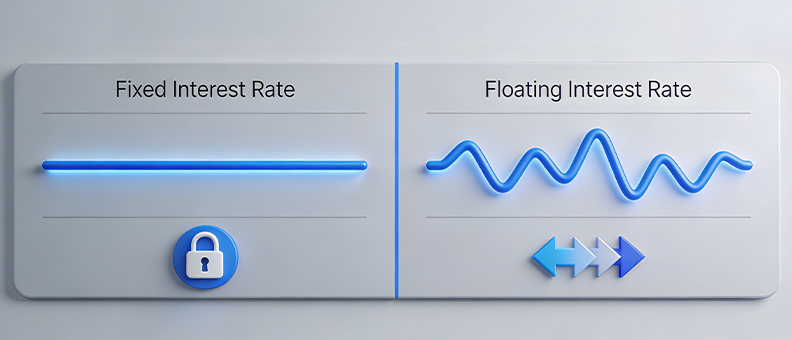
A fixed interest rate means the rate remains unchanged for the agreed tenure of the investment or loan. If you invest in a fixed deposit, bond, or similar instrument at a fixed rate, you know in advance what return you may receive, subject to the product terms. This makes fixed-rate products easier to understand and easier to plan around.
For example, if you invest Rs. 1 lakh in a fixed-income product at 7% per year for a specified term, the agreed rate does not move up or down just because market rates change later. That predictability is the main advantage of a fixed rate. It helps you estimate maturity value, compare options clearly, and align investments with specific financial goals.
What are floating interest rates?
A floating interest rate changes over time because it is linked to a benchmark. Instead of giving you one locked rate for the full tenure, the product follows a formula. A common structure is benchmark plus a spread. If the benchmark changes, your rate also changes at the next reset date.
For instance, if a floating-rate product is linked to an external benchmark and the benchmark rises, the applicable rate may also rise. If the benchmark falls, the return may fall too.
In the context of mutual funds, this concept is reflected in floating interest rate funds. These are a category of debt mutual funds that primarily invest in instruments with variable interest rates. As their returns are linked to benchmark movements, they may perform relatively better in a rising interest rate environment, while returns may moderate when interest rates decline.
How are fixed and floating rates determined?
Fixed rates are usually determined by the issuer based on prevailing interest rates, liquidity conditions, competition, credit risk, and the product’s tenure. A bank sets FD rates based on its funding needs and market conditions. A bond issuer sets coupon rates based on its borrowing cost and investor demand. Once offered and accepted, that fixed rate becomes your contracted rate for the tenure.
Floating rates are determined differently. They are generally tied to a reference point such as the RBI repo rate, T-bill yield, another market benchmark, plus or minus a spread. RBI communication on external benchmark-based lending shows how floating-rate structures are linked to such benchmarks and reset periodically. In practical terms, this means your rate is not decided once and forgotten. It is reviewed at scheduled intervals.
RBI guidance around floating-rate products and benchmark-linked lending emphasises transparency, and banks are expected to use clear benchmark-based pricing rather than vague internal methods in cases where such benchmark linkage is mandated.
Fixed vs. floating rates: Key differences
Understanding how fixed and floating interest rates differ can help you make more informed investment decisions based on your financial goals and risk comfort. Here are eight key differences to help you compare them more effectively:
1. Clarity of returns
A fixed rate gives you more clarity. You know the rate and can estimate the potential final return more easily. A floating rate may involve uncertainty because future resets can raise or reduce your return.
2. Response to market changes
A fixed rate does not react once locked in. A floating rate moves with benchmark changes. That means floating rates are more sensitive to the interest-rate cycle.
3. Stability of returns
With fixed rates, planning is easier because the income pattern is more stable. With floating rates, the actual return can differ from your initial expectation because resets happen over time.
4. Benefit in rising-rate environments
If interest rates are rising, floating rates can become more attractive because they may reset upward. A fixed-rate investment will stay where it is, even when newer products start offering better rates.
5. Benefit in falling-rate environments
If interest rates are falling, fixed rates may become more attractive because you keep the older and higher rate for the full term. Floating rates may reset downward and reduce your earnings.
6. Suitability for financial goals
Fixed rates may be more suitable when you need a clear target amount or stable income. Floating rates may be more suitable when you are comfortable with variation and want market-linked upside.
7. Risk profile
Fixed rates reduce reinvestment and planning uncertainty for the specific tenure, though they carry an opportunity cost if rates rise later. Floating rates reduce the risk of being locked into a low rate during a rising cycle, but they increase income uncertainty.
8. Ease of understanding
Fixed-rate products are simpler for most investors. Floating-rate products need more attention because you must track the benchmark, spread, reset frequency, and the general rate cycle.
Real-life examples of fixed vs floating rates
A bank fixed deposit is the simplest fixed-rate example. Suppose you invest Rs. 2 lakh in an FD at a fixed annual rate for two years. Even if market deposit rates change after six months, your contracted rate for that deposit usually remains unchanged until maturity under the product terms. Since banks are free to set their own term deposit rates, new customers later may get a different rate, but your deposit continues with the rate you locked in.
Now consider a floating-rate loan or bond linked to a benchmark. If the benchmark is 6% and the spread is 2%, the effective rate becomes 8%. If the benchmark later rises to 6.5%, the effective rate becomes 8.5% at the next reset. If the benchmark falls to 5.5%, the effective rate becomes 7.5%.
This is the basic logic of floating-rate calculation, and it is why floating rates may feel attractive in some phases and limiting in others.
Examples for illustrative purposes only.
Factors to consider when choosing a rate type
Choosing between fixed and floating interest rates depends on your financial goals, time horizon, and comfort with changing returns. Here are some key factors to consider when selecting a rate type:
Your Financial Goals
If you are investing for a planned expense such as school fees, a down payment, or a known short-term target, fixed rates may usually be more suitable because predictability matters.
Interest-Rate Cycle
If rates look high and you want certainty, locking into a fixed rate may make sense. If you believe rates could rise further, a floating rate may help you avoid being locked into a lower rate.
Risk Tolerance
If frequent changes make you uneasy, floating rates may not be suitable. If you are comfortable with temporary changes in return, you may appreciate their flexibility.
Investment Tenure
For short periods, the difference between fixed and floating may not be dramatic unless rates are moving sharply. For longer periods, the impact of rate resets becomes more meaningful.
Conclusion
Fixed and floating interest rates are not competing answers to the same question. They solve different problems. A fixed rate can offer relatively consistent potential returns. A floating rate preserves flexibility. One helps you plan with more clarity, while the other keeps you aligned with market direction.
If you want relatively stable projections and a clearer path to a financial goal, fixed rates may be more suitable. If you are comfortable with resets and want to benefit when rates move upward, floating rates may merit a closer look. A suitable approach may be to not pick one side forever, but match the rate type to the purpose of the investment.
FAQs
What does a floating interest rate mean?
A floating interest rate is a rate that changes over time because it is linked to a benchmark or reference rate. If the benchmark changes, your applicable rate changes at the next reset.
What is the main difference between fixed and floating interest rates?
The main difference is stability versus change. A fixed rate stays the same for the agreed tenure, while a floating rate moves with a benchmark and can rise or fall over time.
How does a floating interest rate change?
It changes when its benchmark changes. The product usually follows a formula such as a benchmark plus a spread, and the revision happens on scheduled reset dates.
What is an example of a floating interest rate calculation?
If your rate is benchmark plus 2%, and the benchmark is 6%, your effective rate is 8%. If the benchmark later rises to 6.5%, your rate becomes 8.5% at reset. If it falls to 5.5%, your rate becomes 7.5%.
Are floating rates generally lower than fixed rates?
Not always. They can start lower, equal, or higher depending on market conditions, the benchmark used, and the spread charged. Their real difference is that they can change later.
What are the main pros and cons of a floating interest rate?
The main advantage is that you may benefit if interest rates rise. The main drawback is uncertainty because your return or payment can change during the tenure.