Financial derivatives such as forwards and futures allow market participants to manage price risk or take a position based on the expected movement of an underlying asset. These underlying assets may include commodities, currencies, equity securities, indices and interest-rate instruments.
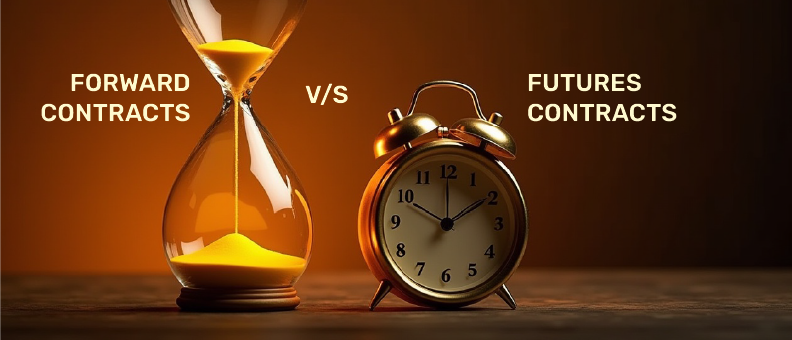
Although the forward contract vs futures contract comparison may appear straightforward, the two instruments differ considerably in how they are traded, settled and managed. This article explains a futures contract and forward contract, their differences, uses, margins and risks.
Table of Contents
What is a futures contract?
A futures contract is a standardised derivative agreement in which two parties agree to buy or sell an underlying asset at a predetermined price on a specified future date.
Futures contracts are traded on recognised exchanges. In India, equity, index, currency, commodity and interest-rate futures may be available through exchanges such as NSE, BSE and MCX, subject to their respective contract specifications and regulatory framework.
Contract terms such as the underlying asset, lot size, expiry date, price quotation and settlement process are specified by the exchange. Market participants commonly use futures to hedge price risk or take a trading position based on expected price movements.
Futures positions are subject to margin requirements and daily mark-to-market settlement. This means gains and losses are calculated against the exchange’s daily settlement price.
Key Takeaways
- Futures are standardised contracts traded on recognised exchanges, while forwards are customised agreements negotiated privately between two parties.
- Futures are subject to exchange margin requirements and daily mark-to-market settlement.
- Forward contracts ordinarily settle according to the terms agreed between the counterparties and carry greater counterparty risk.
- Futures may offer better liquidity and price transparency, while forwards provide greater flexibility for matching a specific commercial exposure.
- Both instruments carry market risk, and their relative risk depends on leverage, liquidity, counterparty strength and settlement terms.
What is a forward contract?
A forward contract is a customised derivative agreement between two parties to buy or sell an underlying asset at an agreed price on a specified future date.
Unlike futures, forwards are privately negotiated and traded over the counter rather than on a recognised exchange. The parties can customise the quantity, price, maturity date, settlement method and other contractual terms.
In India, forward contracts are commonly used by businesses to manage foreign exchange, commodity, interest-rate and other permitted commercial exposures. The availability and conditions of a forward contract depend on the underlying asset, the parties involved and the applicable regulatory framework.
For example, foreign exchange forwards arranged through authorised dealers are governed by applicable RBI directions.
Difference between futures and forwards
A forward vs futures contract comparison is easiest to understand by looking at how the two instruments are structured:
| Parameter | Futures contract | Forward contract |
| Trading venue | Traded on a recognised exchange | Privately negotiated over the counter |
| Contract terms | Standardised by the exchange | Customised by the counterparties |
| Contract size and expiry | Based on exchange specifications | Decided by mutual agreement |
| Counterparty | Clearing corporation facilitates clearing and settlement | Each party is directly exposed to the other |
| Counterparty risk | Reduced through clearing, margins and risk-management mechanisms | Generally higher because performance depends on the counterparty |
| Margin | Exchange and clearing rules prescribe margin requirements | Collateral or margin depends on the agreement and applicable rules |
| Mark-to-market | Gains and losses are calculated and settled regularly | Ordinarily settled according to the contractual terms, often at maturity |
| Liquidity | May be higher for actively traded contracts | Usually lower because contracts are customised |
| Price transparency | Exchange prices are publicly available | Pricing is negotiated privately |
| Exiting the contract | A position can generally be closed by taking an offsetting exchange position | Early termination normally requires counterparty agreement |
| Settlement | Cash settlement or delivery, depending on the contract specifications | Cash settlement or delivery, depending on the agreement |
| Regulation | Subject to exchange rules and the applicable regulatory framework | Subject to the relevant contractual and regulatory framework |
Examples of forward contracts and futures contracts
The following examples show how the two instruments work in practice:
Futures contract example
Assume a futures contract represents 100 units of an underlying asset and the buyer enters the contract at ₹500 per unit.
If the daily settlement price increases to ₹510, the buyer has a mark-to-market gain of:
100 x (₹510 – ₹500) = ₹1,000
If the settlement price instead falls to ₹490, the buyer has a mark-to-market loss of ₹1,000. The actual cash flow, margin requirement and settlement process would depend on the exchange contract.
Currency forward example
An Indian exporter expects to receive USD 100,000 after three months. To reduce uncertainty from exchange-rate movements, the exporter enters into a forward contract with an authorised dealer to sell the dollars at ₹84 per USD.
The agreed rupee value is:
$100,000 x ₹84 = ₹84,00,000
The forward rate provides certainty about the exchange rate for the covered amount. However, the exporter will not benefit if the spot exchange rate at maturity becomes more favourable than the contracted rate.
Commodity forward example
A producer and a manufacturer may agree today on the price and quantity of a commodity to be delivered after six months. This can help the producer manage the risk of falling prices and the buyer manage the risk of rising input costs.
Both parties also give up the benefit they might otherwise receive if the market price moves in their favour.
The figures shown are for illustrative purpose only.
How do futures and forward contracts work?
Both instruments fix contractual terms for a transaction that will be settled later. Their day-to-day operation, however, is different.
Agreement and price movement
Once a contract is entered into, the market price of the underlying asset can move above or below the agreed price.
In a forward contract, the economic gain or loss is ordinarily settled according to the agreed contractual terms, often at maturity. Some arrangements may also require collateral or other payments before maturity.
In a futures contract, the position is marked to the exchange’s settlement price at the end of each trading day. Losses are collected from the relevant clearing members and passed to those with gains through the clearing system.
Margin or collateral
Futures require traders to maintain prescribed margins. Margin is not a payment towards purchasing the underlying asset. It is collateral intended to cover losses and support the clearing system’s risk-management process.
Forward contracts do not follow a single exchange-mandated margin framework. The counterparties may agree on collateral, credit limits, advance payments or other risk protections. Regulated OTC transactions may also be subject to applicable margin and collateral requirements.
How settlement works
A derivative contract may be settled through:
- Physical delivery of the underlying asset
- Cash settlement based on the difference between the contracted price and the applicable settlement price
For futures, the settlement method is determined by the exchange’s contract specifications. For forwards, settlement follows the terms agreed between the parties and applicable regulations.
Source: NSE, settlement mechanism for futures contracts.
Advantages and disadvantages of forward and futures contracts
Both instruments can help manage price exposure, but their structures create different benefits and limitations:
| Contract | Advantages | Disadvantages |
| Forward contract | Terms can be customised to match a specific quantity, date, price or commercial exposure. The parties can also choose the settlement method. | Greater counterparty risk, limited pricing transparency and difficulty in exiting before maturity. Customisation can also make valuation more complex. |
| Futures contract | Exchange trading provides standardisation, transparent pricing and access to clearing mechanisms. Actively traded contracts may be easier to enter or exit. | Standardised terms may not match the exact exposure being hedged. Margin calls and daily settlement can create significant cash-flow requirements. |
Neither contract removes price risk completely. A hedge may not move exactly in line with the underlying exposure, while a speculative position can result in substantial losses.
When to use forwards vs futures
The choice depends on the participant’s exposure, objectives and ability to manage the related risks.
A forward contract may be considered when:
- The quantity or maturity date must match a specific commercial exposure
- The required contract is not available on an exchange
- A business wants to fix the exchange rate for a future foreign currency payment or receipt
- The parties are able to assess and manage each other’s credit risk
- Customised settlement terms are required
A futures contract may be considered when:
- A standardised exchange contract adequately matches the exposure
- Transparent market pricing is preferred
- The participant requires the ability to close a position through an offsetting trade
- Exchange-based clearing is preferred
- The participant can meet upfront and continuing margin obligations
A highly customised forward may provide a closer hedge, while a futures contract may provide greater liquidity. The suitability of either instrument depends on the actual exposure and contract terms.
Margin in futures and forward contracts
Margin treatment is one of the most important differences between the two instruments:
| Criterion | Futures contract | Forward contract |
| Upfront margin | Required under exchange and clearing rules | Depends on the agreement and applicable regulations |
| Daily gains and losses | Calculated through mark-to-market settlement | Ordinarily recognised according to the contractual terms |
| Additional collateral | May be required when the position moves adversely or margin requirements change | May be required if the parties or applicable rules prescribe it |
| Margin shortfall | Can lead to penalties, compulsory position reduction or closure | Consequences depend on the contract |
| Cash-flow requirements | Can change daily | Usually depend on the agreed settlement and collateral terms |
| Risk-management framework | Managed through the exchange and clearing corporation | Managed through bilateral credit and collateral arrangements |
A futures trader can obtain exposure to a contract value larger than the deposited margin. This creates leverage, which magnifies both gains and losses.
Risk profile of futures and forwards
Neither futures nor forwards can be described as universally safer. They carry different forms of risk:
| Risk | Futures | Forwards |
| Market risk | Losses arise when prices move against the position | Losses arise when prices move against the agreed contract |
| Leverage risk | Margin-based exposure can magnify gains and losses | Economic exposure may be large relative to any collateral exchanged |
| Counterparty risk | Reduced through exchange clearing and margins, but not eliminated from the wider settlement system | Generally higher because the contract depends on direct counterparty performance |
| Margin and liquidity risk | Adverse movements can result in additional margin requirements at short notice | Collateral calls may apply if required under the contract |
| Trading liquidity | Varies by contract, expiry and underlying asset | Usually lower because the contract is customised |
| Exit risk | A position can ordinarily be offset, although an illiquid contract may be difficult to exit | Early termination usually requires agreement and may involve a cost |
| Basis risk | The futures contract may not move exactly with the exposure being hedged | A customised contract may reduce basis risk if it closely matches the exposure |
| Settlement risk | Depends on contract specifications and clearing requirements | Depends on the counterparty and agreed settlement procedure |
| Operational risk | Errors in orders, margin management or contract selection can cause losses | Documentation, valuation and settlement errors can cause losses |
Forwards generally carry greater direct counterparty and liquidity risk. Futures reduce these risks through clearing and standardisation but can create substantial leverage, margin-call and short-term cash-flow risk.
Conclusion
Forward and futures contracts both allow market participants to establish a price today for a transaction that will be settled later. Futures offer standardised terms, exchange trading, transparent pricing and clearing support. Forwards provide greater flexibility by allowing the parties to customise the contract.
The distinction is not merely about which contract is safer. Futures carry market, leverage, margin and liquidity risks, while forwards add greater counterparty, valuation and exit risk. Understanding the contract terms, settlement process and worst-case cash-flow requirements is essential before using either instrument.
FAQs
Can retail investors trade futures in India?
Yes. Retail investors can access eligible exchange-traded futures through a SEBI-registered intermediary, subject to account requirements, margins, position limits and risk disclosures. Futures involve leverage and can produce losses greater than the initial margin deposited.
Can individuals enter into forward contracts?
Individuals may access certain permitted forward contracts, particularly foreign exchange products offered through authorised dealers. Availability depends on the underlying exposure, eligibility requirements, documentation and applicable RBI regulations.
Are forward and futures contracts limited to commodities?
No. Derivative contracts may be based on currencies, equity indices, individual securities, interest rates and commodities. Availability depends on exchange listings, bilateral arrangements and the applicable regulatory framework.
Which is riskier, a forward or futures contract?
Forwards generally carry greater direct counterparty and liquidity risk. Futures have lower direct counterparty risk because of exchange clearing, but leverage, daily settlement and margin calls can still create substantial losses.
Can a futures position be closed before expiry?
Yes. A futures position can ordinarily be closed before expiry by entering an offsetting trade in the same contract. Execution depends on market liquidity and available counterparties.
Can a forward contract be cancelled before maturity?
A forward contract may be terminated, amended or offset if the counterparty agrees and applicable rules permit it. Early closure can involve a gain, loss or termination charge based on prevailing market conditions.
Do futures contracts always result in physical delivery?
No. Some futures contracts are cash-settled, while others may require delivery at expiry. The settlement method is specified in the exchange’s contract terms.
Why are futures contracts marked to market daily?
Daily mark-to-market settlement transfers gains and losses regularly through the clearing system. This limits the accumulation of unpaid losses and supports the exchange’s counterparty-risk controls.
Are forward and futures prices always the same?
Not necessarily. Prices can differ because futures are settled daily, while forwards are generally settled under bilateral terms. Interest rates, cash-flow timing, storage costs, income from the underlying asset and market liquidity may also affect pricing.
Can forwards and futures assure a profit?
No. Both contracts can generate losses if market prices move unfavourably. Even a hedge may not fully offset the underlying exposure because of basis risk, contract mismatch, costs or timing differences.