
The recent turbulence in the equity market has reinforced a less talked about investing principal – when outcomes become unpredictable, the importance of robust processes is underscored. In a year marked by inflationary pressures, interest rate uncertainty, shifting global liquidity conditions and geo-political tensions, markets moved sharply between optimism and fear, with stock movements often driven more by sentiment than company performance.
Such periods of volatility test more than portfolios—they also challenge the underlying processes and management approaches. In response, the Bajaj Finserv Large and Mid Cap Fund has remained firmly anchored to its long-term strategy, rather than reacting to short-term market narratives.
Driven by a moat investing approach, the fund’s focus has been on identifying businesses with durable competitive advantages that can potentially deliver relatively consistent returns across market cycles. Such companies tend to be better positioned to navigate challenging conditions and absorb shocks.
This focus on identifying quality businesses rather than reacting to shifting market narratives has helped the portfolio navigate different market conditions and outperform its benchmark over time. Since its inception on February 27, 2024, the fund has delivered a return of 4.04%, compared to 2.84% for the benchmark (Nifty Large Midcap 250 TRI) over the same period.
Data as on March 31, 2026, under Regular-Growth plan. Past performance may or may not be sustained in future. Source: MFI Explorer and Internal Analysis.
Understanding moat investing
The foundation of the fund’s moat investing approach is identifying businesses that are not just performing well today but are structurally positioned to sustain leadership over time.
An economic moat is a distinct and sustainable competitive advantage that may potentially help a company defend or even build on its market presence over time. Moats could come from factors like strong brand recall, cost advantages, wide distribution networks, network effects, or customer loyalty.
Such factors don’t make a company immune to challenges, but they can shape how deftly it responds to difficult conditions and its ability to deliver relatively consistent returns over time.
That said, the portfolio is not static. It is continuously monitored and reviewed. If a company’s competitive strengths appear to be improving, the fund may continue to hold it. If business fundamentals or industry dynamics shift, positions may be reassessed.
A structured, process-led approach
The investment strategy follows a structured process that combines top-down insights with bottom-up stock selection. From a broad universe of 500 companies, a moat lens is applied to identify potential portfolio candidates.
Key metrics used for this include return on incremental capital (ROIC), record of high and sustained margins, high market share and longevity of Return on Equity (RoE). Qualitative factors such as management quality, industry positioning and innovation are also considered.
To this, Bajaj Finserv AMC’s trademark investment philosophy – InQuBe – is applied. This philosophy combines efficient information gathering (In) with sophisticated quantitative analysis (Qu) and insights from behavioural finance (Be).
How the numbers reflect this
From a fundamental standpoint, the portfolio reflects a balance between growth potential and valuation discipline. The fund is positioned with an expected earnings growth (EPS CAGR) of 20.03% over FY25–27, compared to 18.8% for the benchmark, indicating a tilt towards businesses with relatively stronger growth prospects.
This growth orientation is reflected in a higher expected price-to-earnings (P/E) multiple of 34.37 versus 26.21 for the benchmark. However, once growth is factored in through the expected PEG ratio (price-to-earnings to growth ratio) —1.48 for the fund versus 1.95 for the benchmark—the portfolio reflects more balanced valuations.
Another key aspect of the fund’s approach is balancing participation in market opportunities with an awareness of risks.
With a standard deviation of 13.39% compared to 15.69% for the benchmark, the scheme has demonstrated relatively lower volatility while maintaining favourable risk-adjusted performance. A beta of 0.82 and a Jensen’s alpha of 0.45% since inception further reflect its resilient profile and growth, supported by disciplined portfolio construction and stock selection.
Source: Risk Free Rate of Return: 6.98%, Data as on 31st March, 2026; calculated since inception | Source: Internal Analysis, MFI360, Bloomberg | Past performance may or may not be sustained in future.
Anchored yet flexible
Uncertainty is likely to remain a constant in equity markets. In such a setting, staying anchored to a clear investment approach, while retaining the flexibility to adapt, can be important.
The moat-based approach of Bajaj Finserv Large and Mid Cap Fund reflects this balance. By focusing on businesses with relatively enduring strengths and combining this with a structured process, the fund aims to navigate different market conditions with consistency.
To read more about the scheme and to invest, click here.
Bajaj Finserv Large and Mid Cap Fund
| Value of investment of Rs 10,000 | |||||||
| Plan | Period | Fund Returns | Benchmark Returns | Additional Benchmark | Fund (Rs.) | Benchmark (Rs.) | Additional Benchmark (Rs.) |
| Bajaj Finserv Large and Mid Cap Fund: Regular – Growth | 1 Yr | -3.09% | -0.82% | -3.99% | 9,691 | 9,918 | 9,601 |
| Since Inception | 4.04% | 2.84% | 1.42% | 10,862 | 10,602 | 10,299 | |
| Bajaj Finserv Large and Mid Cap Fund: Direct – Growth | 1 Yr | -1.72% | -0.82% | -3.99% | 9,828 | 9,918 | 9,601 |
| Since Inception | 5.57% | 2.84% | 1.42% | 11,198 | 10,602 | 10,299 | |
Returns as on 30th March, 2026. Past performance may or may not be sustained in future. Different Plans i.e. Regular Plan and Direct Plan under the scheme have different expense structure. Benchmark Nifty Large Midcap 250 TRI Additional Benchmark: Nifty 50 TRI Inception Date: 27th February 2024
Period for which scheme’s performance has been provided is computed basis last day of the previous month preceding the date of this material. Returns greater than 1 year are compounded annualized.
Face Value per unit: Rs. 10.
The Fund Managers of the scheme: Mr. Nimesh Chandan (Equity Portion), Mr. Sorbh Gupta (Equity Portion) and Mr. Siddharth Chaudhary (Debt Portion). For the performance of other schemes managed by the Fund Managers which have completed 1 year or more than 1 year since inception, see the link below.
Mr. Nimesh Chandan manages equity portion of Bajaj Finserv Small Cap Fund and Bajaj Finserv Banking and Financial Services Fund. He also manages Bajaj Finserv Low Duration Fund.
Mr. Siddharth Chaudhary manages debt portion of Bajaj Finserv Small Cap Fund, Bajaj Finserv Equity Savings Fund and Bajaj Finserv Banking and Financial Services Fund. He also manages Bajaj Finserv Low Duration Fund.
Mr. Sarth Gupta manages equity portion of Bajaj Finserv Small Cap Fund, Bajaj Finserv Equity Savings Fund and Bajaj Finserv Banking and Financial Services Fund.
However, since these funds have not completed 1 year, the performance is not disclosed.
Other Schemes Managed by Fund Managers
Names of Fund Managers: Mr. Nimesh Chandan, Mr. Sorbh Gupta and Mr. Siddharth Choudhary
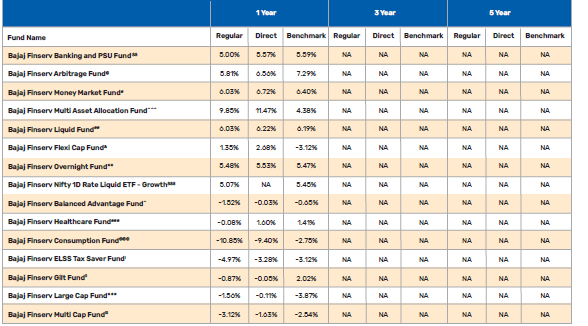
Returns as on 31st March 2026 (for Bajaj Finserv Liquid Fund, Bajaj Finserv Overnight Fund and Bajaj Finserv Nifty 1D Rate Liquid ETF – Growth) and 30th March 2026 (for other schemes).
Inception Date: Bajaj Finserv Money Market Fund – 24th Jul 2023, Bajaj Finserv Liquid Fund – 5th Jul 2023, Bajaj Finserv Overnight Fund – 5th Jul 2023, Bajaj Finserv Flexi Cap Fund – 14th Aug 2023, Bajaj Finserv Banking and PSU Fund – 13th Nov 2023, Bajaj Finserv Balanced Advantage Fund – 15th Dec 2023, Bajaj Finserv Nifty 1D Rate Liquid ETF – Growth –28th May 2024, Bajaj Finserv Multi Asset Allocation Fund – 3rd June 2024, Bajaj Finserv Healthcare Fund – 27th Dec 2024, Bajaj Finserv Consumption Fund – 29th Nov 2025, Bajaj Finserv ELSS Tax Saver Fund – 29th Jan 2025, Bajaj Finserv Gilt Fund – 15thJan 2025, Bajaj Finserv Arbitrage Fund – 15th Sep 2023, Bajaj Finserv Large Cap Fund – 20th Aug 2024 and Bajaj Finserv Multi Cap Fund – 27th February 2025.
Disclaimer: Past performance may or may not be sustained in future. Different plans have different expense structure. Period for which scheme’s performance has been provided is computed basis last day of the previous month preceding the date of this material. Returns are compounded annualized.
Benchmark: #Nifty Money Market Index A-I, ##Nifty Liquid Index A-I, **CRISIL Liquid Overnight Index, $BSE 500 TRI, $$Nifty Banking & PSU Debt Index A-II, ^NIFTY 50 Hybrid Composite debt 50:50 Index, $$$Nifty 1D
Rate Index, ^^^65% Nifty 50 TRI + 25% Nifty Short Duration Debt Index + 10% Domestic Prices of Gold, ###BSE Healthcare Total Return Index (TRI), @@@Nifty India Consumption Total Return Index (TRI), !BSE 500 Total
Return Index (TRI), !!CRISIL Dynamic Gilt Index, @Nifty 50 Arbitrage Index (TRI), ***Nifty 100 Total Return Index (TRI) and !!!NIFTY 500 Multicap 50:25:25 TRI.