
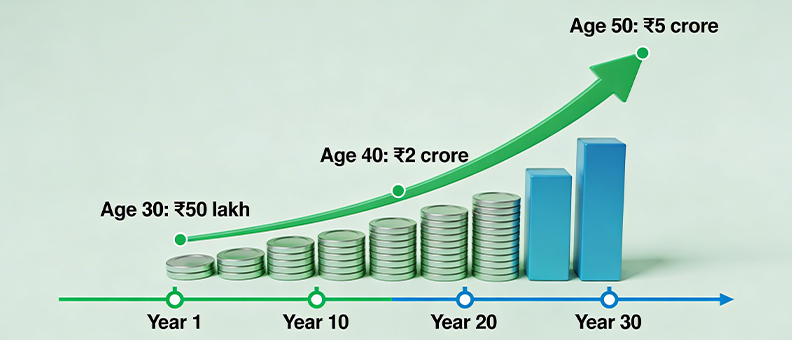
Creating long-term potential wealth in India is something many may aspire to, but it may appear complicated. However, with a consistent SIP method, disciplined investing, and a practical point of view, it may not be as difficult as one may initially think. In this article we explain how an SIP could potentially help you build Rs. 5 crore in the long term, while touching on how starting out young might facilitate the investment process for both novice and experienced investors.
Table of Contents:
- Why building Rs. 5 crore by SIP may be possible
- Understanding SIP and its power of compounding
- Step-by-step SIP plan to potentially build Rs. 5 crore by age 50
- Starting early: Why time may be your biggest asset
- Choosing a suitable monthly SIP amount and step-up strategy
- Expected returns and how to set realistic expectations
- Common mistakes to avoid while building potential wealth through SIP
- Benefits of investing in SIPs
Why building Rs. 5 crore by SIP may be possible
The idea of how to build Rs. 5 crore by SIP may sound ambitious, but a long-term investing plan that aims to leverage the compounding power of the market can potentially make it achievable. By investing relatively affordable amounts regularly, you may give your money the chance to potentially grow and compound over time, provided you start early and sustain the investment.
Understanding SIP and its power of compounding
An SIP or Systematic Investment Plan lets you invest a fixed amount regularly in mutual fund schemes. Instead of worrying about market timing, an SIP spreads your investments over many market phases. Compounding happens if both the money you invest and the realised returns generate further potential returns. Compounding can result in potential growth over time if you stay invested longer in the market.
Step-by-step SIP plan to potentially build Rs. 5 crore by age 50
Here’s a possible step-by-step approach for an individual starting at age 25:
- Define a goal clearly, such as Rs. 5 crore by age 50.
- Select an SIP amount depending on the assumed return.
- Choose suitable categories of investment based on your risk capacity.
- Use an SIP Calculator to estimate the level of monthly contribution needed.
- Review the plan at least once a year to account for any increases to your income.
This approach of steady investing might help you understand how to potentially build Rs. 5 crore by SIP with a disciplined outlook.
Also Read: A guide to create corpus for medical needs with mutual funds
Starting early: Why time may be your biggest asset
A major influential factor in long-term investing is time. Starting early reduces the required monthly SIP significantly. An SIP calculator shows you how. If you start investing approx. Rs. 15,000 per month at the age of 20, with an investment horizon of 30 years and an assumed rate of return of 12%, your projected final corpus could be Rs. 5.30 crore by age 50. However, by age 30, with an investment horizon of 20 years, you will need to invest more than Rs. 51,000 a month to cross the Rs. 5 crore mark, as per the calculator’s estimates.
This shows that early starters could contribute less each month while still aiming for the same potential corpus. Therefore, for someone in their mid-20s, learning how to build Rs. 5 crore by SIP early, might mean smaller instalments and more flexibility later.
You may use the Bajaj Finserv SIP calculator to make similar assessments.
However, it’s essential to note that the assumed rate of return you input in the calculator is not a guarantee – actual returns depend on market movements and may or may not be along expected lines.
The calculator is an aid, not a prediction tool. It may provide only an indicative picture.
Choosing a suitable monthly SIP amount and step-up strategy
When deciding how much to invest monthly, you are advised to factor in your income, expenses, future commitments, and risk tolerance. A key strategy may be the step-up approach of increasing your monthly SIP amount over time (for example, by 10% annually) so your investment grows with your income. If your income rises, increasing the SIP step-up may help maintain the momentum without starting with uncomfortably large amounts.
Expected returns and how to set realistic expectations
Setting realistic return expectations is central to an SIP-based plan. While equity funds are more suitable than debt funds for a Rs. 5 crore long-term SIP plan, higher return potential often comes with higher volatility and risk. So when building your plan to build Rs. 5 crore by investing in SIP, it is advised to assume a realistic rate rather than aiming for unusually high returns.
Common mistakes to avoid while building potential wealth through SIP
Even with a well-structured SIP plan, there are some common mistakes investors could make, such as:
- Waiting too long to start.
- Underestimating inflation and rising cost of living.
- Chasing past performance without regard to future prospects.
- Not increasing SIPs as your income rises.
- Neglecting fees and expenses (which could drag potential returns).
Avoiding these might help keep your journey of building Rs. 5 crore by investing in SIP aligned with realistic expectations.
Past performance may or may not be sustained in future.
Also Read: Start Investing in Mutual Funds with Just Rs. 500
Benefits of investing in SIPs
SIPs offer several potential benefits that may support long-term potential wealth creation:
- They promote regular investment discipline.
- They allow rupee-cost averaging: investing the same amount when markets are high and when low.
- Over decades, the compounding effect might work more powerfully.
Thus, for someone wondering how to build Rs. 5 crore by investing in SIP, SIPs could provide a practical, structured route rather than relying on timing the market or making large one-time bets.
Conclusion
With an early start, disciplined regular investments, realistic return assumptions, and periodic review, you could potentially move towards your goal of building Rs. 5 crore by investing in SIP. It is advised to remember that investment results may vary. Starting early, checking your plan annually, and adjusting as your income and goals evolve may help you stay on track.
FAQs
How much should I start investing monthly to build a Rs. 5 crore corpus by age 50?
This depends mostly on your current age, return expectation, and investment strategy.
Can I build Rs. 5 crore by SIP if I start at age 30 instead of 25?
Yes, it may still be possible, but you will need a higher monthly contribution than if you were to start earlier.
How often should I increase my SIP amount to reach Rs. 5 crore?
Increasing your monthly SIP annually may help. Many investors opt for an increase of 8-10% per year, aligned with income growth or inflation.
What are the risks involved in building wealth through SIP?
Equity markets are volatile. There are no guarantees of returns. If the assumed return rate does not materialise, your corpus may fall short. Also, inflation, taxes, and fees could erode real value.
Is it better to invest in a lumpsum or an SIP for a Rs. 5 crore goal?
Both methods have pros and cons. A lumpsum may potentially gain if market timing is favourable but also comes with higher potential risk. SIPs spread out risk over time and may be more manageable for regular investors.