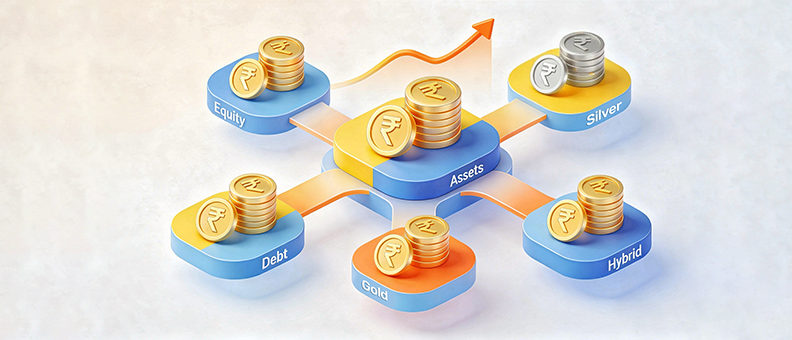
Mutual funds can be a starting point for most new investors. They allow individuals to participate in financial markets without needing deep domain expertise. By pooling money with other investors, you gain access to professionally managed portfolios of stocks, bonds, or other securities. Moreover, building a sound mutual fund portfolio ensures that your investments align with your goals and risk appetite. Read on to understand how to construct a portfolio step by step.
Table of contents
- Understanding mutual fund portfolios
- Why you need a mutual fund portfolio
- Steps to build your mutual fund portfolio
- Common mistakes to avoid
- When to work with a financial advisor
What is a mutual fund portfolio ?
A mutual fund portfolio is a collection of different mutual fund schemes strategically chosen to balance growth, stability, and risk. Instead of investing in a single fund, combining multiple funds across categories ensures that market volatility in one area does not disproportionately impact your overall returns.
Let’s break down the possible components of such a portfolio.
1. Equity funds: These focus on stocks and aim for relatively high growth over time. They carry higher risk but offer the potential for significant returns. Examples include:
- Large cap funds: Invest in well-established companies with relatively stable performance.
- Mid cap/Small cap funds: Target smaller, high-growth potential companies but come with increased volatility.
- Sector-specific funds: Concentrate on industries like technology or healthcare etc., which may rise or fall based on sector trends.
2. Debt funds: These prioritise stability by investing in fixed-income instruments like government bonds, corporate bonds, or treasury bills etc . They generate steady, predictable returns with lower risk. For Example, inter alia, includes:
- Liquid funds: Ideal for short-term goals due to easy withdrawals.
- Corporate bond funds: Offers slightly better return potential than government securities but carry moderate credit risk.
3. Hybrid funds: These blend equity and debt in varying proportions. They adapt to market conditions, making them versatile for medium-term goals. For example, inter alia, includes:
- Aggressive hybrid funds: Allocate 65 – 80% to equities for growth-oriented investors.
- Conservative hybrid funds: Allocate 75– 90% to debt for risk-averse investors.
4. Index funds: These passively track market indices like the Nifty 50 or BSE Sensex. They mirror the index’s performance and have lower fees compared to actively managed funds.
Diversifying across these categories reduces dependence on a single asset class. For instance, during a stock market downturn, equity funds may decline, but debt funds often remain stable, cushioning your portfolio. Similarly, hybrid funds provide a middle ground, adjusting their equity-debt ratio to navigate changing markets.
Also, a well-structured portfolio aligns with your financial goals and risk tolerance. A young investor saving for retirement might allocate 70% to equity funds and 30% to hybrid funds. A retiree seeking income might prefer 60% debt funds and 40% conservative hybrid funds. Regularly reviewing your portfolio ensures it stays aligned with your evolving objectives, even as markets shift.
Why you need a mutual fund portfolio
1. Risk control: Spreading money across asset types prevents one underperforming fund from derailing your goals.
2. Goal-based investing: Portfolios can be structured for specific timelines. Short-term goals (1–3 years) might use debt funds, while long-term goals (10+ years) benefit from equities.
3. Professional expertise: Fund managers analyse markets and adjust holdings, saving you time.
4. Cost efficiency: Buying multiple funds through one platform often incurs lower fees than managing individual stocks.
5. Flexibility: Adjust your portfolio as life changes—like adding conservative funds near retirement.
Steps to build your mutual fund portfolio
1. Define clear financial goals
Identify what you’re saving for and how soon you’ll need the money.
- Short-term goals (1–3 years): These could include building an emergency fund, vacation planning, or car down payment. Relatively lower risk debt funds may be considered for this.
- Medium-term goals (3–5 years): Home renovation or education. Are some examples of mid-term goals.Hybrid funds that invest in both debt and equity assets may be suitable.
- Long-term goals (5+ years):Common goals include retirement or child’s education. Focus on equity funds for long-term growth potential when you have a long horizon.
2. Assess your risk tolerance
Ask yourself –
- Can I handle a significant drop in my portfolio without panicking?
- Does my income allow regular investments during market dips? Younger investors often take more risks, as they have time to recover from losses. Retirees may prefer stable debt funds.
3. Choose fund categories
Allocate percentages based on goals and risk tolerance.Here’s an indicative portfolio mix:
- Aggressive portfolio: 70% equity, 20% hybrid, 10% debt.
- Moderate portfolio: 50% equity, 30% hybrid, 20% debt.
- Conservative portfolio: 30% equity, 40% hybrid, 30% debt.
4. Select specific funds
Research using these criteria –
- Performance: Compare 3–5 year returns against benchmarks.
- Fund manager track record: Look for consistency across market cycles.
- Portfolio overlap: Avoid funds holding the same stocks (e.g., two large-cap funds).
- Expense ratio: Lower expenses can help improve net returns over the long term.
- Risk profile: Review the scheme’s risk level and ensure it aligns with your investment objectives.
- Consistency of performance: Consider how the fund has performed across different market conditions rather than focusing only on recent returns.
Past performance may or may not be sustained in future.
5. Diversify strategically
You can consider including 4–6 funds across categories. For example,
- 2 equity funds (large-cap and mid-cap).
- 1 international equity fund.
- 2 debt funds (corporate bonds and government securities).
- 1 hybrid fund.
Example for illustrative purpose only.
Diversification can also be achieved across asset classes, market capitalisations and geographies. This may help reduce concentration risk within a portfolio.
6. Invest regularly
Use SIPs (Systematic Investment Plans) to invest fixed amounts monthly in general. This averages out purchase costs and reduces timing risks.
7. Monitor and rebalance
Review every 6 months.
- Check performance: Replace consistently underperforming funds.
- Rebalance: Restore original allocations. For example, if equity grows to 65% in a 50% target portfolio, sell some equity and buy debt.
How to create a mutual fund portfolio for income generation
For investors seeking the potential for periodic cash flows, Systematic Withdrawal Plans (SWP) or IDCW payout options in mutual funds may be suitable. Some factors to consider include:
- Define income requirements: Estimate the amount and frequency of cash flows required. This can help determine the portfolio structure and withdrawal strategy.
- Choose suitable fund categories: Depending on the income objective, investors may consider debt funds or hybrid funds. The allocation should align with the desired level of stability, risk tolerance and investment horizon.
- Evaluate the SWP option: An SWP allows investors to withdraw a fixed amount from their mutual fund investments at regular intervals. SWPs can provide a structured approach to generating cash flows while the remaining investment continues to participate in market movements. However, withdrawals are not guaranteed and may reduce the investment corpus, particularly during periods of weak market performance.
- Understand IDCW payout options: Some investors may also consider IDCW payout options for periodic distributions. However, IDCW payouts depend on distributable surplus and are neither fixed nor assured.
- Evaluate historical consistency: While past performance may not be sustained in the future, reviewing a fund’s track record across different market conditions can provide insights into its ability to manage volatility and deliver relatively consistent outcomes.
A disciplined approach, appropriate asset allocation and periodic review can help investors create a mutual fund portfolio aligned with their income-generation objectives.
Factors to consider when creating a mutual fund portfolio
1. Over-diversification: Holding 10+ funds may complicate tracking without reducing risk.
2. Ignoring taxes: Short-term gains (held <12 months) in equity funds are taxed at 20%. Gains from debt funds are taxed as income.
3. Timing the market: Waiting for a “good time” to invest often leads to missed opportunities.
4. Neglecting reviews: Market shifts can skew your asset mix. Rebalancing maintains your target risk level.
5. Following trends: Avoid buying sector-specific funds (e.g., tech stocks) just because they’re popular.
How to monitor and rebalance your mutual fund portfolio
Building a mutual fund portfolio is only the first step. To keep your investments aligned with your financial goals and risk appetite, it is important to review and rebalance your portfolio periodically.
Monitoring involves tracking the performance of your mutual funds and assessing whether they continue to meet your investment objectives. Rebalancing is the process of restoring your portfolio to its intended asset allocation. Over time, market movements can cause certain investments to occupy a larger or smaller share of your portfolio than originally planned.
During a portfolio review, you may evaluate factors such as returns, consistency of performance, changes in fund strategy, portfolio overlap and whether the fund remains suitable for your risk profile.
Many investors review their portfolios annually or when there are significant changes in their financial goals, investment horizon or risk tolerance. However, the appropriate review frequency may vary based on individual circumstances.
When to work with a financial advisor
Consider professional help if
- You have a high net worth or complex goals (e.g., estate planning).
- You lack time to research funds or monitor markets.
- You’re uncertain about tax implications or asset allocation.
Conclusion
Building a mutual fund portfolio requires clarity on goals, risk tolerance, and disciplined investing. Start small, diversify across fund types, and use SIPs for consistency. Avoid emotional decisions during market highs or lows. Tools like portfolio trackers could simplify monitoring, while financial advisors add value for complex needs. Regularly review and adjust your holdings to stay on track.
FAQs:
How to make a mutual fund portfolio for beginners?
Begin by identifying your financial goals, investment horizon and risk tolerance. Choose a diversified mix of 4–6 funds across equity, debt and hybrid categories based on your objectives. Consider investing through SIPs to build investment discipline and review your portfolio periodically to ensure it remains aligned with your goals.
What is a good mutual fund portfolio?
It would vary depending on age, goals and risk appetite. A 25-year-old with a long investment horizon and a very high risk appetite might opt for 80% equity and 20% debt. A 55-year-old closer to retirement might find a more balanced profile (e.g.: 40% equity and 60% debt) more suitable.
How do I know if my mutual fund portfolio is good or bad?
One way to assess portfolio performance is to compare the returns of every fund to its benchmark (e.g., Nifty 50 for equity funds). If your portfolio underperforms the benchmark or its peers consistently, you may need to reassess your fund choices.
However, a mutual fund portfolio should be evaluated based on how well it aligns with your financial goals, risk tolerance and investment horizon rather than short-term returns alone. Suitable asset allocation and sufficient diversification are important.
How to create your own portfolio?
Start by identifying your financial goals, investment horizon and risk tolerance. You can then open an investment account through a mutual fund platform, AMC or reputed broker and begin investing. Goal-based calculators such as a retirement calculator, child education calculator or dream home calculator may help estimate the amount required to achieve your financial objectives.
How do I choose a mutual fund portfolio?
You can build a mutual fund portfolio by selecting a mix of fund types based on your investment horizon and risk comfort. For long-term goals, equity funds may be suitable, while debt or hybrid funds can help balance risk for shorter timelines. You may also include index funds for low-cost market exposure and actively managed funds for potential growth opportunities.