
BAJAJ FINSERV ASSET MANAGEMENT LIMITED.

When India Vix Spikes: Why Investors Panic—And How to Stay Rational

India Vix Spikes

Besides global developments, policy announcements and economic data, markets are also driven by investors’ sentiments. When there are ups and downs in the market, sentiments like fear and uncertainty may take over. One metric that measures and evaluates the investor sentiment in India is the India VIX or India Volatility Index. Whenever the India VIX spikes, it signals heightened market volatility and nervousness among participants.

In this article, we will learn more about India VIX, its importance, interpretation, and historical instances. 

Table Of Content

  • What is the India VIX?
  • Importance of India VIX index
  • Interpreting the India VIX: What the numbers tell you
  • Historical instances of high India VIX and market reactions
  • How to stay rational when India VIX spikes

What is the India VIX?

Commonly known as the ‘fear gauge or fear index’, India VIX index stands for the India Volatility Index. Though India VIX was introduced in the National Stock Exchange in 2008, the Volatility Index (VIX) was first introduced in the Chicago Board Options Exchange in 1993. A disclaimer on the NSE website states: “’VIX’ is a trademark of Chicago Board Options Exchange, Incorporated (“CBOE”) and Standard & Poor’s has granted a license to NSE, with permission from CBOE, to use such mark in the name of the India VIX and for purposes relating to the India VIX.”

India VIX measures the market’s expectation of volatility over the next 30 calendar days, derived from the prices of Nifty 50 index options. In simple words, the India VIX gives investors an estimate of how much the Nifty 50 index might move, up or down, within a short period.

However, it is important to remember India VIX doesn’t predict market direction.

Read Also: How to Identify Volatile Stocks in the Market

Importance of India VIX index

Measuring market sentiment

India VIX index reflects how the market collectively expects prices to potentially move in the near term.

Risk management tool

It may help portfolio managers, investors and traders to assess market fluctuations.

Option data based

Commonly known as the NIFTY VIX, this index is derived from the prices of near- and next-month Nifty 50 index options traded on the NSE.

Strategic hedging

Investors may often rely on VIX levels to design cushioning strategies, such as purchasing options when market volatility is expected to rise. However, investors must note that markets may not move as speculated and hence the success of these strategies is not guaranteed.

Read Also: Market Mood Index (MMI): Meaning, Advantages and Zones

Interpreting the India VIX: What the numbers tell you

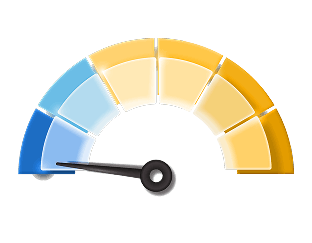
The India VIX usually moves within a specific range. In normal times, it tends to stay between 11 and 17. But when market uncertainty increases, the India VIX might jump much higher.

Here’s how it’s generally understood:

Rising India VIX: When the India VIX goes up, it indicates that investors may be more nervous or fearful. This often happens when the market is falling or swinging sharply, as people rush to buy options to mitigate risk. A higher VIX means the market expects bigger price movements in the Nifty.

Falling India VIX: When the India VIX goes down, it shows investors are more relaxed and confident. This usually happens when the market is stable or rising, as investors are more open to taking risks.

Usually, the India VIX and the Nifty 50 move in opposite directions when the VIX rises, the Nifty 50 tends to fall and when the VIX drops, the Nifty 50 often climbs. However, this might not always be true. During special situations like the Union Budget or RBI policy announcements, the market might move one way while the India VIX stays high because traders expect big moves in the near future.

Historical instances of high India VIX and market reactions

The global financial crisis (2008–09)

When India VIX was introduced back in 2008, the world was experiencing a financial crisis. During this period, India VIX soared amid panic owing to recession fears. Stock prices fell and investors’ confidence hit record lows.

The COVID-19 pandemic (2020)

India VIX reached spiked once again way in 2020 when the world was grappling with COVID-19. It was one of the biggest global challenges and the spike in India VIX was triggered by fears of a prolonged lockdown, halted production and economic contradiction. During this period, Indian equity markets witnessed sharp declines, with the Nifty 50 dropping significantly in March, 2020.

Geopolitical events and policy shocks

India VIX has also experienced sudden short-term spikes during geopolitical events and policy changes. Events such as the Russia-Ukraine conflict in 2022, sudden changes in crude oil prices and domestic elections have caused short-term spikes in the India VIX. Each of these events brought uncertainty about trade flows, inflation, and interest rates.

How to stay rational when India VIX spikes

Focus on long-term goals

Volatility may affect short-term prices but might not impact the long-term potential of fundamentally sound investments. Revisiting your investment goals and time horizon may help you avoid panic-driven decisions.

Diversify your portfolio

Diversification is a key risk management strategy. Spreading your investments across asset classes such as equity, debt and gold might help mitigate the impact of short-term fluctuations.

Continue systematic investments

Systematic Investment Plans (SIPs) are a convenient tool that may help investors mitigate risks of volatility and average out the cost of investment. Monthly or quarterly investment in SIPs might be simple, effective and affordable.

Seek professional advice

It is always advisable to consult a qualified financial adviser, who may help you make objective decisions based on data rather than emotions.

Read Also: Market Sentiment Analysis and its Impact on Mutual Funds

Conclusion

The India VIX can serve as a valuable indicator of market sentiment and volatility expectations. It reflects the collective emotions of investors—fear, uncertainty, or calm—and provides insight into how market participants might perceive near-term risks. When the India VIX spikes, it may not necessarily mean the market will dip; it only indicates heightened uncertainty.


At Bajaj Finserv AMC, we recognise that emotions are the cornerstone of investor behaviour – not just for investors but for investment professionals too. That’s why, behavioural finance is at the heart of our investment philosophy, InQuBe, which combines the Information Edge, Quantitative Edge and Behavioural Edge. By understanding, tracking and monitoring market sentiments and our own investment biases, we seek to make mindful and strategic investment decisions. Get the Behavioural edge by investing with Bajaj Finserv AMC. Read more about InQuBehere.

Start an SIP

Every long-term goal begins with a simple step. Explore mutual funds from Bajaj Finserv AMC and choose between equity, debt, hybrid and passive funds. Start an SIP to invest regularly, build consistency, and potentially achieve your financial goals.

Get A Call Back

Want help planning your investments?

Share your details and our experts will guide you.

By submitting my details, I agree to receive a call from
Bajaj Finserv AMC for assistance.

Grow wealth with mutual funds

Must Read

28-Understanding-the-risks-and-benefits-of-SIP
Risks and Benefits of Systematic Investment Plan (SIP)

Investing in SIPs has gained immense popularity over the years.

What are Flexi Cap Funds? Features, Benefits & How it Works

Flexi cap mutual funds belong to the equity mutual fund

investor-behaviour-impact-market-conditions
How does investor behaviour impact market conditions?

The financial market is heavily influenced by investor sentiment. Emotion,

Calculators

FAQs

Fund Collections

Disclaimer

Mutual Fund investments are subject to market risks, read all scheme related documents carefully. This document should not be treated as endorsement of the views/opinions or as investment advice. This document should not be construed as a research report or a recommendation to buy or sell any security. This document is for information purpose only and should not be construed as a promise on minimum returns or safeguard of capital. This document alone is not sufficient and should not be used for the development or implementation of an investment strategy. The recipient should note and understand that the information provided above may not contain all the material aspects relevant for making an investment decision. Investors are advised to consult their own investment advisor before making any investment decision in light of their risk appetite, investment goals and horizon. This information is subject to change without any prior notice. The content herein has been prepared on the basis of publicly available information believed to be reliable. However, Bajaj Finserv Asset Management Ltd. does not guarantee the accuracy of such information, assure its completeness or warrant such information will not be changed. The tax information (if any) in this article is based on prevailing laws at the time of publishing the article and is subject to change. Please consult a tax professional or refer to the latest regulations for up-to-date information.

Login/Signup