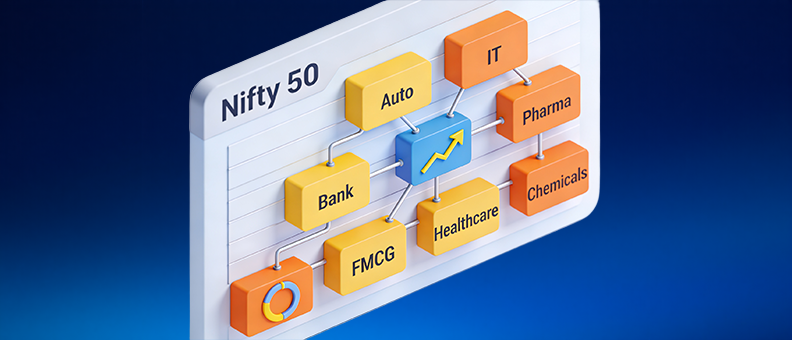
The Nifty 50 provides exposure to 50 large and liquid companies listed on the National Stock Exchange of India (NSE). Its constituents represent several important sectors of the economy, which makes the index more diversified than an investment in a single company or sector.
However, diversification should not be confused with capital protection. The Nifty 50 is an equity index, and its value can fall sharply during market corrections, recessions and periods of global uncertainty. A fund that tracks the index carries the same broad equity-market risk, along with costs and the possibility of tracking difference.
The answer to the question, “Is the Nifty 50 safe during market volatility?”, depends on what an investor means by “safe”. It may reduce company-specific risk compared with holding one or two stocks, but it cannot prevent losses or guarantee recovery within a particular period.
Table of Contents
What does a safe investment really mean?
Investment safety can refer to several different things: protection of the original capital, stability of value, certainty of income, liquidity or a lower probability of default. No single investment offers all these features in equal measure.
Fixed deposits generally offer a predetermined rate of interest, subject to the terms of the deposit. Market-linked investments such as equity mutual funds do not provide fixed or assured returns. Their value changes according to the prices of the securities held by the scheme.
The Nifty 50 can reduce the impact of poor performance in one company by spreading exposure across 50 constituents. However, diversification within equities cannot protect the portfolio from a broad market decline. If most large cap stocks fall together, the index can also decline considerably.
Returns on fixed deposits/savings accounts are fixed, however, returns on mutual funds are subject to market risks.
Key Takeaways
- The Nifty 50 spreads exposure across 50 large and liquid stocks, but it remains subject to equity-market risk.
- Market crashes can cause substantial short-term declines in the index, and the timing of a recovery cannot be predicted.
- A longer horizon provides more time to remain invested through market cycles, but it does not guarantee positive returns.
- Investing through an SIP may reduce dependence on a single entry point, although it cannot protect an investor from losses.
- Suitability depends on the investor’s goal, horizon, asset allocation, liquidity requirements and ability to withstand declines.
Understanding Nifty 50 risk
The Nifty 50 is widely diversified within the large cap segment, but investors remain exposed to several risks:
- Market risk: Economic weakness, geopolitical events, changes in interest rates or widespread selling can cause most constituent stocks to decline together.
- Concentration risk: The index is weighted by free-float market capitalisation. Larger constituents and heavily represented sectors can therefore have a greater effect on its movement.
- Valuation risk: Investing when market valuations are elevated can affect subsequent returns, particularly over shorter periods.
- Sector risk: Changes affecting a major sector can influence several constituents at the same time.
- Liquidity risk at the fund level: The underlying Nifty 50 stocks are generally liquid, but ETF trading volumes and bid-ask spreads can vary.
- Tracking difference: An index fund or ETF may not deliver exactly the same return as its benchmark because of expenses, cash holdings, taxes and portfolio-rebalancing requirements.
- Behavioural risk: Investors may convert a temporary market decline into a permanent loss by redeeming during panic without considering their goal or asset allocation.
NSE Indices states that the Nifty 50 represented approximately 53.73% of the free-float market capitalisation of stocks listed on the NSE as of 30 March 2026. It is calculated using a free-float market-capitalisation-weighted methodology.
Source: NSE Indices overview of the Nifty 50.
Why investors consider a Nifty 50 index fund
A Nifty 50 index fund seeks to replicate the composition and performance of the Nifty 50, subject to expenses and tracking difference. Investors may consider such a fund for the following reasons:
- Diversified large cap exposure: A single investment provides exposure to 50 companies from different sectors.
- Rules-based portfolio: Constituents are selected and reviewed according to a published index methodology.
- Lower dependence on individual stock selection: Investors do not need to identify and monitor each constituent separately.
- Transparent holdings: The benchmark’s constituents and weights are published and periodically updated.
- Generally lower portfolio turnover: Passive funds usually trade to reflect index changes and investor flows rather than frequent active investment calls.
- Accessibility: Depending on the scheme, investors may invest through a lumpsum contribution or an SIP.
These features do not make the investment risk-free. The fund follows the index during both rising and falling markets and does not move into cash merely because market conditions become uncertain.
Nifty 50 during market crashes: The COVID-19 example
The COVID-19 sell-off shows how quickly the Nifty 50 can decline even though it consists of large and liquid companies. Based on Nifty 50 price index closing levels published by the NSE:
| Date | Nifty 50 closing level | What happened |
| 14-Jan-20 | 12,362.30 | Pre-crash reference high |
| 23-Mar-20 | 7,610.25 | Lowest closing level during the COVID-19 sell-off |
| 09-Nov-20 | 12,461.05 | Index moved above the January reference level |
| 31-Dec-20 | 13,981.75 | Calendar-year closing level |
Between 14 January and 23 March 2020, the index declined by approximately 38.4%. On 23 March alone, it fell by approximately 13% from the previous trading day’s close.
The subsequent recovery was also sharp. By 9 November 2020, the index had moved above its 14 January closing level. It ended 2020 approximately 14.9% above its closing level on 31 December 2019.
This period highlights two sides of market volatility. An investor who redeemed near the March low would have realised a substantial loss, while one who remained invested participated in the recovery. However, the speed of the 2020 recovery should not be treated as a template for future market crashes. A later decline may be deeper or take much longer to recover.
The figures refer to the Nifty 50 price index and do not include dividends, fund expenses, tracking difference or taxes. Returns earned through an index fund would also depend on the investor’s purchase and redemption dates.
Source: NSE Nifty 50 index information and historical data.
Past performance may or may not be sustained in future.
How volatile is the Nifty 50?
The Nifty 50 consists of large and actively traded stocks, but its daily and periodic returns can still fluctuate significantly. During a broad market correction, diversification across 50 companies may provide limited protection because correlations between equity stocks can rise.
The index may generally be less volatile than a single stock, a narrowly focused sector index or some mid cap and small cap indices. This is a relative comparison, not an assurance of stability.
Volatility also differs from permanent loss. Prices may fluctuate and later recover, but recovery is not certain within the investor’s required timeframe. A person investing for a goal due in two years faces a different level of practical risk from someone investing for a goal that is more than a decade away.
Is the Nifty 50 suitable for long-term investing?
The Nifty 50 may be considered for long-term goals by investors who understand equity risk and can withstand periods of substantial decline. Its 50 constituents provide exposure to established companies across several parts of the economy, while semi-annual reconstitution allows the index to reflect changes in the eligible large cap universe.
NSE Indices schedules Nifty 50 reconstitution semi-annually, with changes becoming effective on the last working day of March and September. Reconstitution helps maintain the index according to its selection rules, but it does not ensure that every new constituent will perform well.
A longer investment horizon may provide more time for earnings growth and compounding and allow an investment to pass through different market cycles. It does not guarantee that the investment will earn a positive return or meet a financial goal.
Source: NSE Indices reconstitution calendar.
Past performance may or may not be sustained in future.
Who may consider investing in the Nifty 50?
A Nifty 50 index fund may be considered by investors who:
- Are investing towards a long-term financial goal
- Can accept fluctuations in the value of their investment
- Prefer diversified exposure to the large cap segment
- Want a rules-based passive investment approach
- Understand that returns will broadly follow the index before expenses and tracking difference
- Have sufficient liquidity outside the investment for near-term expenses
It may be less suitable for investors who:
- Require guaranteed returns or capital protection
- Need the invested money for a near-term goal
- Are likely to redeem after a sharp market decline
- Already have considerable exposure to the same large cap stocks through other schemes
- Require an investment with low short-term volatility
There is no prescribed minimum holding period that makes a Nifty 50 investment safe. The suitable horizon depends on the investor’s goal, financial circumstances, asset allocation and risk tolerance.
When should you invest in a Nifty 50 index fund?
There is no guaranteed entry point, so the timing should reflect the investor’s financial circumstances rather than a short-term market forecast:
- Purpose of the investment: The investment should be linked to a clearly defined financial goal.
- Time available: The horizon should allow the investor to remain invested through periods of market volatility.
- Capacity to absorb losses: Investors should consider whether they can withstand a substantial decline without redeeming prematurely.
- Existing equity exposure: Current investments in equities and large cap funds should be reviewed to avoid excessive concentration or portfolio overlap.
- Emergency savings: Adequate accessible savings may reduce the need to redeem the investment during a market downturn.
- Source of the investment amount: Investors contributing from regular income may consider an SIP, while those with a lumpsum may compare immediate investment with phased deployment.
- Market timing: Waiting indefinitely for a lower index level can delay investing, while investing before a correction can result in a short-term loss.
Neither an SIP nor a lumpsum investment is assured to produce the better outcome. The appropriate approach depends on the investor’s goal, horizon, cash flow and comfort with near-term volatility.
How to manage risk while investing in the Nifty 50
Risk cannot be removed from an equity investment, but it can be managed within a broader financial plan:
- Use an appropriate asset allocation: Combine equity exposure with suitable debt, cash or other assets based on the goal and risk appetite.
- Match the investment to the goal: Avoid relying on equity investments for money required at short notice.
- Invest gradually where appropriate: An SIP spreads purchases across different market levels and reduces dependence on one entry date.
- Maintain emergency savings: Accessible reserves can reduce the need to redeem investments during a market decline.
- Check portfolio overlap: Holding several large cap or Nifty 50-linked funds may not provide meaningful additional diversification.
- Review tracking difference and expenses: These factors affect how closely an index fund follows its benchmark.
- Rebalance periodically: Market movements can cause equity exposure to move away from the intended asset allocation.
- Review the Riskometer: The scheme’s Riskometer and benchmark Riskometer can help investors understand the stated risk level.
An SIP does not assure profits or protect against losses in declining markets. It changes the timing of investments, not the risk of the underlying securities.
Nifty 50 index funds versus other investment options
Different investments serve different purposes and should not be compared solely on returns:
| Investment option | Return structure | Capital protection | Liquidity and horizon |
| Nifty 50 index fund | Market-linked | Not guaranteed | Generally suited to longer horizons |
| Bank fixed deposit | Interest fixed according to deposit terms | Subject to bank and deposit-insurance considerations | Depends on tenure and premature-withdrawal terms |
| Public Provident Fund | Government-declared interest | Government-backed | Long lock-in with limited withdrawal facilities |
| Gold or gold ETF | Market-linked | Not guaranteed | Liquidity depends on the form of investment |
| Debt mutual fund | Market-linked | Not guaranteed | Risk and horizon vary by scheme category |
A Nifty 50 index fund may offer equity-market participation but can experience substantial fluctuations. Fixed deposits and PPF provide greater certainty over the applicable return structure, while gold and debt mutual funds carry their own market, credit, interest-rate and liquidity risks.
The appropriate choice depends on the goal, required liquidity, time horizon, taxation and ability to accept losses. Investors may also use more than one asset class rather than treating these options as direct substitutes.
Returns on fixed deposits/savings accounts are fixed, however, returns on mutual funds are subject to market risks.
Conclusion
The Nifty 50 is diversified across 50 large and liquid stocks, but it is not a safe investment in the sense of guaranteeing capital or returns. Its value can decline significantly during a market crash, recession or period of economic uncertainty.
For investors with a suitable horizon and risk appetite, a Nifty 50 index fund can provide rules-based exposure to the large cap segment. An SIP, appropriate asset allocation, emergency savings and periodic rebalancing may help manage investment risk, but none of these measures can prevent market-linked losses.
The decision should be based on the investor’s financial goal and ability to remain invested through volatility rather than an assumption that large cap stocks cannot fall.
FAQs
Is the Nifty 50 a safe investment for beginners?
The Nifty 50 can provide beginners with diversified exposure to 50 large and liquid stocks, but it does not protect their capital. Beginners should assess their investment horizon, asset allocation and ability to withstand market declines before investing.
Is the Nifty 50 safe for the long term?
The Nifty 50 remains market-linked even over the long term, so returns and capital are not guaranteed. A longer horizon provides more time to remain invested through market cycles but cannot ensure a favourable outcome.
Can you lose all your money in the Nifty 50?
A complete loss would require all 50 constituent companies to become worthless simultaneously, which is far less likely than the failure of one company. However, substantial declines are possible, and investors should not treat a total loss as the only measure of risk.
Is investing in the Nifty 50 better than a fixed deposit?
Neither is universally better. A Nifty 50 index fund offers market-linked equity exposure with the risk of loss, while a fixed deposit provides interest according to agreed terms and may be more suitable for investors prioritising greater return certainty.
What happens to the Nifty 50 during a recession?
The Nifty 50 may decline during a recession as investors revise expectations for company earnings and economic growth. The size and duration of the decline depend on the severity of the recession, valuations and wider market conditions.
Is an SIP in a Nifty 50 index fund suitable during volatile markets?
An SIP can spread investments across different market levels and reduce dependence on one entry date. It cannot prevent losses, guarantee a lower average cost or ensure that the index will recover.
How do I assess the risk of a Nifty 50 investment?
Review your financial goal, time horizon, equity allocation, liquidity needs and ability to withstand a substantial decline. For an index fund, also examine the Riskometer, tracking difference, expense ratio and portfolio overlap.
How long should I stay invested in a Nifty 50 index fund?
There is no mandatory period that guarantees returns. The investment should be held for a horizon consistent with an equity-oriented goal and reviewed as the goal approaches or the investor’s circumstances change.
Should I invest in the Nifty 50 during a market correction?
A correction can offer a lower entry level, but prices may continue to fall and recovery may take time. Any investment should remain consistent with the investor’s goal, horizon, asset allocation and risk appetite.
Does the Nifty 50 always recover after a market crash?
The Nifty 50 has recovered from past market crashes over different periods, but past recoveries do not guarantee the timing or extent of a future recovery.
Can a Nifty 50 index fund underperform the Nifty 50?
Yes. Expenses, cash holdings, taxes, transaction costs and portfolio-rebalancing factors can cause an index fund’s return to differ from the benchmark. Investors can compare tracking difference when evaluating funds.