

Prices rarely move in a straight line. They may speed up, slow down or change direction as market momentum changes. The Moving Average Convergence Divergence, commonly called MACD, helps traders compare recent price momentum with the longer-term trend.
By presenting this relationship through two lines and a histogram, the indicator can make changes in momentum easier to observe. This article explains how MACD is calculated, what its different components mean and how traders commonly interpret its signals.
Table of Contents
What is MACD?
MACD stands for Moving Average Convergence Divergence. It is a trend-following momentum indicator developed by Gerald Appel. It compares two exponential moving averages, or EMAs, to show how shorter-term price momentum is behaving in relation to longer-term momentum.
The standard MACD uses:
- A 12-period EMA to represent relatively recent price movement
- A 26-period EMA to represent the longer price trend
- A 9-period EMA of the MACD line as the signal line
The MACD line is calculated by subtracting the 26-period EMA from the 12-period EMA. The MACD line and signal line are then plotted together, usually with a histogram showing the difference between them.
Unlike RSI, MACD does not move within a fixed range. Its value changes according to the price and movement of the asset being analysed.
Key Takeaways
- MACD is a trend-following momentum indicator that compares shorter-term price movement with the longer-term trend.
- The standard MACD line subtracts the 26-period exponential moving average from the 12-period exponential moving average.
- Its signal line and histogram help show whether momentum may be strengthening, weakening or moving towards a crossover.
- Traders commonly study signal-line crossovers, zero-line movement and divergence between MACD and the asset’s price.
- MACD uses historical price data and may give delayed or repeated signals, particularly when the market is moving sideways.
Why is it called Moving Average Convergence Divergence?
The name describes how the shorter and longer exponential moving averages behave in relation to each other. They converge when the gap between them narrows and diverge when it widens. This changing distance causes the MACD line to move towards or away from zero.
An exponential moving average gives more weight to recent prices than a simple moving average. This makes MACD more responsive to recent price changes, although it still relies on historical data.
MACD line, signal line and histogram explained
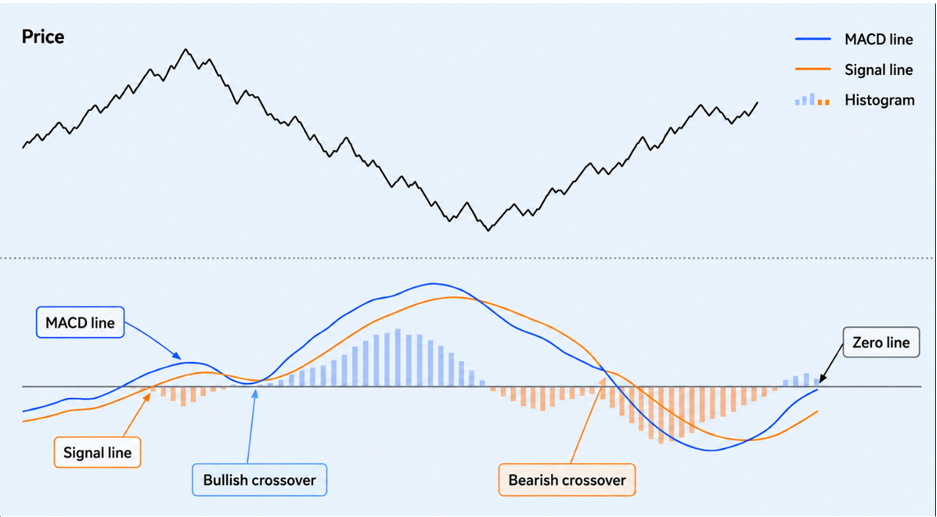
The MACD tool contains three connected components. Each presents a different part of the momentum picture:
MACD line
The MACD line is the difference between the 12-period EMA and the 26-period EMA. It reacts more quickly to recent price changes than the signal line. A MACD value above zero means the 12-period EMA is above the 26-period EMA. A value below zero means the shorter EMA is below the longer EMA.
Signal line
The signal line is generally a 9-period EMA of the MACD line. Because it smooths the MACD readings, it moves more gradually than the MACD line. Traders compare the two lines to observe whether recent momentum may be strengthening or weakening relative to its recent average.
MACD histogram
The histogram shows the difference between the MACD line and the signal line:
MACD histogram = MACD line − Signal line
The histogram is above zero when the MACD line is above the signal line and below zero when the MACD line is below it. Expanding or contracting bars help show whether the distance between the lines is widening or narrowing.
How MACD is calculated
The formula for calculating MACD is as follows:
- Calculate the 12-period EMA from the asset’s closing prices.
- Calculate the 26-period EMA from the asset’s closing prices.
- Subtract the 26-period EMA from the 12-period EMA to get the MACD line.
- Calculate a 9-period EMA of the MACD line to get the signal line.
- Subtract the signal line from the MACD line to get the MACD histogram.
How to interpret MACD signals
MACD readings describe changes in the relationship between shorter-term and longer-term momentum. Traders commonly examine signal-line crossovers, the zero line, the histogram and divergence:
MACD line and signal line crossover
When the MACD line crosses above the signal line, it may indicate that upward momentum is strengthening relative to its recent average. This is commonly described as a bullish crossover.
When the MACD line crosses below the signal line, downward momentum may be strengthening, or upward momentum may be weakening. This is commonly described as a bearish crossover.
A crossover reflects a change in momentum. It does not, by itself, establish that the price trend will continue or reverse.
Zero-line crossover
The zero line represents the point at which the 12-period and 26-period EMAs have the same value.
- Crossing above zero: The 12-period EMA has moved above the 26-period EMA. This may suggest a change towards upward momentum.
- Crossing below zero: The 12-period EMA has moved below the 26-period EMA. This may suggest a change towards downward momentum.
Because a zero-line crossover occurs only after the two moving averages have changed position, it can appear after a price movement has already begun.
MACD histogram
The histogram helps show how the relationship between the MACD and signal lines is changing:
- Bars moving further above zero show that the MACD line is pulling further above the signal line.
- Bars moving further below zero show that the MACD line is moving further below the signal line.
- Bars contracting towards zero show that the distance between the two lines is narrowing, which may precede a crossover.
The histogram shows how the difference between the MACD and signal lines is changing, rather than the size of the price movement itself.
Can MACD settings be changed?
The 12-period EMA, 26-period EMA and 9-period signal line are standard MACD settings, but traders can adjust them for different timeframes and strategies. Shorter settings respond more quickly to price changes but may produce more frequent false signals. Longer settings move more gradually and may identify broader trends, though signals can appear later.
No setting works consistently across every asset or market condition. The selected periods should therefore be tested against the asset, timeframe and trading approach being used.
Bullish vs bearish MACD divergence
Divergence occurs when the price and MACD move in different directions. It may indicate that the momentum behind the prevailing price trend is changing.
Bullish MACD divergence: The price forms a lower low while MACD forms a higher low. This may suggest that downward momentum is weakening, even though the price has continued to fall.
Bearish MACD divergence: The price forms a higher high while MACD forms a lower high. This may suggest that upward momentum is weakening, even though the price has continued to rise.
Divergence does not establish when or whether a reversal will occur. It is generally interpreted alongside the price trend and other market information.
How MACD may respond to a rapid price rise or fall
During a rapid price rise, the 12-period EMA may move upward faster than the 26-period EMA, causing the MACD line to rise. If the MACD line also moves above and further away from the signal line, the histogram may expand above zero. This may suggest that upward momentum is increasing.
During a rapid price fall, the shorter EMA may decline faster than the longer EMA, causing the MACD line to fall. If the MACD line moves below and further away from the signal line, the histogram may expand below zero. This may suggest increasing downward momentum.
If the pace of the price movement begins to slow, the histogram may start contracting even before the price changes direction. This can help traders observe that momentum may be easing, but it does not establish what the price will do next.
How do traders use MACD?
A practical advantage of MACD is that it brings information about trend direction and momentum into one view. Traders commonly use it to:
- Observe trend direction: The position of the MACD line relative to zero can indicate whether the shorter EMA is above or below the longer EMA.
- Monitor momentum changes: Signal-line crossovers and histogram movements may help traders assess whether momentum is strengthening or weakening.
- Identify possible turning points: Divergence between price and MACD may draw attention to a trend that is losing momentum.
- Add context to other analysis: MACD readings can be compared with price patterns, trading volume, support and resistance levels or other indicators.
- Review different timeframes: The indicator can be applied to daily, weekly or intraday charts, although its readings will reflect the timeframe selected.
These uses help organise technical observations. The meaning of a MACD reading still depends on the wider price trend and market conditions.
Limitations of MACD
MACD can help traders organise information about momentum and trend direction, but it also has important limitations:
- It uses past price data: Because MACD is calculated from moving averages, a signal may appear only after a price move has begun.
- Sideways markets can produce repeated crossovers: When prices move within a narrow range, the MACD and signal lines may cross frequently without a lasting trend developing.
- It does not consider fundamental information: MACD does not account for company performance, valuation, market news or economic conditions.
- Readings depend on the selected timeframe: A bullish reading on one timeframe can appear alongside a bearish reading on another.
- Rapid price movements can make signals difficult to interpret: Sharp changes can cause the lines and histogram to move quickly before the broader trend becomes clear.
- Divergence may persist: Price and MACD can continue moving differently for some time without a reversal taking place.
For this reason, traders commonly interpret MACD alongside the price trend, volume and other relevant information.
Past performance may or may not be sustained in future.
MACD vs Relative Strength Index (RSI)
MACD and the Relative Strength Index are both momentum indicators, but they answer different questions. MACD examines the relationship between moving averages, while RSI measures the speed and magnitude of recent price changes:
| Feature | MACD | RSI |
| Type of indicator | Trend-following momentum indicator | Momentum oscillator |
| Main focus | Relationship between shorter and longer moving averages | Speed and magnitude of recent price changes |
| Components | MACD line, signal line and histogram | A single line moving between 0 and 100 |
| Standard calculation | Difference between the 12-period and 26-period EMAs, with a 9-period signal line | Average gains and losses, commonly measured over 14 periods |
| Range | No fixed upper or lower limit | Fixed range from 0 to 100 |
| Common readings | Signal-line crossovers, zero-line crossovers, histogram changes and divergence | Overbought or oversold readings, centre-line movement and divergence |
| Typical context | Often examined when assessing trend direction and changes in momentum | Often examined when assessing whether a price move may be becoming extended |
| Key limitation | Can produce repeated crossovers in sideways markets | Overbought or oversold readings do not necessarily mean an immediate reversal |
Neither indicator is more accurate in every market condition. Some traders examine both because they present momentum from different perspectives.
Conclusion
MACD converts the relationship between shorter and longer exponential moving averages into two lines and a histogram. Signal-line crossovers, zero-line movement, histogram changes and divergence can help traders observe how momentum is changing.
The indicator is based on historical prices, so its readings may appear after a move has begun and can become less clear in sideways markets. The key is to understand what each reading suggests within the wider price trend, rather than treating a crossover or divergence as a definite trading instruction.
FAQ’s
What is MACD full form?
MACD stands for Moving Average Convergence Divergence. It is a momentum based technical indicator developed by Gerald Appel. The indicator compares short term and long term exponential moving averages to identify changes in trend strength, direction, and momentum, helping traders analyse potential market movements systematically.
What is a MACD indicator?
The MACD indicator is a trend-following momentum tool that calculates the difference between a short-term EMA (usually 12 days) and a long-term EMA (usually 26 days) of a security’s price.
How do you use the MACD indicator?
The MACD indicator is used to analyse momentum and trend direction by comparing two moving averages. Traders observe MACD line crossovers, signal line movements, and histogram changes to interpret potential trend shifts. It is generally used along with other indicators and risk management, not as a standalone decision tool.
What is MACD divergence?
MACD divergence occurs when price and MACD move in opposite directions. For example, if price makes a higher high but MACD forms a lower high, it may suggest weakening momentum and a possible trend reversal.
What is the MACD signal for buy?
A commonly observed signal occurs when the MACD line crosses above the signal line, indicating potential upward momentum. Traders may also watch for histogram expansion or divergence confirmation. However, such signals do not guarantee outcomes and are typically validated with price action, trend analysis, and prudent risk management.
Is MACD a leading or lagging indicator?
MACD is generally classified as a lagging indicator because it is derived from moving averages based on past price data. It reacts to established trends rather than predicting future movements. Some divergence patterns may appear earlier, but outcomes remain uncertain and require confirmation from additional analysis tools.
Is MACD a reliable indicator?
MACD is commonly used to observe trend direction and momentum, but no technical indicator is consistently reliable across all market conditions. Its readings can become less clear in sideways markets or during frequent price fluctuations. Traders may compare MACD with price action, volume and other indicators to gain additional context.
Is MACD suitable for beginners?
MACD may be suitable for beginners who want to understand how shorter-term momentum compares with a longer-term trend. Its three components are relatively straightforward once their relationship is understood. New users can begin by observing the indicator across different market conditions before interpreting individual crossovers.
How can MACD be used with other indicators?
MACD may be examined alongside RSI, volume, support and resistance levels or price patterns. RSI can provide information about the pace of a price move, while volume may help show the level of market participation. Using different indicators provides additional context, although their signals may not always agree.
Can MACD be used for intraday trading?
MACD can be applied to intraday charts to analyse shorter-term momentum. However, shorter timeframes may contain more market noise and produce frequent crossovers. Traders may therefore examine the broader price trend, volume and risk parameters when interpreting intraday MACD readings.
What is a suitable MACD value?
There is no fixed MACD value considered universally suitable. Interpretation depends on market context, timeframe, and asset behaviour. Positive MACD values indicate upward momentum, while negative values suggest downward momentum. Traders may combine MACD readings with volume, support resistance levels, and broader analysis before taking trading decisions.
What do 12, 26 and 9 mean in MACD?
The numbers represent the standard periods used to calculate MACD. The 12-period and 26-period exponential moving averages form the MACD line, while a 9-period exponential moving average of that line forms the signal line.
What is the best MACD setting?
There is no single ‘best’ MACD setting that works in every situation. Shorter settings react faster but may generate more false signals, while longer settings respond more slowly and may suit broader trend analysis. The choice depends on the asset, timeframe and trading approach.
Our Calculators