
If you have ever heard the term ‘timing the market’, you may wonder how investors do it. This strategy involves predicting the upward or downward direction of the market and making investment decisions accordingly. But ‘timing the market’ is not just a gut feeling; experienced investors use different tools to find the general sentiment of the market before reacting. And Market Mood Index is one of the popular sentiment-analysis tools used by investors in India.
Table of contents
- What is the market mood index (MMI) and how does it work?
- Understanding market mood index (MMI) zones: From extreme fear to extreme greed
- Market mood index trends and their interpretation
- Zones of market mood index: The 5 components of MMI
- Practical examples of market mood index in the Indian market
- Factors to take into account before using market mood index (MMI)
- Advantages of using the market mood index for investors
- Limitations and factors to consider when using the market mood index
- What are the alternatives to market mood index?
- Market mood index vs other sentiment tools
- How to use the market mood index in your investment strategy
What is the market mood index (MMI) and how does it work?
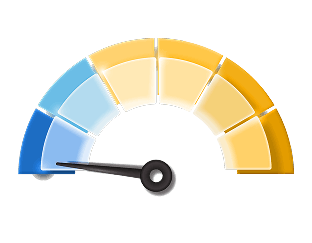
MMI is a tool that reflects the overall outlook and emotional sentiment prevailing in the market. MMI is commonly represented on a scale of 0-100 where values ranging from 0-49 indicate bearish (negative) sentiment, 50 indicates neutrality and 51-100 indicate bullish (positive) sentiment.
Investors can use MMI in addition to other tools for fundamental and technical analysis to understand the overall market sentiment. They can make decisions about buying, selling, or holding investments based on whether the market is feeling bullish or bearish since the goal is to buy low and sell high.
It is important to note that the market mood index is a sentiment-based framework rather than a formally regulated or exchange-published index. It is used to gauge prevailing investor psychology and should be interpreted as an indicative tool.
Understanding market mood index (MMI) zones: From extreme fear to extreme greed
Rather than measuring fundamentals or valuations, MMI tracks emotional patterns such as fear, caution, optimism, and greed. These emotions can influence short-term market movements and decision-making, making MMI a sentiment-based reference tool rather than a return or valuation metric.
MMI is typically divided into zones that represent different sentiment states. The extreme fear zone reflects heightened pessimism, where investors may react strongly to negative news or uncertainty. The fear and cautious zones indicate improving sentiment, though confidence may still be limited. Neutral represents a balanced phase where neither fear nor optimism dominates. The greedy and extreme greed zones reflect rising confidence and optimism, where risk-taking behaviour may increase.
MMI may be used to:
- Understand prevailing market sentiment
- Identify emotionally driven market phases
- Support disciplined portfolio review discussions
- Avoid reactive decisions during sentiment extremes
Market mood index trends and their interpretation
Some of the key MMI trends that can be used to interpret MMI are:
- Bullish trends: When the MMI stays in the “greed zone” for an extended period, it often signals that the market is on an upward trajectory, driven by optimism, strong earnings, or positive economic indicators.
- Bearish trends: A sustained bearish sentiment, where the MMI remains in the “fear zone”, can indicate that the market is in a downturn. This can be triggered by economic slowdowns, political instability, or negative global events.
- Neutral trends: When the value of MMI stays around 50, it suggests market indecision. In these periods, the market may not be trending strongly in either direction and investor sentiment may be waiting for new information, such as earnings reports or economic data releases, to push the market in one direction.
Zones of market mood index: The 5 components of MMI
The five main Market Mood Index zones representing a different level of market sentiment are:
- Extreme fear (Value 0-30): The extreme fear zone, as the name suggests, signals that investors are very nervous because the market is likely experiencing a sell-off.
- Fear (Value 30-50): The fear zone of the Market Mood Index indicates that investors are cautious because the market is uncertain but not panicked. Many traders may be holding off on big investment moves.
- Neutral (Value 50): The neutral MMI zone represents a state where the market is balanced and stable. The market is showing no clear trend as it is moving sideways.
- Greed (Value 50-70): This zone signals that investors are more willing to take risks, which often drives up prices. While opportunities exist for finding good investments, there is a risk of overpaying.
- Extreme greed (Value 70-100): Consider this as the red flag zone in the Market Mood Index, meaning it is recommended to avoid making investments during this time because the prices are likely inflated.
Read Also: Price-to-Earnings (P/E) Ratio: Meaning, Uses and Formula
Practical examples of market mood index in the Indian market
During the 2017–2018 bull run in the Nifty, investor sentiment reflected strong optimism and risk appetite, often associated with a “greed” phase in market mood frameworks. Rising stock prices, sustained inflows, and elevated valuations suggested heightened confidence, with some segments showing signs of excess optimism.
In contrast, during the COVID-19–induced market crash, sentiment shifted sharply towards fear and risk aversion. Heightened uncertainty and panic selling led to sharp declines across indices, while investors gravitated towards perceived stable assets such as gold and government securities.
Factors to take into account before using market mood index (MMI)
If you want to use MMI to make investment decisions, you need to take these factors into consideration:
- Credibility of data used: The output of the MMI calculation is as good as the input parameters used. You must verify that the data sources used to calculate MMI are accurate and taken from credible sources.
- Real-time dynamics: A single announcement, social media activity or piece of news can change the market sentiment. Therefore, you must remember that MMI does not accurately reflect real-time market conditions.
- External factors: It is crucial to keep in mind that MMI can easily be influenced by external factors like economic data, geopolitical events, and global market trends.
- Additional analysis: MMI cannot be considered a reliable stand-alone indicator of the market sentiment. It has its pros and cons. You must use other tools for a complete analysis of market sentiment before making an investment decision.
Advantages of using the market mood index for investors
- Sentiment analysis: The Market Mood Index provides a quick snapshot of the market sentiment, helping investors gauge if the market is overly optimistic or fearful.
- Helps identify market trends: By tracking market sentiment, MMI can highlight potential market turning points. This can help investors to enter or exit positions at optimal times.
- Simplifies decision-making: MMI offers a clear, easy-to-understand indicator of market psychology that both novice and experienced investors can use to make informed decisions.
- Risk management: MMI helps investors avoid emotional decisions by understanding market sentiment and potential risks.
Read Also: India VIX – How Investors Can Prepare For Market Volatility
Limitations and factors to consider when using the market mood index
One key limitation is that sentiment indicators may remain in extreme zones for extended periods. Markets may continue rising even when MMI reflects greed, or remain subdued despite fear-driven sentiment. This means MMI does not provide signals on when sentiment-driven trends may reverse.
MMI is also influenced by short-term news flow and market volatility. Sudden global events, policy announcements, or geopolitical developments may temporarily shift sentiment without materially altering long-term fundamentals. Interpreting such movements without context may lead to reactive decisions.
Important factors to consider when using MMI include:
- MMI is not a timing or return prediction tool
- It does not account for individual company or sector fundamentals
- It should not replace asset allocation or risk assessment frameworks
- It reflects collective emotion, not long-term return potential
What are the alternatives to market mood index?
While you can gauge the general market sentiment by following social media trends, news and surveys, here are the two main alternatives to the Market Mood Index in India:
- Fear and greed index (FGI): It measures market sentiment through seven factors like stock momentum; volatility; safe-haven demand and so on, indicating whether investors are fearful or greedy.
- India VIX (Volatility Index): It tracks implied volatility in the Nifty 50 Index. India VIX Index reflects investor uncertainty and market risk. A higher value indicates more fear in the market and a lower value indicates stability in the market.
Market mood index vs other sentiment tools
Sentiment tools are designed to capture how investors feel about the market at a given point in time. The market mood index (MMI) is one such indicator, but it differs in structure and interpretation from other commonly referenced sentiment measures used in the Indian market.
MMI focuses on behavioural patterns by mapping emotions such as fear, caution, neutrality, and greed into clearly defined zones. Its primary purpose is to highlight emotional extremes in the market. This makes it easier to interpret sentiment in a broad, intuitive manner, particularly for retail investors seeking a high-level view of market psychology.
Other sentiment tools often rely on specific data points. For example, volatility indices reflect expected market volatility, while put-call ratios are derived from derivatives positioning. Fund flow data indicates where institutional or retail money is moving. These tools are more data-driven and may require deeper interpretation, as they reflect positioning or expectations rather than emotions directly.
How to use the market mood index in your investment strategy
One practical way to use MMI is as a context-setting tool during portfolio reviews. When markets move sharply, MMI may help investors identify whether price movements are being driven more by sentiment than by changes in fundamentals. This awareness may support calmer, more disciplined decision-making, particularly during volatile phases.
MMI may be integrated into an investment approach by:
- Using it to understand market sentiment during reviews, not to predict returns
- Combining it with fundamentals, valuations, and asset allocation analysis
- Using it as a reminder to stay aligned with risk appetite and time horizon
- Avoiding changes based solely on sentiment readings
Read Also: Fear & Greed Index: What It Is and How It Works?
Conclusion
The Market Mood Index is a useful tool for understanding market sentiment, offering insights into investor emotions. While it helps identify trends and potential turning points, it should not be used in isolation. Investors should consider other factors along with MMI for well-rounded decision-making.
Frequently Asked Questions
Are the fear and greed index and the market mood index the same?
While both Fear and Greed Index and MMI aim to measure investor sentiment and market emotions, they differ in terms of their methodology and specific focus. The Fear and Greed Index is a specific tool aimed at measuring the short-term emotional sentiment in the market. MMI offers a broader analysis of the overall market sentiment.
Is the market mood index reliable for predicting market movements?
While MMI can be used as an indicator of market sentiment, it is not always a guaranteed predictor of future market movements. It should be used alongside other tools and analyses for more accurate decision-making.
How is the Market Mood Index (MMI) calculated?
The Market Mood Index is typically derived by combining multiple market and behavioural indicators—such as volatility levels, market breadth, derivatives positioning, trading activity, and investor flows—to assess overall sentiment. The exact inputs, weightages, and scoring methodology can vary across frameworks, making MMI an indicative sentiment gauge rather than a precise or regulated index.
Can the Market Mood Index predict market tops and bottoms?
Market Mood Index does not predict market tops or bottoms with certainty. It indicates prevailing sentiment, which may appear elevated near market peaks or depressed near downturns. However, sentiment can remain extreme for extended periods, making MMI unsuitable as a standalone timing indicator for precise market entry or exit decisions.
How does MMI differ from other sentiment indicators like the Fear and Greed Index?
The Market Mood Index (MMI) is a broad, illustrative framework used to understand overall investor sentiment. It does not follow a single standardised calculation method. In contrast, indicators like the Fear and Greed Index are typically platform-specific tools with defined data inputs. Both aim to capture market sentiment but are best used as supportive indicators rather than standalone decision tools.
Is MMI suitable for short-term trading or long-term investing?
Market Mood Index is primarily used as a sentiment reference rather than an investment decision tool. It may offer context for short-term market conditions but has limited relevance for long-term investing. Long-term decisions are better supported by fundamentals, valuation, diversification, and alignment with financial goals and risk appetite over time.
What are the limitations of relying solely on the Market Mood Index?
Relying solely on the Market Mood Index ignores fundamental analysis, valuation metrics, and macroeconomic factors. Sentiment indicators are inherently subjective and may lag actual market movements. MMI may also generate false signals during volatile periods, making it unsuitable as the only input for investment or trading decisions.