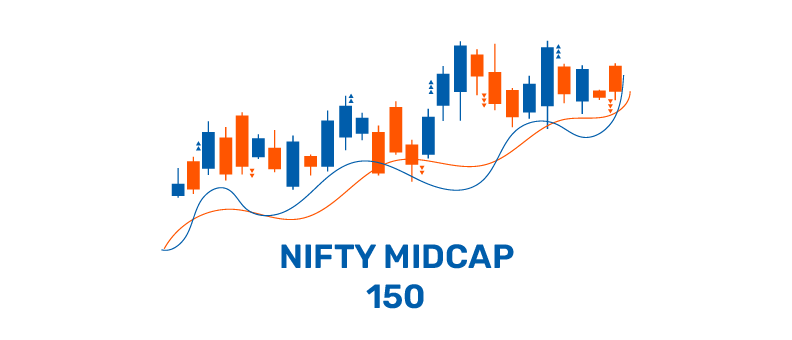
Mid cap companies sit between India’s largest listed businesses and the smaller companies further down the market. The Nifty Midcap 150 Index tracks 150 such companies, giving you a broad view of how this part of the equity market is performing.
The index represents companies ranked from 101 to 250 by full market capitalisation within the Nifty 500. This article explains how these companies are selected and weighted, how the index has performed and how investors can gain exposure through index funds and ETFs.
Table of Contents
What is the Nifty Midcap 150 Index?
The Nifty Midcap 150 is a broad-market index managed by NSE Indices. It represents the next 150 companies after the 100 largest companies within the Nifty 500, based on full market capitalisation.
The index is designed to measure the performance of India’s mid cap segment. It includes companies from several sectors, such as financial services, capital goods, healthcare, automobiles, technology and consumer businesses.
A company’s weight in the index depends on its free-float market capitalisation. This means a company with a larger publicly tradable market value generally has a greater influence on the index.
Key Takeaways
- The Nifty Midcap 150 represents 150 companies ranked from 101 to 250 by full market capitalisation within the Nifty 500.
- Constituent weights are based on free-float market capitalisation, so companies with a larger publicly tradable value have a greater influence.
- The index is reviewed semi-annually using data for the six-month periods ending January 31 and July 31.
- Investors cannot buy the index directly but can gain exposure through index funds and ETFs designed to track it.
- Mid cap stocks provide access to companies at an intermediate stage of growth but may experience sharper price movements than large cap stocks.
How is the Nifty Midcap 150 calculated?
The Nifty Midcap 150 is calculated using free-float market capitalisation. The calculation considers the value of shares available for public trading rather than every share issued by a company.
Companies with a higher free-float market capitalisation receive a greater index weight and have more influence on its movement.
Free-float market capitalisation = Share price × Outstanding shares × Investible Weight Factor
The Investible Weight Factor represents the proportion of a company’s shares considered available for public trading. Promoter holdings and certain strategic holdings are generally excluded.
The index value is calculated as follows:
Index value = Current free-float market capitalisation ÷ Base free-float market capitalisation × Base index value
Suppose a company has one lakh outstanding shares priced at ₹30 and an Investible Weight Factor of 0.60. Its free-float market capitalisation would be ₹18 lakh.
The figures shown are for illustrative purpose only
Source: NSE Indices, Methodology Document for Equity Indices, September 2026.
Features of the Nifty Midcap 150 Index
The structure of the index determines the companies it represents, how they are weighted and when its composition is reviewed.
- Market segment: The index represents companies ranked from 101 to 250 by full market capitalisation within the Nifty 500.
- Number of constituents: It contains 150 companies.
- Weighting method: Each constituent is weighted using free-float market capitalisation.
- Base date: The index has a base date of April 1, 2005.
- Base value: Its base value is 1,000.
- Launch date: The index was launched on April 1, 2016.
- Calculation frequency: The index is calculated in real time.
- Review frequency: It is rebalanced semi-annually.
- Return variant: Its total return version is called the Nifty Midcap 150 Total Return Index.
Source: NSE Indices, Nifty Midcap 150 Index factsheet, August 31, 2026.
Nifty Midcap 150 vs other Nifty midcap indices
NSE Indices maintains several midcap indices, but they differ in the number of companies they cover and the purpose they serve.
| Point of comparison | Nifty Midcap 150 | Nifty Midcap 100 | Nifty Midcap Select |
| Number of constituents | 150 | 100 | 25 |
| Stock universe | Companies ranked 101 to 250 within the Nifty 500 | Top 100 companies from the Nifty Midcap 150 | Selected liquid stocks from the Nifty Midcap 150 |
| Selection focus | Broad representation of the mid cap segment | Larger companies within the mid cap segment | Liquidity, market capitalisation and F&O availability |
| Weighting method | Free-float market capitalisation | Free-float market capitalisation | Free-float market capitalisation |
| Main use | Broad mid cap benchmark | Benchmark for a narrower mid cap portfolio | Underlying index for derivatives and other index-linked products |
The Nifty Midcap 150 offers the widest coverage among these three indices. The Nifty Midcap 100 covers a narrower group, while the Nifty Midcap Select focuses on 25 liquid mid cap stocks.
Source: NSE Indices, Nifty Midcap 150, Nifty Midcap 100 and Nifty Midcap Select factsheets, August 31, 2026.
How are companies selected for the Nifty Midcap 150?
NSE Indices uses predefined entry and exit rules to keep the index aligned with the mid cap segment.
- A company must be part of the Nifty 500 to be considered.
- A security may be included if its full-market-capitalisation rank is among the top 225.
- A security may also be included if its full market capitalisation is at least 1.5 times that of the smallest existing constituent.
- A constituent may be removed if its full-market-capitalisation rank falls below 275.
- A company is removed if it is no longer part of the Nifty 500.
- Newly listed companies are assessed using three months of data instead of the usual six months.
The index is reviewed twice a year using data for the six-month periods ending January 31 and July 31. Four weeks’ notice is ordinarily provided before a change takes effect.
Source: NSE Indices, Nifty Midcap 150 Index factsheet, August 31, 2026.
What happens when the index is rebalanced?
During a semi-annual review, companies may be added or removed based on the index’s eligibility and market-capitalisation rules. Constituent weights may also be updated.
Index funds and ETFs tracking the Nifty Midcap 150 then adjust their portfolios to reflect the revised composition. These transactions, along with expenses and operational factors, can contribute to tracking difference between an investment product and the index.
What is the Nifty Midcap 150 Total Return Index?
The Nifty Midcap 150 is available as a Price Return Index and a Total Return Index. The difference lies in how dividends are treated.
The Price Return Index measures changes in the share prices of its constituent companies. The Nifty Midcap 150 Total Return Index, or TRI, also assumes that dividends paid by those companies are reinvested in the index.
Because it includes reinvested dividends, the TRI provides a fuller measure of the return generated by the underlying portfolio. Mutual fund schemes that use the index as a benchmark commonly refer to the TRI version in their scheme documents and performance disclosures.
Historical returns of the Nifty Midcap 150 Index
The price and total return versions of the index produced the following returns as of August 31, 2026.
| Period | Price return | Total return |
| QTD | 3.13% | 3.33% |
| YTD | 5.66% | 6.17% |
| 1 year | 13.43% | 14.13% |
| 5 years | 17.02% | 17.83% |
| Since inception | 15.88% | 17.21% |
QTD, YTD and one-year figures are absolute returns. Returns for periods longer than one year are CAGR returns. The total return figures include dividends assumed to be reinvested.
Source: NSE Indices, Nifty Midcap 150 Index factsheet, August 31, 2026.
Past performance may or may not be sustained in future
Top sectors by weight in the Nifty Midcap 150
The index covers several industries, although free-float weighting means some sectors have a larger representation than others.
| Sector | Weight |
| Financial Services | 28.92% |
| Capital Goods | 13.56% |
| Healthcare | 10.22% |
| Automobile and Auto Components | 6.68% |
| Consumer Services | 5.68% |
| Information Technology | 5.43% |
| Consumer Durables | 4.53% |
| Fast Moving Consumer Goods | 3.90% |
| Chemicals | 3.37% |
| Metals & Mining | 3.23% |
| Telecommunication | 2.84% |
| Realty | 2.63% |
| Power | 2.49% |
| Oil, Gas & Consumable Fuels | 2.37% |
| Services | 1.67% |
| Construction Materials | 1.03% |
| Textiles | 0.83% |
| Diversified | 0.33% |
| Construction | 0.28% |
Source: NSE Indices, Nifty Midcap 150 Index factsheet, August 31, 2026. Sector weights may change as constituent prices and the index composition change.
Top Nifty Midcap 150 stocks by weight
The following companies had the highest index weights as of August 31, 2026.
| Company | Weight |
| BSE Ltd. | 3.14% |
| Federal Bank Ltd. | 2.06% |
| Multi Commodity Exchange of India Ltd. | 2.03% |
| Laurus Labs Ltd. | 1.74% |
| One 97 Communications Ltd. | 1.69% |
| Hero MotoCorp Ltd. | 1.65% |
| Coforge Ltd. | 1.62% |
| IndusInd Bank Ltd. | 1.57% |
| PB Fintech Ltd. | 1.52% |
| Bharat Heavy Electricals Ltd. | 1.51% |
Source: NSE Indices, Nifty Midcap 150 Index factsheet, August 31, 2026. Constituent weights may change with market movements and index reviews.
Please note that the reference to any industry/sector/stock is provided for illustrative purposes only. This should not be construed as a research report or a recommendation to buy or sell any security or sector.
Factors that influence the Nifty Midcap 150
Mid cap companies respond to economic conditions, business performance and changes in investor demand. The following factors can influence the index.
- Economic growth: Demand for the products and services of mid cap businesses can rise or fall with economic activity.
- Corporate earnings: Revenue, margins, debt levels and profit announcements can affect constituent share prices.
- Interest rates: Higher borrowing costs can affect companies that rely on debt to expand their businesses.
- Market liquidity: Changes in the availability of capital can affect demand for mid cap stocks and the prices at which they trade.
- Domestic consumption: Several mid cap companies depend on household spending and business demand within India.
- Currency movements: A weaker or stronger rupee can affect companies that import raw materials or earn revenue overseas.
- Regulatory changes: New rules may affect operating costs, business models and profitability across different industries.
- Global market sentiment: International events and changes in investor risk appetite can influence flows into Indian equities.
Benefits of the Nifty Midcap 150 Index
The index offers a structured way to follow or gain exposure to India’s mid cap segment.
- Broad mid cap exposure: The index covers 150 companies across several sectors instead of relying on a small group of stocks.
- Rules-based selection: Constituents are selected and reviewed according to a published methodology.
- Reduced dependence on one company: The broad constituent base limits the influence of any single stock, although it does not remove market or sector risk.
- Access through passive products: Index funds and ETFs can provide exposure without requiring investors to select and manage 150 individual stocks.
- Participation in expanding businesses: The index includes companies that may still be expanding their operations, customer base or market presence.
Risks of the Nifty Midcap 150 Index
The index is diversified across numerous companies, but mid cap investing still carries material risks.
- Market risk: The value of the index can rise or fall because of economic conditions, market sentiment and company performance.
- Higher volatility: Mid cap stocks may experience sharper price movements than established large cap companies.
- Liquidity risk: Some constituents may have lower trading volumes than large cap stocks, particularly during periods of market stress.
- Business risk: Companies that are still expanding may face challenges related to funding, profitability, competition, governance or execution.
- Sector concentration risk: Some sectors have larger index weights and can have a greater effect on performance.
- Valuation risk: Strong demand for mid cap stocks can raise valuations, increasing the effect of an earnings disappointment or a change in market sentiment.
- Tracking difference risk: An index fund or ETF may not reproduce index returns exactly because of expenses, transaction costs, cash holdings and portfolio adjustments.
Who may consider investing in the Nifty Midcap 150?
Exposure to the index may be suitable for investors who understand the fluctuations associated with mid cap equities.
- Investors with a long investment horizon may have more time to manage periods of market weakness.
- Investors should be comfortable with sharper price movements than those generally associated with large cap equities.
- The allocation should fit the investor’s financial goals, risk appetite and existing portfolio.
- Investors seeking passive mid cap exposure may consider an index fund or ETF that tracks the index.
- Investors requiring greater short-term stability may find a concentrated mid cap allocation less suitable.
How to invest in the Nifty Midcap 150
The index is a benchmark and cannot be purchased directly. Investors can gain exposure through products designed to track it.
Nifty Midcap 150 index funds
An index fund seeks to replicate the index by holding its constituents in similar proportions. Investors can generally invest through an SIP or a lumpsum amount, subject to the scheme’s terms. A demat account is generally not required for investing in an index mutual fund.
Nifty Midcap 150 ETFs
An ETF tracking the Nifty Midcap 150 can be bought and sold on a stock exchange through a demat and trading account. Its traded price may differ slightly from its underlying NAV because of market demand, liquidity and the bid-ask spread.
Actively managed mid cap funds
An actively managed mid cap fund does not attempt to replicate the index. Its fund manager selects and manages a portfolio within the scheme’s investment mandate. Its portfolio and returns can therefore differ considerably from the Nifty Midcap 150.
What should you compare before choosing an index fund or ETF?
Funds tracking the same index can still produce different investor outcomes. The following factors can help you compare them.
- Tracking difference: This shows how much the fund’s return differed from the index return over a period.
- Tracking error: This measures how consistently the fund followed its benchmark.
- Expense ratio: This represents the recurring expenses charged to the scheme.
- ETF liquidity: This affects how easily ETF units may be bought or sold near their prevailing market value.
- Bid-ask spread: This is the difference between the highest available buying price and the lowest available selling price for an ETF.
- Fund size and operating history: These provide context about the product’s scale and the period for which it has tracked the index.
Tracking difference deserves attention alongside the expense ratio because it reflects the actual return gap after expenses and other portfolio factors.
Nifty Midcap 150 index fund vs actively managed mid cap fund
Both routes provide exposure to mid cap companies, but they follow different portfolio approaches.
| Point of comparison | Nifty Midcap 150 index fund | Actively managed mid cap fund |
| Portfolio approach | Seeks to replicate the Nifty Midcap 150 | Fund manager selects and manages the portfolio |
| Stock selection | Determined by index methodology | Determined by the fund manager within the scheme mandate |
| Main objective | Track the index before expenses | Seek to outperform the benchmark over time |
| Expense structure | Generally lower because the portfolio follows an index | Generally higher because the portfolio is actively researched and managed |
| Return difference | Affected by expenses and tracking difference | Affected by stock selection, allocation, expenses and market conditions |
| Dependence on fund manager | Limited | Higher |
| Outperformance | Not the objective | May outperform or underperform the benchmark |
Neither route assures returns. The relevant choice depends on the investor’s preference for passive or active management, along with costs, risk appetite and investment horizon.
Are mid cap funds better than large cap funds?
Mid cap funds and large cap funds invest in different parts of the equity market. One category is not automatically better than the other.
| Point of comparison | Mid cap funds | Large cap funds |
| Main investment segment | Mid cap companies | Large cap companies |
| Business profile | Companies that may still be expanding their operations | Larger and generally more established businesses |
| Price movements | Can experience sharper fluctuations | Generally experience relatively lower fluctuations |
| Liquidity | Underlying shares may have lower trading liquidity | Underlying shares are generally more widely traded |
| Investment horizon | Usually suited to a longer horizon | Can also suit long-term investors seeking relatively more established equity exposure |
| Risk considerations | Higher exposure to business, liquidity and valuation risk | Lower mid cap exposure but still subject to equity-market risk |
The suitable allocation depends on the investor’s goals, investment horizon, risk appetite and existing portfolio rather than recent returns alone.
Conclusion
The Nifty Midcap 150 provides a broad view of India’s mid cap market by tracking 150 companies ranked from 101 to 250 within the Nifty 500. Its rules-based construction, sector spread and broad constituent base make it a useful benchmark for understanding the performance of this market segment.
Investors can gain exposure through index funds or ETFs, but the choice should account for the higher fluctuations associated with mid cap equities. Expense ratio, tracking difference, liquidity, time horizon and existing asset allocation also matter when evaluating a product linked to the index.
FAQs
What is the Nifty Midcap 150 Index?
The Nifty Midcap 150 is an NSE index that represents 150 companies ranked from 101 to 250 by full market capitalisation within the Nifty 500.
What is a Nifty Midcap 150 index fund?
A Nifty Midcap 150 index fund is a mutual fund scheme that seeks to replicate the index by investing in its constituent stocks in similar proportions, subject to tracking error.
What is the difference between Nifty Midcap 150 and Nifty Midcap 150 TRI?
The Nifty Midcap 150 Price Return Index measures changes in constituent share prices, while the Nifty Midcap 150 TRI also assumes that dividends are reinvested.
How many stocks are included in the Nifty Midcap 150?
The index contains 150 companies representing the mid cap segment of the Nifty 500.
When was the Nifty Midcap 150 Index launched?
The index was launched on April 1, 2016. Its base date is April 1, 2005, and its base value is 1,000.
What was the five-year return of the Nifty Midcap 150?
As of August 31, 2026, the five-year CAGR was 17.02% for the Price Return Index and 17.83% for the Total Return Index. Past performance may or may not be sustained in future.
Does the Nifty Midcap 150 constituent list change?
Yes. The index is reviewed semi-annually, and companies may be added or removed according to the eligibility and market-capitalisation rules.
Is the Nifty Midcap 150 suitable for long-term investing?
Products tracking the index may be considered by investors who have a long investment horizon and can accept the fluctuations associated with mid cap equities. Suitability also depends on the investor’s goals, risk appetite and existing portfolio.
What is the difference between Nifty 100 and Nifty Midcap 150?
The Nifty 100 represents the 100 largest companies within the eligible market universe, while the Nifty Midcap 150 represents the next 150 companies ranked from 101 to 250 within the Nifty 500.
Can I invest directly in the Nifty Midcap 150 Index?
No. The index is a numerical benchmark and cannot be purchased directly. Investors can gain exposure through an index fund or ETF designed to track it.
Related Searches