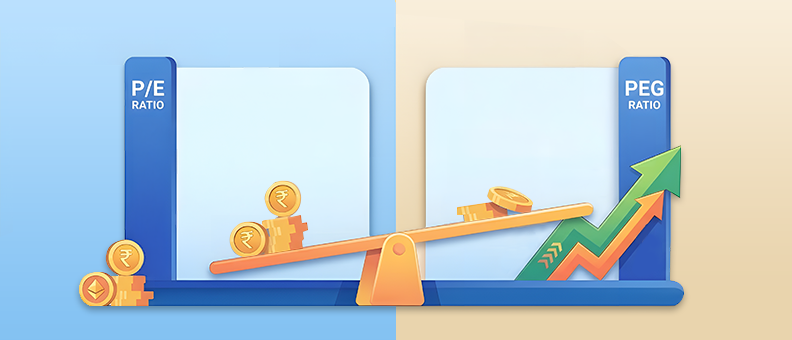
The discussion around PEG ratio vs P/E ratio comes up often because both ratios are commonly used to assess valuation, although they address slightly different aspects of price, earnings, and growth expectations. While the P/E ratio focuses on how a stock is valued relative to its current earnings, the PEG ratio adds expected earnings growth into the analysis. Understanding the difference between the two may help investors interpret valuation metrics with greater context.
Table of Contents
What is the P/E ratio?
The price-to-earnings ratio, or P/E ratio, shows how much the market is willing to pay for every rupee of a company’s earnings. It is commonly calculated by dividing the current market price per share by earnings per share.
In simple terms, it shows how many times a stock is trading relative to its earnings. A higher P/E may indicate expectations of higher future earnings growth potential, while a lower P/E may reflect weaker expectations, temporary pressure, or relatively lower valuation.
On its own, however, the ratio does not explain why the valuation is high or low. That is why investors often compare a stock’s P/E ratio with its historical levels, sector peers, or broader market valuations.
What is the PEG ratio?
The PEG ratio, or price/earnings-to-growth ratio, extends the P/E ratio by including expected earnings growth. To calculate the PEG ratio, the P/E ratio is divided by the expected earnings growth rate expressed in percentage terms. This may help investors assess whether a higher P/E valuation appears aligned with expected earnings growth.
For example, a company may appear highly valued when assessed only through the P/E ratio. However, after considering expected earnings growth through the PEG ratio, the valuation may appear differently when growth expectations are factored in.
PEG ratio vs P/E ratio: Key differences
In the P/E vs PEG ratio discussion, the central difference is simple: the P/E ratio looks only at current valuation relative to earnings, while the PEG ratio adjusts that valuation for expected growth.
The P/E ratio is easier to calculate and widely used across market commentary, stock screeners, and index-level valuation discussions. The PEG ratio goes one step further and asks whether that valuation still looks reasonable after factoring in earnings growth.
That said, the P/E ratio vs PEG ratio choice is not about one replacing the other. The P/E ratio works as a quick first filter. The PEG ratio may be more suitable when growth expectations matter. If growth projections are uncertain, the PEG ratio can become less reliable. But if growth is stable and well-tracked, the PEG ratio may add useful context that the P/E ratio alone does not provide.
Formula for calculating PEG ratio and P/E ratio
The formula for the P/E ratio is:
P/E Ratio = Market Price per Share / Earnings per Share
The formula for the PEG ratio is:
PEG Ratio = P/E Ratio / Earnings Growth Rate
Suppose a stock trades at ₹200 and its earnings per share are ₹20. Its P/E ratio would be 10. If its expected earnings growth rate is 15%, the PEG ratio would be approximately 0.67.
The P/E ratio indicates that the stock is trading at 10 times its earnings, while the PEG ratio incorporates expected earnings growth into the valuation analysis.
The figures shown are for illustrative purpose only
Example of PEG ratio vs P/E ratio calculation
- Company A has a P/E ratio of 30 and expected earnings growth of 15%, resulting in a PEG ratio of 2.0.
- Company B has a P/E ratio of 40 and expected earnings growth of 50%, resulting in a PEG ratio of 0.8.
Based only on the P/E ratio, Company A may appear relatively lower valued. However, after considering expected earnings growth through the PEG ratio, Company B may appear differently valued relative to growth expectations.
The figures shown are for illustrative purpose only
When should you use PEG ratio over P/E ratio?
The PEG ratio may be useful when comparing businesses with different growth rates, especially in sectors where earnings growth expectations are relatively higher. In such situations, the P/E ratio alone may make a high-growth company appear expensive even when growth expectations may partly explain the valuation premium.
The PEG ratio may also be relevant in growth-oriented valuation analysis. However, the P/E ratio may still be sufficient when growth is modest, cyclical, uncertain, or difficult to forecast. When future earnings growth forms an important part of valuation analysis, the PEG ratio may offer additional valuation context beyond the P/E ratio.
Limitations of P/E ratio and PEG ratio
Understanding the limitations of these ratios may help investors interpret valuation metrics with greater context:
- The P/E ratio does not account for factors such as growth, debt levels, cash flows, or overall business quality.
- The P/E ratio may become less useful when earnings are negative, unusually high, or temporarily depressed.
- The PEG ratio depends on expected earnings growth, and growth forecasts can change quickly over time.
- If growth assumptions are inaccurate, the PEG ratio may create a misleading impression of valuation.
- Both ratios are generally more useful as comparative tools rather than standalone decision-making measures.
- Investors often review these ratios alongside return ratios, balance-sheet strength, cash generation, and sector context.
How investors in India use these ratios
Investors in India often compare P/E ratios within sectors while assessing relative valuations. If several stocks trade at P/E ratios above historical averages, some investors may interpret overall market valuations as relatively elevated compared with past levels. Market commentary around benchmark indices also frequently refers to the P/E ratio as a valuation indicator.
The PEG ratio is generally used more selectively when investors compare valuation levels with expected earnings growth in growth-oriented businesses. For mutual fund investors, these ratios may provide additional context regarding portfolio valuation. However, mutual fund selection also depends on factors such as portfolio construction, investment mandate, risk profile, and investment process.
FAQs
What is a good PEG ratio for a stock?
A PEG ratio around 1 is sometimes interpreted as broadly aligned with growth expectations, although interpretation can vary across sectors and depends on the quality of growth estimates. It should not be treated as a fixed benchmark.
Is a low P/E ratio always good?
No. A low P/E ratio may reflect weaker growth prospects, sector-specific pressures, or earnings concerns rather than indicating relatively lower valuation on its own.
What is the main difference between PEG and P/E ratio?
The P/E ratio measures price relative to current earnings, while the PEG ratio incorporates expected earnings growth into valuation analysis.
Can PEG ratio be negative?
Yes. If expected earnings growth is negative, the PEG ratio can also become negative, which may reduce its usefulness for interpretation.
Which ratio is better for mutual fund investors?
Neither ratio works as a standalone measure for mutual fund evaluation. These ratios may provide valuation context, but mutual fund analysis also depends on portfolio strategy, risk profile, and investment objectives.
Is the P/E ratio useful for all sectors?
No. The P/E ratio may become less useful in sectors where earnings are highly volatile, temporarily distorted, or not the primary driver of valuation.
How often should investors review these ratios?
Many investors review valuation ratios alongside earnings results, valuation updates, or while comparing businesses within the same sector rather than monitoring them in isolation every day.
Where can I find PEG and P/E ratio data for Indian stocks?
Indian investors commonly access valuation data through stock exchange websites, broker platforms, company filings, market-data platforms, and financial information portals.