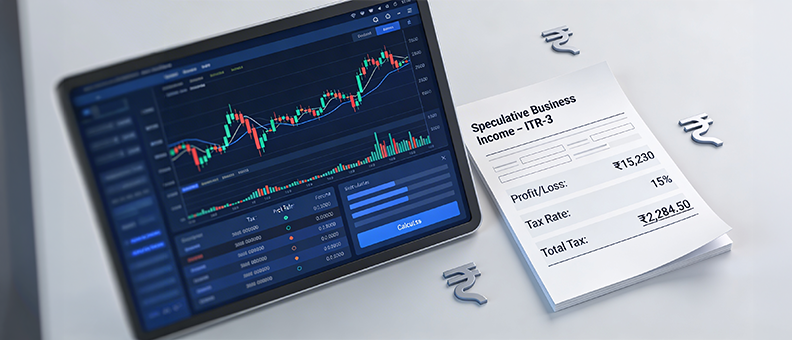
Intraday trading is taxed differently from delivery-based share investing in India. Since shares are bought and sold on the same trading day without taking delivery, these transactions are generally treated as speculative business transactions under Section 43(5) of the Income Tax Act, 1961. As a result, any profits from intraday trading are usually taxed as business income and not as capital gains.
Knowing how intraday trading is taxed can help you understand your tax liability, report income correctly, and comply with income tax rules. This article explains how intraday trading profits are taxed, how losses are treated, the applicable tax slab rates, turnover calculation, and when a tax audit may apply.
Table of Contents
What is intraday trading?
Intraday trading refers to the purchase and sale of listed securities within the same trading day without taking delivery of shares. All positions are squared off before market closing hours. These transactions are treated differently from delivery-based investments for taxation purposes.
What are capital assets and trading assets?
For income tax purposes, securities may be classified as either capital assets or trading assets, depending on why they are bought and how they are used. This classification decides whether the income is taxed as capital gains or business income.
Capital assets
Capital assets are securities purchased as long-term investments with the aim of building wealth over time. Investors usually hold these assets for a period before selling them. Any gains from their sale are generally taxed as capital gains, subject to the applicable tax provisions. Examples of capital assets include:
- Shares held as long-term investments
- Equity mutual fund units held for investment
- Bonds purchased for long-term investment
Trading assets
Trading assets are securities bought mainly for frequent buying and selling to earn from short-term price movements. Income from these transactions is generally treated as business income. In the case of intraday trading, where shares are bought and sold on the same trading day without taking delivery, the transactions are generally treated as speculative business transactions under Section 43(5) of the Income Tax Act, 1961. Examples of trading assets include:
- Shares bought and sold through intraday trading
- Securities traded frequently as part of a trading business
- Derivative contracts, such as futures and options, subject to the applicable tax provisions
Also Read: Intraday Trading Strategies: Meaning, Risks & Tips for Beginners
How are intraday trading profits taxed in India?
Income from intraday trading is classified as speculative business income under Section 43(5) of the Income Tax Act, 1961. Unlike capital gains taxation, speculative trading income is added to the taxpayer’s total income and taxed according to the applicable income tax slab rate under the chosen tax regime.
How to report intraday trading income in your Income Tax Returns
If you earn income from intraday trading, it needs to be reported correctly in your income tax return. Since intraday trading is treated as a speculative business activity under Section 43(5) of the Income Tax Act, 1961, the applicable income head, ITR form and filing due date are different from those for capital gains.
Income head
Profits or losses from intraday trading are reported under “Profits and Gains of Business or Profession.” Since shares are bought and sold without taking delivery, the income is generally treated as speculative business income.
ITR form
Taxpayers reporting intraday trading income generally need to file ITR-3, as the income is treated as business income. Depending on the applicable tax provisions, books of account and other financial records may also need to be maintained.
Due date for filing the income tax return
The due date for filing your income tax return depends on whether a tax audit applies. For FY 2025–26 (AY 2026–27), taxpayers with business or professional income whose accounts do not require a tax audit generally need to file their return by 31 August 2026. If a tax audit is applicable, the due date is generally 31 October 2026. These due dates may be revised if the Central Board of Direct Taxes (CBDT) issues an extension or amends the applicable provisions.
Applicable income tax slab rates for traders
Understanding both old and new tax regimes is necessary when calculating tax liability on intraday trading income.
Old tax slabs:
- No tax if total income is up to ₹2.5 lakh.
- 5% on income between ₹2.5 lakh and ₹5 lakh.
- 20% on income between ₹5 lakh and ₹10 lakh.
- 30% on income above ₹10 lakh.
New tax slabs
- Up to ₹4 lakh – Nil
- ₹4–₹8 lakh – 5%
- ₹8–₹12 lakh – 10%
- ₹12–₹16 lakh – 15%
- ₹16–₹20 lakh – 20%
- ₹20–₹24 lakh – 25%
- Above ₹24 lakh – 30%
Treatment of intraday trading losses: Set-off and carry forward rules
Since intraday trading is speculative in nature, losses arising from such transactions are treated as speculative business losses. These losses may be set off only against speculative business income and cannot be adjusted against salary income or non-speculative income.
Speculative losses may be carried forward for up to four assessment years, provided the income tax return is filed within the due date under Section 139(1). This differs from non-speculative business losses, which may be set off against other business income (except salary) and carried forward for up to eight assessment years.
Also Read: Swing Trading vs. Day Trading: What’s the Difference?
Tax audit requirements for intraday trading
A tax audit under Section 44AB of the Income Tax Act may become mandatory for intraday traders under certain conditions.
For traders not opting for the presumptive taxation scheme:
A tax audit is required if total trading turnover exceeds ₹10 crore during a financial year, provided cash receipts and cash payments do not exceed 5% of total transactions. If either exceeds this threshold, the audit limit reduces to ₹1 crore.
For traders opting for the presumptive taxation scheme (Section 44AD):
The presumptive taxation scheme allows small businesses to declare income at a prescribed rate without maintaining detailed books of account. Eligible resident individuals, Hindu Undivided Families (HUFs), and partnership firms may opt for presumptive taxation subject to eligibility conditions.
- Eligibility: The scheme may be opted for where total turnover does not exceed ₹3 crore, provided cash receipts do not exceed 5% of total receipts.
- Audit trigger: A tax audit becomes mandatory if income declared under the presumptive scheme is lower than the prescribed presumptive rate (6% of digital turnover or 8% of cash turnover) and total income exceeds the applicable basic exemption limit (₹2.5 lakh under the old regime or ₹4 lakh under the new regime)
- An audit may also be required if a taxpayer opts out of the presumptive taxation scheme after choosing it earlier and total income exceeds the basic exemption limit.
Is a tax audit required for intraday trading?
A tax audit is not required only because you trade intraday. It depends on your trading turnover, reported profit and whether you use the presumptive taxation scheme under Section 44AD.
If you opt for presumptive taxation
A tax audit is generally not required if:
- Your turnover is up to ₹3 crore, subject to the prescribed cash transaction limit.
- You declare profit of at least 6% of digital turnover.
A tax audit may apply if you report a loss or profit below 6% and your total income exceeds the basic exemption limit.
If you do not opt for presumptive taxation
A tax audit is generally not required if turnover is up to ₹1 crore. If turnover is higher, the applicable limits under Section 44AB must be checked.
If turnover exceeds ₹10 crore
A tax audit is generally required when turnover exceeds ₹10 crore, provided cash receipts and cash payments do not exceed 5% of total transactions.
Tax audit rules may change, so the applicable limits should be checked for the relevant financial year.
What is turnover for intraday trading?
For intraday trading, turnover is calculated by adding the absolute value of all profits and losses made during the financial year. In simple terms, every profit and every loss is added together. Losses are not adjusted against profits while calculating turnover.
For example, suppose you make a profit of ₹1,000 on one intraday trade and incur a loss of ₹1,000 on another. Even though your net profit is zero, your trading turnover will be ₹2,000 (₹1,000 + ₹1,000).
Example
| Trade | Profit/Loss |
| Trade 1 | Profit of ₹500 |
| Trade 2 | Loss of ₹8,000 |
| Trading turnover | ₹ 8,500 |
In this example, the profit and loss are added using their absolute values. Therefore, the turnover is ₹500 + ₹8,000 = ₹8,500.
This method is generally used to calculate turnover for all intraday trades executed during the financial year and is relevant for determining whether tax audit provisions may apply.
The figures shown are for illustrative purpose only
Calculating trading turnover for tax purposes
For intraday trading, turnover is calculated as the sum of the absolute values of all profits and losses arising from trades during the financial year. Both profitable and loss-making trades are included while computing turnover.
For example, if a trader earns a profit of ₹1,500 on one trade and incurs a loss of ₹5,000 on another, the turnover would be ₹6,500. Turnover is generally computed by aggregating the absolute differences (profits and losses) for the financial year.
Also Read: Trading Basics: History, Benefits and How Does it Work?
Conclusion
Tax treatment of intraday trading differs significantly from delivery-based investing because it is classified as speculative business activity. Understanding how such income is taxed, how losses may be adjusted, and when audit requirements apply may help traders manage tax reporting and compliance more effectively. Intraday trading involves high market risk, and tax treatment may vary based on individual circumstances; consultation with a qualified tax professional may assist in accurate compliance.
FAQs
Is intraday trading considered a business or capital gain?
Intraday trading is classified as speculative business activity. Therefore, profits or losses are treated under business income and not capital gains.
Which ITR form should be used for reporting intraday trading income?
Since intraday trading income is treated as speculative business income, taxpayers reporting such income are generally required to file ITR-3. However, those opting for presumptive taxation under Section 44AD, subject to eligibility conditions, may file ITR-4.
Can intraday losses be set off against salary income?
No. Speculative losses arising from intraday trading may be set off only against speculative business income and cannot be adjusted against salary income.
How many years can intraday trading losses be carried forward?
Speculative losses from intraday trading may be carried forward for up to four assessment years, provided the income tax return is filed within the prescribed due date.
When is a tax audit mandatory for an intraday trader?
A tax audit may become mandatory if turnover exceeds ₹10 crore during a financial year, provided both cash receipts and cash payments do not exceed 5% of total transactions. If either exceeds this threshold, the audit limit reduces to ₹1 crore. Under the presumptive taxation scheme, an audit may also be required if declared income falls below the prescribed presumptive rate (6% of digital turnover or 8% of cash turnover) and total income exceeds the applicable basic exemption limit.
Our Calculators