
The same stock can remain in one portfolio for a decade and another for just ten minutes. An investor may be backing the company’s long-term prospects, while a trader is responding to a shorter-term price movement. This contrast lies at the heart of trading vs investing. Understanding the difference between trading and investing can clarify the research, time, costs and risks each approach demands, before an overlooked distinction turns into an avoidable financial decision.
Key Takeaways
- Investing generally involves holding assets for long-term goals, while trading seeks to act on shorter-term price movements.
- Investors often study business fundamentals and asset allocation. Traders may place greater emphasis on price, volume and market behaviour.
- Trading usually requires more frequent decisions and may result in higher transaction costs.
- Neither approach assures profits or protects capital.
- Tax treatment depends on the instrument, holding period and whether the activity is classified as investment or business activity.
What is stock market investing?
Stock market investing involves buying shares, equity mutual funds or ETFs, typically with a long-term financial goal. Unlike trading, the focus is generally on the underlying business or portfolio rather than short-term price movements.
Investors may assess earnings, financial position, valuations, industry conditions and long-term business prospects. Potential returns can come from price appreciation and dividends or distributions, where declared. A longer holding period gives the investment thesis more time to develop, but it does not assure gains or recovery from a decline.
What are the different types of investing?
The main types of investing differ in what you own, how potential returns arise and the risks involved:
Stock investing
Buying shares gives an investor partial ownership in a company. Potential returns may come from price appreciation and dividends, where declared, while losses can arise from weaker business performance or market conditions.
Mutual fund and ETF investing
Mutual funds and exchange-traded funds invest pooled money across a portfolio of securities. Depending on the scheme, they may provide exposure to equities, debt, commodities or multiple asset classes, with returns linked to the underlying portfolio.
Fixed income investing
Bonds and other fixed income securities may provide scheduled interest and principal repayment according to their terms. Their value and potential returns can be affected by credit quality, interest rates, inflation and liquidity.
Deposit-based investing
Fixed deposits provide interest at a stated rate for a specified tenure, subject to the institution’s terms. They are deposit products rather than market-traded securities and may carry penalties or reduced interest for premature withdrawal.
Real estate investing
Property may generate rental income and capital appreciation if its value rises. Legal checks, maintenance expenses, transaction costs and relatively limited liquidity can affect the realised outcome.
Gold and commodity investing
Exposure to gold and other commodities may be taken through physical holdings or eligible financial products. Prices can fluctuate because of global demand, currency movements, inflation expectations and economic conditions.
Returns on fixed deposits/savings accounts are fixed, however, returns on mutual funds are subject to market risks.
How does rupee-cost averaging work in regular investing?
Within the trading vs investing comparison, regular investing follows a schedule instead of relying on short-term entry and exit decisions. An SIP, or Systematic Investment Plan, allows a fixed amount to be invested in a mutual fund at regular intervals.
As the NAV changes, each instalment buys more units at lower prices and fewer units at higher prices. Purchases made at different NAVs create an average acquisition cost over time. This can reduce dependence on one entry point and encourage consistency, but it does not guarantee a lower cost than a lump-sum investment or remove market risk.
What is stock market trading?
Stock market trading involves buying and selling securities to act on expected price movements. Positions may remain open for a few minutes, several days or a few months, depending on the trading strategy. Traders commonly assess price patterns, volumes, market news, liquidity and volatility. Frequent decisions can increase transaction costs, execution risk and emotional pressure. Margin trading and leveraged derivative positions can magnify both gains and losses.
What are the different types of trading?
The common types of trading differ in their holding periods, decision rules and the market movements they target:
Intraday trading
Intraday positions are opened and closed within the same trading session. They require close monitoring because prices can move rapidly, and positions placed as intraday orders must be closed or converted within the broker’s specified timeline.
Swing trading
Swing trading involves holding positions for several days or weeks to act on short-term price movements. Decisions may be based on technical analysis, market developments or a combination of factors.
Positional trading
Positional trades may remain open for several weeks or months. Traders may consider broader price trends, economic developments and company-specific information when making decisions.
Scalping
Scalping involves placing multiple trades over seconds or minutes to act on small price movements. Transaction costs, liquidity and execution speed can materially affect the outcome.
Momentum trading
Momentum trading involves taking positions in securities showing sustained price movement and trading activity. The strategy can be used over different timeframes, with positions generally closed when momentum weakens or a predefined exit condition is reached.
Fundamental and technical analysis in investing and trading
Fundamental analysis evaluates a company’s revenue, profitability, cash flow, financial position, valuation and industry conditions. It is commonly used in long-term investing, although swing and positional traders may also consider company or economic developments.
Technical analysis examines price and volume data using charts, trends and indicators to identify possible trade setups, entry points and exits. It is more commonly associated with short-term trading.
The emphasis placed on each method is one practical difference between trading and investing, although they can be used together. Neither can predict market movements with certainty.
Similarities between investing and trading
Although their timelines and methods differ, investing and trading share certain characteristics:
- Both involve committing capital to financial assets.
- Market movements can result in gains or losses.
- Research, planning and disciplined decision-making remain relevant.
- Brokerage, taxes and other costs can affect the realised outcome.
- Decisions may be influenced by fear, overconfidence or recent market movements.
- Neither approach assures returns or protection of capital.
Difference between trading and investing
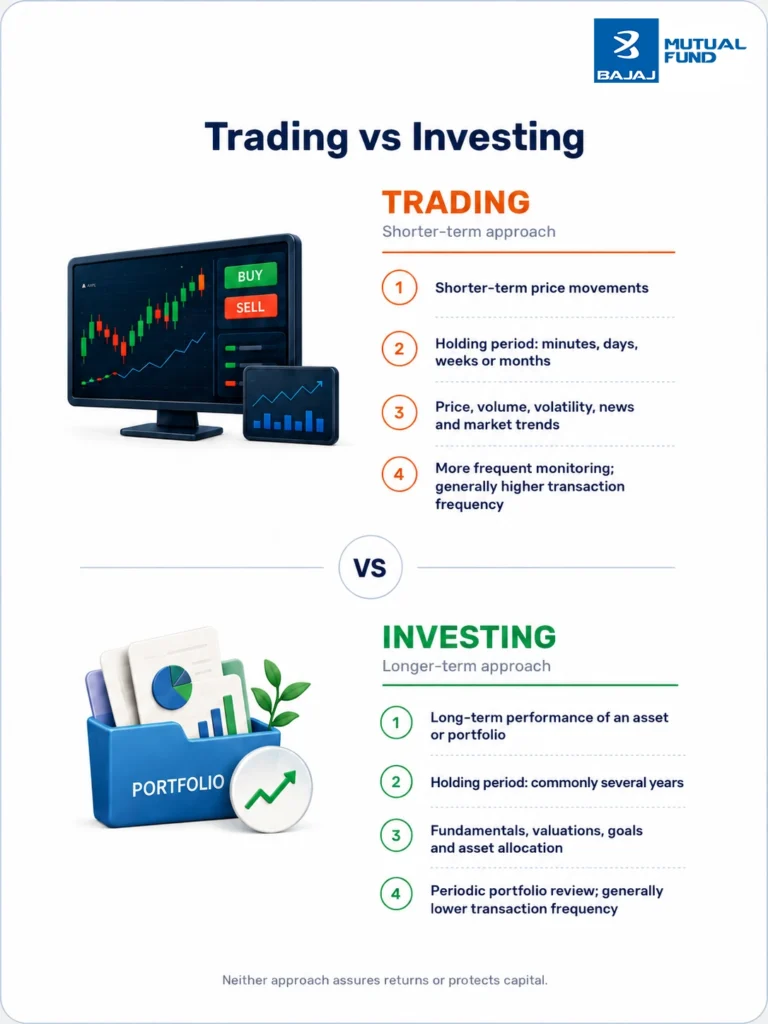
The main difference between trading and investing lies in the purpose, holding period and decision-making process.
| Basis | Investing | Trading |
| Primary objective | Participation in the long-term performance of an asset or portfolio | Acting on shorter-term price movements |
| Typical holding period | Commonly several years | Minutes, days, weeks or months |
| Decision basis | Business fundamentals, valuations, goals and asset allocation | Price, volume, volatility, news and market trends |
| Monitoring | Periodic portfolio review | More frequent or continuous monitoring |
| Transaction frequency | Generally lower | Generally higher |
| Costs | Fewer transactions may result in lower trading costs | Frequent activity can increase brokerage, statutory charges and slippage |
| Risk profile | Depends on the asset, valuation, diversification and holding period | Includes market, timing and execution risk, which may increase with margin or derivatives |
| Response to volatility | Investors may remain invested if the original rationale remains valid | Traders may enter or exit based on predefined price or risk limits |
| Source of potential return | Price appreciation, interest, dividends or distributions | Price changes over the duration of the trade |
| Role of compounding | Reinvested gains or income may compound over time | Frequent withdrawals, losses and costs can limit compounding |
How behaviour affects trading and investing
Behaviour is an often-overlooked part of trading vs investing. Rapid feedback from trading can encourage overconfidence after a gain or impulsive attempts to recover a loss. Constant price movements may also lead to excessive trading or abandoning an established strategy.
Investors face different pressures. They may sell during a sharp decline, chase recent performance or retain an asset after the original investment rationale has weakened.
Predefined entry and exit rules and position limits can support trading discipline. For investors, a documented investment rationale, asset allocation and periodic review may reduce emotionally driven decisions. Neither approach removes market risk.
Trading vs investing: Which approach may be suitable?
The more suitable approach depends on the person’s objectives, knowledge, available time and ability to absorb losses.
Investing may be considered by
Investing may align more closely with people who prefer a longer horizon and fewer day-to-day decisions:
- People working towards financial goals over several years.
- Those who prefer periodic reviews instead of monitoring prices throughout the day.
- Individuals seeking exposure through diversified mutual funds, ETFs, bonds or a portfolio of securities.
- Anyone willing to remain invested through market fluctuations without assuming that recovery is assured.
Trading may be considered by
Trading demands closer market attention, more frequent decisions and clearly defined risk controls:
- Participants with the time and knowledge needed to monitor markets closely.
- Those who understand order execution, transaction costs and short-term price risk.
- Individuals who can follow predefined entry, exit and position-sizing rules.
- People using capital whose loss would not affect essential expenses or near-term financial goals.
A person may use both approaches, but keeping long-term investments separate from trading capital can make their respective objectives, performance and risks easier to track.
Limitations of trading and investing
A balanced trading vs investing comparison should consider the practical limitations of both approaches.
Limitations of trading
Trading limitations arise largely from time demands, frequent transactions and short-term uncertainty:
- Close market monitoring can require considerable time and attention.
- Short holding periods increase dependence on entry timing, exit timing and order execution.
- Brokerage, statutory charges, bid-ask spreads and slippage can accumulate across multiple trades.
- Margin and leveraged derivative positions can magnify losses.
- Rapid feedback may encourage emotional decisions or excessive trading.
- Frequent transactions can make record-keeping and tax reporting more involved.
Limitations of investing
Investing limitations are more closely connected with asset selection, market cycles and the holding period:
- Market value may remain below the purchase price for an extended period.
- A longer holding period cannot compensate for a weak business, excessive valuation or unsuitable asset.
- Selling before an investment thesis develops may disrupt a financial goal or crystallise a loss.
- Concentrated portfolios remain exposed to company and sector-specific risks.
- Inflation can reduce the purchasing power of realised returns.
Tax implications of trading vs investing in India
The tax treatment of trading vs investing depends on the instrument, holding period and whether securities are held as capital assets or stock-in-trade. Transaction frequency alone does not decide the classification. Intention, accounting treatment and the facts surrounding the activity may also be considered.
Taxation of investments
For listed equity shares and units of equity-oriented funds that meet the applicable Securities Transaction Tax conditions:
- Short-term capital gains: Gains on assets held for 12 months or less are generally taxed at 20%.
- Long-term capital gains: Gains on assets held for more than 12 months are generally taxed at 12.5% on aggregate eligible long-term capital gains exceeding ₹1.25 lakh in a tax year.
Applicable surcharge and cess may be added to these rates. Different rules apply to debt instruments, certain mutual fund categories, unlisted securities, real estate and commodities.
Taxation of trading activity
Income from securities held as stock-in-trade is generally taxed as business income at the applicable rate. Intraday equity trades settled without delivery are usually treated as speculative business activity. Eligible derivatives traded on a recognised stock exchange are generally treated as non-speculative business transactions.
Business expenses and the rules for adjusting or carrying forward losses differ from those applicable to capital gains. Speculative and non-speculative business losses also follow different set-off and carry-forward rules.
Sources: Income Tax Department, Income-tax Act, 2025, Sections 196 and 198 and provisions concerning speculative transactions; CBDT Circular No. 6/2016 on the classification of income from shares and securities.
The tax information in this article is based on prevailing laws at the time of publishing the article and is subject to change. Please consult a tax professional or refer to the latest regulations for up-to-date information.
Conclusion
Trading and investing use the same markets but approach them with different objectives. Investing generally connects capital with long-term goals and the performance of underlying assets. Trading focuses more closely on shorter-term price movements and requires frequent decisions.
Holding period is only one part of the distinction. Research methods, transaction costs, risk controls, tax treatment and the time available for monitoring also matter. Understanding these differences can help separate a financial plan from a short-term market position.
FAQs
What is the main difference between trading and investing?
The main difference between trading and investing is their timeframe and objective. Investing generally involves holding assets for long-term goals, while trading involves more frequent transactions based on shorter-term price movements.
Are trading and stocks the same?
No. A stock is a financial asset representing ownership in a company. Trading is the activity of buying and selling stocks or other financial instruments.
Is trading part of the stock market?
Yes. Stock trading is an activity conducted in the stock market, where participants buy and sell listed shares and other eligible securities through recognised stock exchanges.
What are the four main types of trading?
Four commonly recognised types of trading are intraday trading, swing trading, positional trading and scalping. They differ mainly in their holding periods, trading frequency and the price movements they target.
Which is more profitable, trading or investing?
Neither approach is inherently more profitable. Outcomes depend on market conditions, asset selection, strategy, transaction costs, risk management and individual decisions. Both trading and investing can result in losses.
Is trading or investing more suitable for beginners?
Long-term investing through a diversified product may require fewer decisions and less market monitoring than active trading. Suitability still depends on the person’s goals, risk tolerance, product knowledge and ability to absorb losses.
Can a person invest and trade at the same time?
Yes. A person can maintain long-term investments and a separate trading allocation. Keeping their capital, objectives and records separate makes performance, risk and tax treatment easier to assess.
Does long-term investing guarantee profits?
No. A longer holding period gives an investment thesis more time to develop, but it does not assure gains or recovery from a decline.
How are trading and investing taxed differently in India?
Investments held as capital assets are generally taxed under capital-gains rules. Securities held as stock-in-trade may generate business income, while intraday equity trading is generally treated as speculative business activity. Eligible exchange-traded derivatives are generally treated as non-speculative business transactions.
Tools for Investors