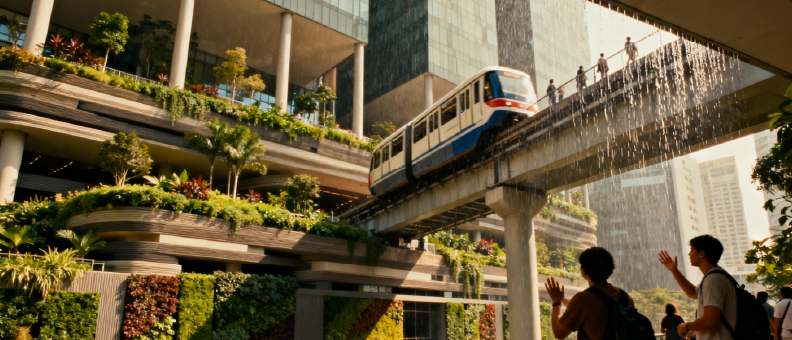
Across India, cities are growing, expanding, and changing at a pace that is reshaping how people live, work and consume. New neighbourhoods are coming up, commutes are getting longer for some and shorter for others, and daily needs—from food to finance—are increasingly supported by digital tools and on-demand services. These shifts reflect a long-running structural force: urbanisation.
Urbanisation is often described as a megatrend because it evolves slowly over decades and influences several aspects of life at once. As more people move towards urban and peri-urban areas, the ripple effects spread across housing, mobility, employment, consumption, and community life. But megatrends rarely move in a straight line. They bring opportunities, challenges, and trade-offs that vary from one region to another.
This article looks at the opportunities and friction points emerging from India’s ongoing urbanisation journey.
Table of Content
- The opportunity: Rising demand across goods and services
- The opportunity: Integration of technology into daily life
- The opportunity: Growth of peri-urban and Tier-2 cities
- The challenges: Infrastructure and pace of development
- The challenge: Affordability and inequality
- The challenge: Environmental pressures
- Looking ahead
The opportunity: Rising demand across goods and services
As cities expand, they create new economic activity. Shops, services, restaurants, schools, clinics, mobility options, and financial services often see growing demand where populations concentrate. Even small changes in density may influence how people spend—whether it’s eating out more often, relying on delivery services, or using digital tools for daily tasks.
This growth is not uniform across all regions. Larger metros may experience saturation, while smaller cities—supported by better connectivity, industry hubs, or educational centres—may see more vibrant and diverse patterns of consumption. But the overall direction seems to be that urbanisation may boost demand for a wider range of goods and services.
Read Also: Urbanisation & Middle Class: Shaping Investment Trends
The opportunity: Integration of technology into daily life
Urban lifestyles tend to encourage technology adoption. Payments, mobility, shopping, entertainment, and personal finance often become more digitised in busy, high-density environments. For many households, digital convenience helps them manage time pressures, commutes, and multitasking.
This creates an ecosystem where multiple sectors interact—retail with logistics, mobility with mapping tools, healthcare with teleconsultation, financial services with digital identity verification. The result is a dynamic network of services shaped by long-term urban living patterns.
The opportunity: Growth of peri-urban and Tier-2 cities
As big cities expand outward, the surrounding towns often benefit from improved roads, connectivity, and job opportunities. These peri-urban areas have the potential to evolve into independent economic pockets with strong local consumption.
Similarly, many Tier-2 cities are seeing rising aspirations, improving infrastructure, and growing digital participation. This broadening of urban demand beyond a few metros may support more balanced regional development over time.
Read Also: Megatrends Of The 1980s Vs Today: What Has Changed?
The challenges: Infrastructure and pace of development
Urbanisation also brings significant challenges. Cities can grow faster than roads, housing, transport, and essential services. This creates everyday friction for residents—traffic congestion, stressed public utilities, overcrowded transport, and long commutes.
Such gaps influence consumption as well. People may choose certain services simply because they are easier to access within their immediate neighbourhoods, while others remain underutilised due to convenience barriers. The uneven pace of development can therefore create wide variation in urban experiences.
The challenge: Affordability and inequality
City life can be expensive. Housing costs, commuting expenses, and day-to-day spending often rise as cities grow. This can widen affordability gaps across income groups. Some families may access premium convenience-driven services, while others rely on more traditional options.
Urbanisation, therefore, does not create uniform outcomes. It reshapes choices differently depending on household budgets, local infrastructure, and the availability of public services.
The challenge: Environmental pressures
Growing cities also face environmental stresses—waste management, air quality, water availability, and energy usage. These challenges often require long-term planning, policy coordination, and community participation.
At the same time, these pressures are prompting the rise of new sectors such as sustainable mobility, energy-efficient housing materials, and greener public infrastructure. But adoption can vary, and the pace of improvement depends on local policy and investment.
Read Also: The Origin of Megatrends: History, Evolution, and Impact
Looking ahead
Urbanisation is one of India’s most influential megatrends, but its impact is not simply a story of expansion. It’s a story of intersections—between infrastructure and lifestyle, public services and private innovation, affordability and aspiration.
The opportunities lie in better connectivity, richer service ecosystems, and more vibrant local economies. The challenges centre around uneven development, environmental pressures, and the need for resilient urban planning.
For observers and participants in this megatrend, the key is recognising that urbanisation unfolds gradually and differently across regions. The most resilient outcomes may come from approaches that balance growth with accessibility, sustainability, and long-term community wellbeing.
Note: References to any industry/sector are provided for illustrative purposes only. This should not be construed as a research report or a recommendation to buy or sell any security or sector. At Bajaj Finserv Asset Management Ltd, we aim to harness the power of megatrends by offering investors access to themes shaping the world’s future — from clean energy to technology, innovation, demographic shifts and more. Many of our funds follow a megatrends investment approach to help you participate in these long-term shifts, with a focus on growth potential and diversification. Build your future-focussed portfolio with Bajaj Finserv AMC.