
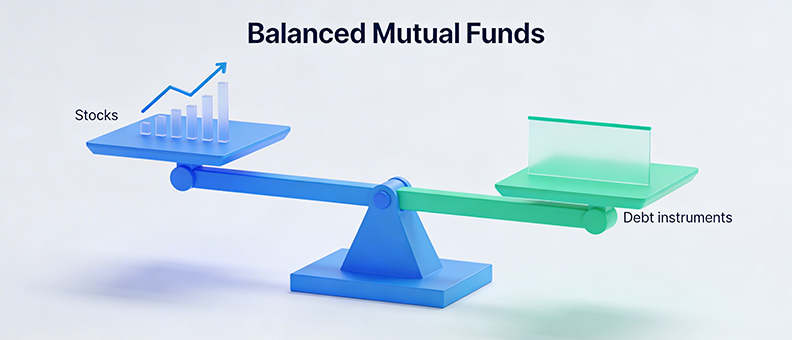
For many investors, balanced funds can feel like a middle path. Instead of choosing only equity for growth potential or only debt for relative stability, these funds combine both in a single scheme. The equity portion aims to support long-term wealth creation, while the debt portion may help reduce overall volatility along the way. These features make balanced funds easier to understand for beginners who may not have the capacity to pick separate funds and rebalancing them on their own.
This article explains meaning of balanced funds, the different types available, their key features, taxation rules, and the points investors in India may want to review before investing.
What are balanced funds?
Balanced funds are hybrid mutual fund schemes that invest in both equity (shares) and fixed-income instruments (government securities or corporate bonds). The scheme mandate sets an equity-debt allocation, and the fund manager invests accordingly.
In India, SEBI’s scheme categorisation framework groups such products under hybrid schemes, helping investors compare similar mutual fund schemes on a like-for-like basis.
This definition of balanced funds is different from pure equity mutual funds or pure debt funds because the investor gets exposure to both asset classes within one hybrid scheme. In practice, balanced funds are part of the broader category of hybrid mutual fund schemes.
Types of balanced funds
For investors looking to understand the types of balanced funds, the main hybrid categories are:
- Conservative hybrid fund: Invests 10% to 25% equity and 75% to 90% debt
- Balanced hybrid fund: Invests 40% to 60% equity and 40% to 60% debt
- Aggressive hybrid fund: Invests 65% to 80% equity and 20% to 35% debt
- Dynamic asset allocation: Equity and debt levels can change based on the fund’s model
- Multi asset allocation fund: Invests in at least three asset classes (such as equity, debt and commodities) with minimum allocation of 10% in all three asset classes
- Arbitrage fund: A scheme that follows an arbitrage strategy and invests at least 65% in equity and equity-related instruments
- Equity savings fund: A scheme that invests at least 65% in equity and equity-related instruments (with 15%–40% net long equity exposure), a minimum of 10% in debt, and the remainder in arbitrage opportunities, as defined in the SID.
Features of balanced funds
Balanced funds typically offer:
- Diversification across equity and debt within one scheme.
- Disclosed allocation bands, supporting ‘true-to-label’ investing.
- Rebalancing aligned to the scheme mandate (especially in balanced hybrid and dynamic allocation funds).
- Market-linked NAV: the unit value changes with portfolio value.
- Costs such as the expense ratio (TER), which can affect net returns over time.
How do balanced mutual funds work?
When investors buy units, the money is pooled and invested across equity and debt based on the scheme’s allocation pattern. Aggressive hybrids are more equity-heavy, conservative hybrids are more debt-heavy, and balanced advantage funds can shift the mix more dynamically.
Equity holdings add growth potential (and downside risk). Debt holdings can provide coupon income, but prices can move when interest rates change, and they carry credit risk.
The allocation range is disclosed in the scheme information document. This matters because the risk and return potential depend on equity exposure.
Why investors consider balanced funds
Many investors consider balanced funds because they offer a middle path between growth potential and relative stability. The equity portion may support long-term capital appreciation, while the debt portion may cushion some market swings. This may suit investors who find pure equity funds too volatile for their comfort level.
These schemes can also simplify asset allocation. Instead of separately buying equity and debt funds and then rebalancing, the investor gets one product that is managed within a defined framework. That convenience may appeal to investors who want discipline without making frequent allocation decisions themselves.
How to invest in balanced mutual funds
Investing steps are similar to other mutual funds:
- Complete KYC and choose a platform (AMC, RTA, bank, or an online investment platform).
- Pick the fund type first (conservative, balanced hybrid, aggressive hybrid, or balanced advantage) based on your risk profile.
- Decide on SIP or lump sum. A SIP calculator can help estimate outcomes at assumed return rates (these are not guaranteed).
- Review key details: asset allocation, debt portfolio quality, expense ratio, and exit load.
- If planning income, check SWP calculator estimates and the likely tax impact before starting withdrawals.
Investors comparing mutual funds with PMS (Portfolio Management Services) should note that PMS is a separate, more customised structure, and SEBI’s investor page states it carries a much higher minimum investment threshold.
Taxation rules of balanced mutual funds in India
The tax treatment of hybrid mutual funds depends on their equity exposure and applicable rules:
Equity-oriented balanced mutual fund taxation
Balanced mutual funds with at least 65% allocation to domestic equity are classified as equity-oriented for tax purposes. Gains on units held for up to 12 months are taxed at 20%, while gains above ₹1.25 lakh on units held for more than 12 months are taxed at 12.5%, without indexation.
Debt-oriented hybrid fund taxation
Hybrid funds with less than 65% allocation to equity are treated as debt-oriented and taxed accordingly. For units acquired on or after 1 April 2023, gains are taxed as per the investor’s income tax slab, while certain older investments may be subject to different long-term tax rules.
Because the classification (and purchase/transfer dates) can change the tax outcome, investors should verify the scheme-specific tax treatment before investing.
Things to consider before investing in balanced funds
Balanced funds are still market-linked products, not fixed deposits. Their NAV can rise or fall, and the suitable option depends on the investor’s goals, time horizon, cash-flow needs, and comfort with volatility. A short holding period may increase the chance of exiting during an unfavourable phase.
It is also useful to review the debt portfolio quality, rebalancing approach, tax treatment and cost structure. Investors seeking higher growth potential may compare them with pure equity funds, while very conservative investors may still find them unsuitable.
Conclusion
Balanced funds may be suitable for Indian investors who want equity and debt exposure within one scheme. They offer a relatively balanced risk-return profile and a simpler starting point than managing separate funds, but suitability depends on the fund type, time horizon, cost, and tax treatment. A careful review of the scheme objective and risk profile remains important before investing.
FAQs
What is balanced fund meaning?
It usually refers to a hybrid mutual fund that invests in both equity and debt.
Who can invest in balanced funds?
They may suit beginners, moderate-risk investors, and those who want a single-fund asset allocation approach.
Do balanced funds give good returns?
They may offer moderate long-term return potential, but returns are market-linked and not assured.
What are the benefits of investing in balanced funds?
Diversification, professional rebalancing, and relatively smoother portfolio behaviour are key benefits.
What should be the investment horizon for balanced funds?
The horizon depends on the category, but equity-leaning balanced funds are generally better assessed over the medium to long term.
Which is better: equity or balanced fund?
That depends on risk appetite and time horizon. Pure equity funds may suit higher-risk investors, while balanced funds may suit those wanting some debt exposure.
Are balanced funds a good investment?
They can be appropriate for the right goal and risk profile, but they are not one-size-fits-all products.
What is the interest rate of balanced fund?
Balanced funds do not have a fixed interest rate because they are market-linked mutual funds.
What is the disadvantage of balanced funds?
They can still fall in value and may lag pure equity funds in strong bull markets.
Are balanced funds tax free?
No. Tax treatment depends on the fund’s structure, equity mix and holding period.