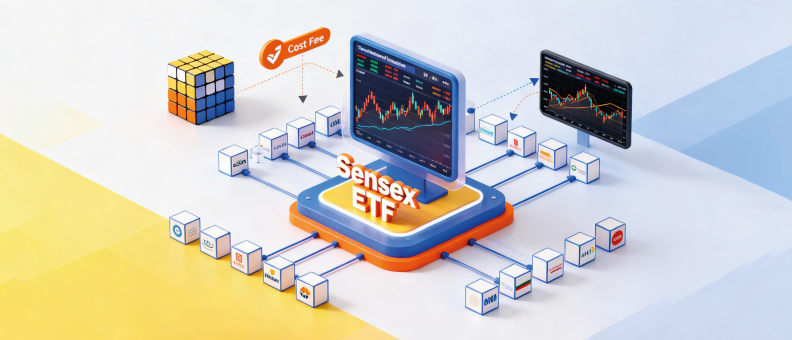
In market parlance, the term “Sensex ETF” is commonly used to refer to Exchange Traded Funds tracking the BSE Sensex (formerly known as the S&P BSE Sensex), an index comprising stocks of the country’s 30 largest companies in terms of market capitalisation. It provides exposure to a segment of India’s large cap equity market through a single market-linked instrument.
For beginner investors, a Sensex ETF reduces the need to select individual stocks. Instead, investors purchase units of a fund designed to replicate the performance of the underlying benchmark.
What is Sensex ETF?
ETFs track market indices such as the BSE Sensex (formerly known as the S&P BSE Sensex) and trade on stock exchanges like shares. The BSE Sensex is a free-float market capitalisation-weighted index comprising 30 large, established companies listed on the Bombay Stock Exchange (BSE).
The Sensex ETF replicates the BSE Sensex by holding the same shares in roughty the same weightages. The ETF seeks to deliver returns that closely correspond to the index (subject to tracking error), rather than outperform it.
This passive structure may make ETFs easier to understand and follow than actively managed mutual funds.
How does a Sensex ETF work?
When investors buy units of a Sensex ETF, the invested money is deployed into a portfolio constructed to match the benchmark. Because the index uses free-float market capitalisation weights, companies with larger market capitalisation typically receive higher weights in the ETF portfolio.
ETF units trade on the exchange throughout market hours, so their market price fluctuates during the day. In addition, the scheme publishes a daily Net Asset Value (NAV) based on the value of its underlying holdings after expenses.
Tracking error is an important indicator of how closely the ETF follows the index. Liquidity and market-making activity also influence trading efficiency because ETFs are exchange-traded instruments.
Sensex ETF vs Sensex index fund
A clear understanding of how Sensex ETFs and Sensex index funds differ can help investors choose an option that better aligns with their investment approach and convenience preferences:
| Parameter | Sensex ETF | Sensex Index Fund |
| Investment Route | Bought and sold on the stock exchange | Purchased directly from the mutual fund house |
| Account Requirement | Requires a demat and trading account | Does not require a demat account |
| Pricing Mechanism | Prices fluctuate intraday based on market demand and supply | Transactions are executed at the end-of-day NAV |
| Transaction Timing | Real-time trading during market hours | Processed once daily after market close |
| Investment Mode | Exchange-based purchases, even for periodic investments | More suitable for automated investments such as SIPs |
| Ease of Use for Beginners | May require familiarity with stock market transactions | Operationally simpler for systematic, small investments |
Planning tools such as SIP calculators estimate the potential future value of regular investments, while SWP calculators help model periodic withdrawals. These tools provide indicative projections and not assured outcomes.
Benefits of Sensex ETF
A Sensex ETF may offer the following features:
- One-transaction large cap diversification: The index includes large, liquid companies across multiple sectors listed on the BSE.
- Lower-cost passive structure: Passive ETFs often have lower expense ratios compared to many actively managed schemes, though costs may vary across funds.
- Exchange-traded flexibility: Units may be bought or sold on the stock exchange during trading hours, subject to liquidity.
Risks associated with Sensex ETFs
- Market risk: The ETF’s performance generally moves in line with the index, which is subject to equity market fluctuations.
- Concentration risk: Because the index contains only 30 companies, sectoral or company-level concentration may be higher compared to broader indices.
- Tracking and liquidity risks: Tracking error may arise due to expenses, cash holdings, or operational factors. Low trading volumes can widen bid-ask spreads, potentially affecting transaction prices.
Expense ratio and costs of Sensex ETFs
The expense ratio represents the annual fee charged by the scheme. This varies across ETFs, so investors should review scheme documents and factsheets.
The overall cost of investing in an ETF is not limited to the expense ratio. Investors may also incur brokerage charges, Securities Transaction Tax (STT), and the impact of bid-ask spreads when trading on the exchange.
Taxation of Sensex ETFs in India
BSE Sensex ETFs qualify as equity-oriented funds because they invest predominantly in domestic equities. Under prevailing tax rules:
- Short-term capital gains (holding period up to 12 months): taxed at the applicable rate as per prevailing tax laws
- Long-term capital gains (holding period over 12 months): taxed at the applicable rate on gains exceeding the prescribed exemption limit, as per prevailing tax regulations
- STT applies on sale of units through a recognised stock exchange
Sensex ETF performance over time
Sensex ETFs aim to replicate the performance of the underlying index. Over long periods, the index has historically reflected trends in India’s economic growth and corporate earnings, although past performance does not guarantee future outcomes.
Who may consider investing in a Sensex ETF?
A Sensex ETF may be considered by investors who:
- Seek broad exposure to large-cap Indian equities without selecting individual stocks
- Prefer passive investing strategies
- Have a medium- to long-term investment horizon and can tolerate equity market volatility
- Are comfortable transacting through a demat and trading account
Some investors also review valuation indicators such as the price-to-earnings ratio of the index as part of broader market analysis. These metrics should be interpreted alongside financial goals, time horizon, and risk tolerance.
How to invest in a Sensex ETF in India
A typical process may include:
- Open a demat and trading account
- Compare available Sensex ETFs based on their expense ratio, trading volume, bid-ask spread, and tracking error
- Review scheme documents to understand the benchmark, costs, and risk factors
- Purchase units on the stock exchange through a broker platform
- Review the investment periodically in line with long-term objectives
Conclusion
A Sensex ETF is a passive investment instrument that tracks one of India’s most widely followed equity indices. It offers diversified exposure to large-cap equities with transparent holdings and relatively lower ongoing costs, but it also involves market risk, tracking risk, and trading-related costs.
For investors seeking broad large-cap exposure without selecting individual stocks, a Sensex ETF may be considered if it aligns with their financial goals, investment horizon, and risk tolerance.
FAQs
How is a Sensex ETF different from a Sensex index fund?
A Sensex ETF trades on the stock exchange during market hours and requires a demat account. A Sensex index fund is purchased from the mutual fund house and transactions occur at the end-of-day NAV.
Can investors buy and sell Sensex ETFs on the stock exchange?
Yes. ETFs trade like shares on recognised stock exchanges and may be bought or sold during market hours, subject to liquidity.
What are the benefits of investing in a Sensex ETF?
Common features include diversified exposure to the Sensex, passive investment structure, transparency of holdings, and relatively lower ongoing costs compared to many active funds.
Are Sensex ETFs suitable for long-term investing?
They may be suitable for investors seeking long-term large-cap equity exposure who can remain invested through market fluctuations. Suitability depends on financial goals and risk tolerance.
What costs are involved in investing in a Sensex ETF?
Costs may include the expense ratio, brokerage charges, STT, and the impact of bid-ask spreads during trading.
How are Sensex ETFs taxed in India?
If classified as equity-oriented funds, taxation generally follows the equity mutual fund framework under prevailing tax laws, including short-term and long-term capital gains rules.