Time is an essential part of an investment journey. While investors often focus on potential returns and market performance, the length of time for which funds remain invested – the investment time horizon – also plays a role in shaping risk exposure, product selection, and overall investment planning.
This guide explains what an investment time horizon means, outlines different time horizon categories, and discusses how the concept relates to mutual fund investing.
Table of Contents:
- Understanding investment time horizon & its meaning
- Why investment time horizon matters
- Types of investment time horizons
- Aligning your goals with your investment time horizon
- How to determine your personal time horizon
- Role of investment time horizon in risk management
- Investing with Bajaj Finserv AMC
- Adjusting your time horizon: When and why?
Understanding investment time horizon & its meaning
An investment time horizon refers to the period for which an investor intends to keep funds invested before withdrawal. This period may range from short durations, such as a few weeks or months, to longer spans of several years, depending on the nature of the financial objective. Examples include planning for near-term expenses, building an emergency reserve, funding education, or working towards long-term potential wealth creation.
The chosen time horizon influences asset allocation decisions, liquidity preferences, and the balance between growth-oriented instruments (which may carry higher risk) and relatively stable instruments, with more modest return potential. Generally, longer time horizons may allow investors to withstand market volatility better than shorter time horizons.’As a result, the time horizon is often considered alongside other factors when evaluating mutual fund categories, as different categories may behave differently across varying market phases and timeframes.
Also Read: How Investment Horizons Impact Arbitrage Funds Returns
Why investment time horizon matters
The investment time horizon serves as an important planning reference that helps determine appropriate investment strategies. While it provides flexibility in investment choices, it should be aligned with specific financial goals and liquidity needs to potentially optimize outcomes. Understanding it may help in setting relatively realistic expectations.
Different time horizons align differently with equity funds, debt funds, hybrid funds, or liquid funds. Over shorter periods, equity-oriented investments may experience significant interim volatility, while debt-oriented funds may show relatively lower variability, though outcomes are not assured in either case. Considering the intended duration of investment may help investors evaluate how investment characteristics relate to the planned use of funds.
In general terms:
- Over longer periods, the impact of short-term market volatility may reduce, though outcomes remain market-linked.
- Shorter horizons may place greater emphasis on liquidity and relative stability of capital.
- Longer horizons may allow inclusion of growth-oriented investments as part of an overall asset mix.
Types of investment time horizons
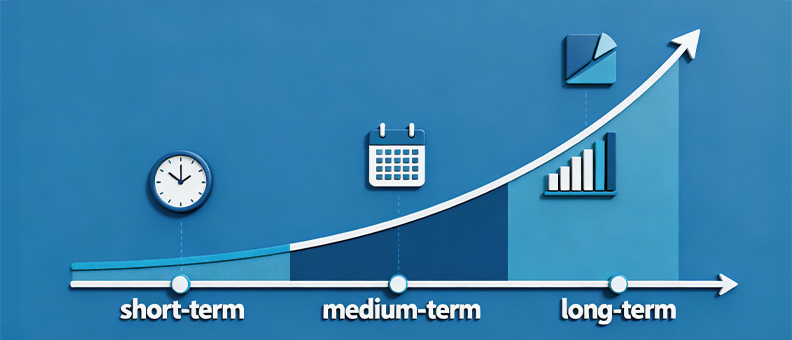
Investment time horizons are commonly grouped into three broad categories. Each category reflects a different balance between potential growth and relative stability. This classification may help investors relate personal financial goals to suitable mutual fund categories, rather than focusing only on return potential.
Short-term investment horizon (Less than 3 Years)
A short-term investment horizon generally applies when funds are required in the near future. Examples may include planned expenses or temporary allocation of surplus funds. For such horizons, investors may explore:
- Liquid funds, which invest in money market instruments with short maturities.
- Overnight funds, which invest in securities with one-day maturity.
- Other debt funds with relatively lower sensitivity to interest rate movements.
While liquid funds, overnight funds and money market funds are generally considered for very short durations – such as a few weeks or months – other debt funds may be suitable when you plan to stay invested for a year or more. However, different debt funds carry varying degrees of interest rate risk, credit risk, and liquidity risk that should be evaluated based on your risk tolerance.
Medium-term investment horizon (3 to 5 Years)
A medium-term horizon may offer greater flexibility. This timeframe may allow investors to consider a mix of income-oriented and growth-oriented exposures. Commonly considered options may include:
- Debt funds with moderate or higher duration exposure.
- Hybrid funds that combine equity and debt components.
Long-term investment horizon (5 years and beyond)
A long-term investment time horizon is often associated with long-range financial goals such as retirement planning or long-term potential wealth creation. Over extended periods:
- Equity funds may exhibit potential for growth aligned with their long-term nature.
- Hybrid funds, such as multi asset allocation or balanced advantage funds, may be considered for investors who are comfortable with some equity exposure but want to moderate it with some exposure to debt or other asset classes.
- The effect of interim market volatility may moderate over time, though this is not guaranteed.
Aligning your goals with your investment time horizon
Aligning financial goals with an appropriate investment time horizon is an important aspect of mutual fund investing. The time horizon refers to the period for which funds are intended to remain invested, based on when the goal is expected to arise—such as short-, medium-, or long-term needs—rather than on return expectations.
Tools such as SIP calculators may be used to illustrate how investments might potentially accumulate over a selected period. These illustrations are based on assumptions and estimates and do not represent assured or guaranteed results.
Having a defined time horizon may support a more organised investment approach and encourage consistency. However, investment behaviour and potential outcomes continue to be influenced by market conditions and individual circumstances.
The calculator is an aid, not a prediction tool. It may provide only an indicative picture.
Also Read: Patience & Time Horizon in Megatrend Investing
How to determine your personal time horizon
Determining an individual investment time horizon may involve considering:
- Expected timelines for financial goals.
- Stability of income and visibility of cash flows.
- Comfort with interim market fluctuations.
- Liquidity needs and access to funds, if required.
- Existing financial commitments and responsibilities.
Age may influence this assessment, but it is not the sole factor. Financial responsibilities, goal priorities, and liquidity needs may carry equal importance.
Role of investment time horizon in risk management
Risk and time horizon are closely linked. A shorter horizon may offer limited scope to manage interim market volatility, particularly for equity-oriented investments. A longer horizon may provide more time for portfolio adjustments, though it does not eliminate risk.
SEBI’s risk-o-meter framework highlights that mutual fund schemes carry varying levels of risk based on asset composition. Time horizon may help investors assess how different risk levels align with their investment plans.
Investing with Bajaj Finserv AMC
Bajaj Finserv AMC offers mutual fund schemes across equity, debt and hybrid categories. It also offers index funds and ETFs.
As outlined earlier in the article, funds with high equity exposure may be more suitable for longer horizons, whereas funds with heavy debt exposure may be considered for shorter terms. References to fund categories in the context of time horizon are intended for general understanding and do not indicate performance expectations.
You can see the full list of schemes here. Please note that each scheme has its own risk profile and investment objective. Investors are advised to read all scheme-related documents carefully.
Adjusting your time horizon: When and why?
Investment time horizons may change due to shifts in income, personal circumstances, or financial priorities. Adjustments may become relevant during significant life events or when financial goals are revised. Periodic reviews may help investors assess whether asset allocation continues to align with updated timelines and liquidity needs, while remaining mindful of market conditions.
Conclusion
An understanding of investment time horizon may provide useful perspective when making investment-related decisions. Considering mutual fund investments alongside time-based goals may support a more organised approach that looks beyond short-term market movements. This perspective applies to both SIP based and lumpsum investments.
Frequently Asked Questions
What factors influence your investment time horizon?
Factors may include goal timelines, income stability, liquidity needs, comfort with market fluctuations, and personal financial responsibilities.
Can a longer investment time horizon guarantee higher returns?
No. A longer horizon does not guarantee outcomes. It may allow more time for market cycles to play out, but potential returns remain market-linked.
How often should I review my investment time horizon?
Reviews may be aligned with major life events or meaningful changes in financial circumstances.
What is the difference between time horizon and investment period?
Time horizon refers to the planned duration of investment, while the investment period reflects the actual time funds remain invested.
Does my age impact my investment time horizon?
Age may influence planning, but financial goals, responsibilities, and timelines may be equally important considerations.