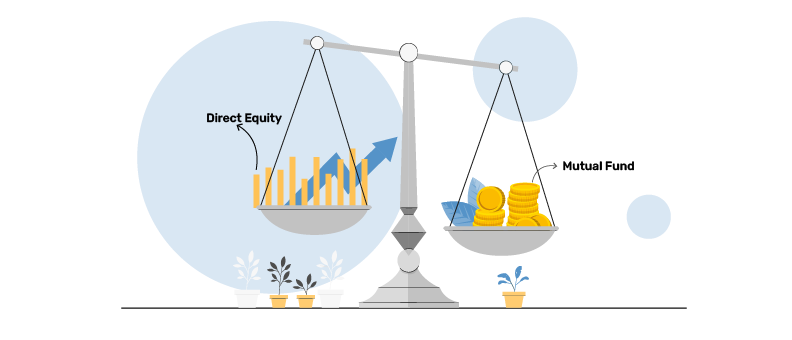
Mutual funds and direct equity both provide access to the securities market, but the investment experience is different. A mutual fund offers exposure to a portfolio managed according to a defined mandate, while a direct equity investment requires the investor to select and monitor individual company shares.
The choice involves more than comparing returns. Diversification, control, costs, research requirements, investment horizon and risk also matter. Understanding these differences can help investors decide whether one approach, or a combination of both, fits their financial plan.
Key Takeaways
- Mutual funds pool investors’ money into a portfolio, while direct equity provides ownership in individually selected companies.
- Mutual funds may offer diversification and professional or index-based portfolio management.
- Direct equity provides greater control but requires company research, portfolio construction and regular monitoring.
- Both approaches are market-linked and can result in losses.
- The choice depends on the investor’s knowledge, time commitment, risk appetite, investment horizon and diversification needs.
Direct equity versus equity mutual funds
The following comparison shows how ownership and portfolio management differ between direct equity vs equity mutual funds:
| Basis | Direct equity | Equity mutual fund |
| Ownership | Shares of selected companies | Units of a mutual fund scheme |
| Security selection | Decided by the investor | Managed by a fund manager or determined by an index |
| Diversification | Depends on the investor’s portfolio | Depends on the scheme’s mandate and holdings |
| Research required | Company-level research | Scheme selection and periodic review |
| Control | Investor controls each transaction | Portfolio decisions follow the scheme mandate |
| Time commitment | Generally higher | Generally lower |
| Costs | Brokerage, demat charges and statutory transaction costs may apply | Expense ratio and applicable exit load |
| Investment method | Shares are purchased through a trading account | Lumpsum investments and SIPs may be available |
| Pricing | Executed at the available market price | Open-ended scheme transactions generally occur at the applicable NAV |
| Income | Companies may declare dividends | A scheme may declare Income Distribution cum Capital Withdrawal |
| Company-specific risk | Can be high in a concentrated portfolio | Spread across holdings, although concentration risk may remain |
| Demat account | Required for listed shares | Not generally required for conventional mutual fund units |
Neither approach assures returns. An equity mutual fund can decline during a broad market fall, while direct equity is additionally affected by developments involving the companies selected.
Example of direct equity and mutual fund investing
An example can make the mutual fund and equity difference easier to understand:
Consider Rohan, who wants exposure to listed technology companies.
With direct equity, Rohan selects individual companies after examining their finances, business prospects, competitive position and valuation. His outcome depends on the companies selected and the allocation to each one.
Alternatively, he may invest in an equity mutual fund that holds technology companies as part of its portfolio. Depending on the scheme, it may also invest across other sectors. Rohan owns units of the scheme, while the portfolio is managed by a fund manager or follows an index.
The mutual fund route changes how the portfolio is selected and managed. It does not remove market risk.
The figures shown are for illustrative purpose only.
Please note that the reference to any industry/sector/stock is provided for illustrative purposes only. This should not be construed as a research report or a recommendation to buy or sell any security or sector.
Benefits of investing through mutual funds
Mutual funds may appeal to investors who want market exposure without selecting every security themselves:
- Diversification: One scheme can provide exposure to several securities.
- Professional management: Actively managed funds place portfolio decisions with an appointed fund manager.
- Passive options: Index funds provide rules-based exposure to an underlying benchmark.
- Regular investing: An SIP allows a specified amount to be invested periodically.
- Lower monitoring requirements: Investors review the scheme rather than tracking every holding independently.
- Choice across asset classes: Different categories provide exposure to equity, debt or a combination of assets.
The value of these features depends on the scheme selected. The investment objective, portfolio, benchmark, Riskometer, expenses and suggested investment horizon should be reviewed before investing.
Benefits of direct equity investing
Direct equity may suit investors who want complete responsibility for portfolio decisions:
- Security-level control: The investor chooses each company and allocation.
- Portfolio customisation: Holdings can be selected according to the investor’s research and strategy.
- Direct ownership: The investor holds company shares rather than mutual fund units.
- Control over transactions: Purchase and sale decisions are made by the investor during market hours.
- No scheme expense ratio: There is no mutual fund management fee, although brokerage, demat charges, taxes and other transaction costs may apply.
These features require time, knowledge and discipline. Greater control does not reduce company-specific or market risk.
Risks of mutual funds and direct equity
The sources and concentration of risk differ across the two routes:
Risks of direct equity
Selecting individual shares exposes investors to risks arising from both the companies chosen and their own portfolio decisions:
- Company-specific developments can materially affect a stock’s value.
- A small portfolio may be concentrated in a few companies or sectors.
- Weak research or emotionally driven decisions may lead to losses.
- Frequent transactions can increase costs.
- Some shares may experience sharp price movements or limited liquidity.
Risks of equity mutual funds
Equity mutual funds spread investments across securities, but their structure and portfolio choices introduce the following risks:
- The NAV can decline when the underlying portfolio falls.
- A scheme may underperform its benchmark or category.
- Sectoral, thematic and focused funds may carry significant concentration risk.
- Passive funds may differ from their benchmarks because of expenses and tracking difference.
- The selected scheme may not suit the investor’s goal, horizon or risk appetite.
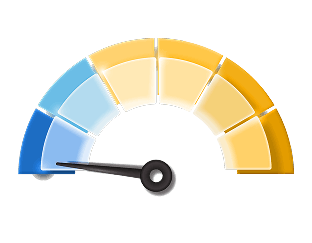
SEBI’s Riskometer displays the stated risk level of a mutual fund scheme on a scale from low to very high. The classification can change with the scheme’s portfolio and should be reviewed before investing.
Source: SEBI Investor, understanding the Riskometer.
How to choose between direct equity and an equity mutual fund
The better fit depends on what the investor can manage consistently:
| Consideration | Direct equity may be considered when | An equity mutual fund may be considered when |
| Research capability | The investor can analyse individual companies | The investor prefers fund-managed or index-based selection |
| Time availability | Regular portfolio monitoring is practical | Limited time is available for company-level research |
| Diversification | The investor can construct and maintain a diversified portfolio | Diversification through one scheme is preferred |
| Control | Security-level control is important | Portfolio decisions can follow the scheme mandate |
| Investment method | Individual share purchases are preferred | An SIP or lumpsum investment is preferred |
| Risk | Company-specific risk is understood and acceptable | A portfolio approach is preferred, subject to scheme risk |
| Experience | The investor understands financial statements and valuation | Selecting a scheme is more manageable than selecting individual shares |
The choice does not have to be exclusive. Investors may hold mutual funds and a separate direct equity portfolio, provided each allocation serves a defined purpose and the combined portfolio does not create unintended concentration.
Taxation of equity mutual funds and direct equity
Qualifying listed equity shares and units of equity-oriented mutual funds receive broadly similar capital-gains treatment when the prescribed Securities Transaction Tax conditions are met:
| Holding period | Classification | General tax treatment |
| 12 months or less | Short-term capital gain | Taxed at 20% |
| More than 12 months | Long-term capital gain | Aggregate eligible gains exceeding ₹1.25 lakh in a financial year are taxed at 12.5% |
The ₹1.25 lakh threshold is shared across eligible long-term capital gains covered by the relevant equity-taxation provisions. It is not available separately for every security, scheme or transaction.
Dividends from shares and Income Distribution cum Capital Withdrawal from mutual funds are generally included in the investor’s taxable income. Applicable surcharge and 4% health and education cess may increase the final tax liability.
These rates do not apply to every mutual fund. Tax treatment depends on whether the scheme meets the legal definition of an equity-oriented fund and whether the prescribed transaction conditions are satisfied.
Sources: Income Tax Department, tax on short-term capital gains under Section 196; Income Tax Department, tax on long-term equity gains under Section 198.
The tax information in this article is based on prevailing laws at the time of publishing the article and is subject to change. Please consult a tax professional or refer to the latest regulations for up-to-date information.
Common mistakes to avoid
Recognising the common missteps associated with each route can lead to more considered investment decisions:
While investing in direct equity
Careful research and disciplined portfolio management can help investors avoid these common mistakes:
- Buying shares based only on tips, social-media posts or recent price movements
- Concentrating too much money in one company or sector
- Ignoring valuation while focusing only on business quality
- Trading frequently without considering costs
- Failing to review changes in the company or its industry
- Investing money required for near-term commitments
While investing in mutual funds
Choosing a suitable scheme requires more than comparing returns, so investors should avoid these common mistakes:
- Selecting a scheme only because of recent returns
- Ignoring the investment objective, portfolio and Riskometer
- Choosing a scheme that does not match the goal or horizon
- Holding several similar schemes with substantial portfolio overlap
- Overlooking the expense ratio, exit load and taxation
- Assuming diversification prevents every loss
Past performance may or may not be sustained in future.
Conclusion
The main equity and mutual fund difference lies in how securities are selected, managed and monitored. Direct equity gives the investor control over individual holdings but requires research and portfolio management. A mutual fund provides access to a professionally managed or index-based portfolio through scheme units.
Neither route is universally better. The choice should reflect the investor’s financial goals, investment horizon, risk appetite, research capability and available time. A combination may also be considered if each allocation has a defined role and the complete portfolio remains appropriately diversified.
FAQs
What is the main difference between mutual funds and direct equity?
Direct equity gives an investor ownership in selected companies. A mutual fund gives the investor units in a scheme that holds a portfolio of securities according to its mandate.
Which is more suitable for a beginner, mutual funds or direct equity?
A diversified mutual fund may be easier for a beginner who does not have the time or knowledge to analyse individual companies. The selected scheme must still suit the investor’s goal, horizon and risk appetite.
Is direct equity riskier than an equity mutual fund?
A concentrated direct equity portfolio generally carries greater company-specific risk than a diversified equity fund. An equity mutual fund still carries market risk and may also be concentrated by sector, theme or strategy.
Can an investor lose all the money invested in direct equity?
Yes. A share can lose most or all of its value if the company fails or becomes insolvent. Diversification may reduce dependence on one company but cannot eliminate losses.
Can a mutual fund lose money?
Yes. A mutual fund’s NAV can decline when its underlying investments lose value. The type and degree of risk depend on the scheme category and portfolio.
Can beginners invest in direct equity?
Yes, but they should first understand company analysis, valuation, diversification, transaction costs and market risk. Starting with a limited allocation can reduce the effect of early mistakes.
How does liquidity differ between mutual funds and equities?
Listed shares are traded during exchange hours at available market prices. Units of an open-ended mutual fund are generally purchased or redeemed with the fund at the applicable NAV, subject to cut-off times, exit loads and scheme terms.
Which is better for long-term growth, mutual funds or direct equity?
Neither is consistently better. The outcome depends on the securities or scheme selected, investment cost, purchase timing, market performance and investor decisions.
Can an investor hold both direct equity and mutual funds?
Yes. Mutual funds may form a diversified portfolio core, while direct shares may be held separately according to the investor’s research and risk appetite. Portfolio overlap and concentration should still be reviewed.
Do investors need a demat account for mutual funds?
A demat account is not generally required for conventional mutual fund units. It is required for purchasing listed shares and exchange-traded funds directly.
Are equity funds and direct equity taxed in the same way?
Qualifying listed equity shares and equity-oriented mutual funds receive broadly similar capital-gains treatment when the prescribed Securities Transaction Tax conditions are met. Different rules may apply to other fund categories or transactions.
Tools for Investors