BAJAJ ASSET MANAGEMENT LIMITED.

Campaign word3

Naam aur kaam,
Dono mein flexible

Understanding Flexi Cap Fund

Campaign word3

Naam aur kaam,
Dono mein flexible

Understanding Flexi Cap Fund

A simple way to diversify

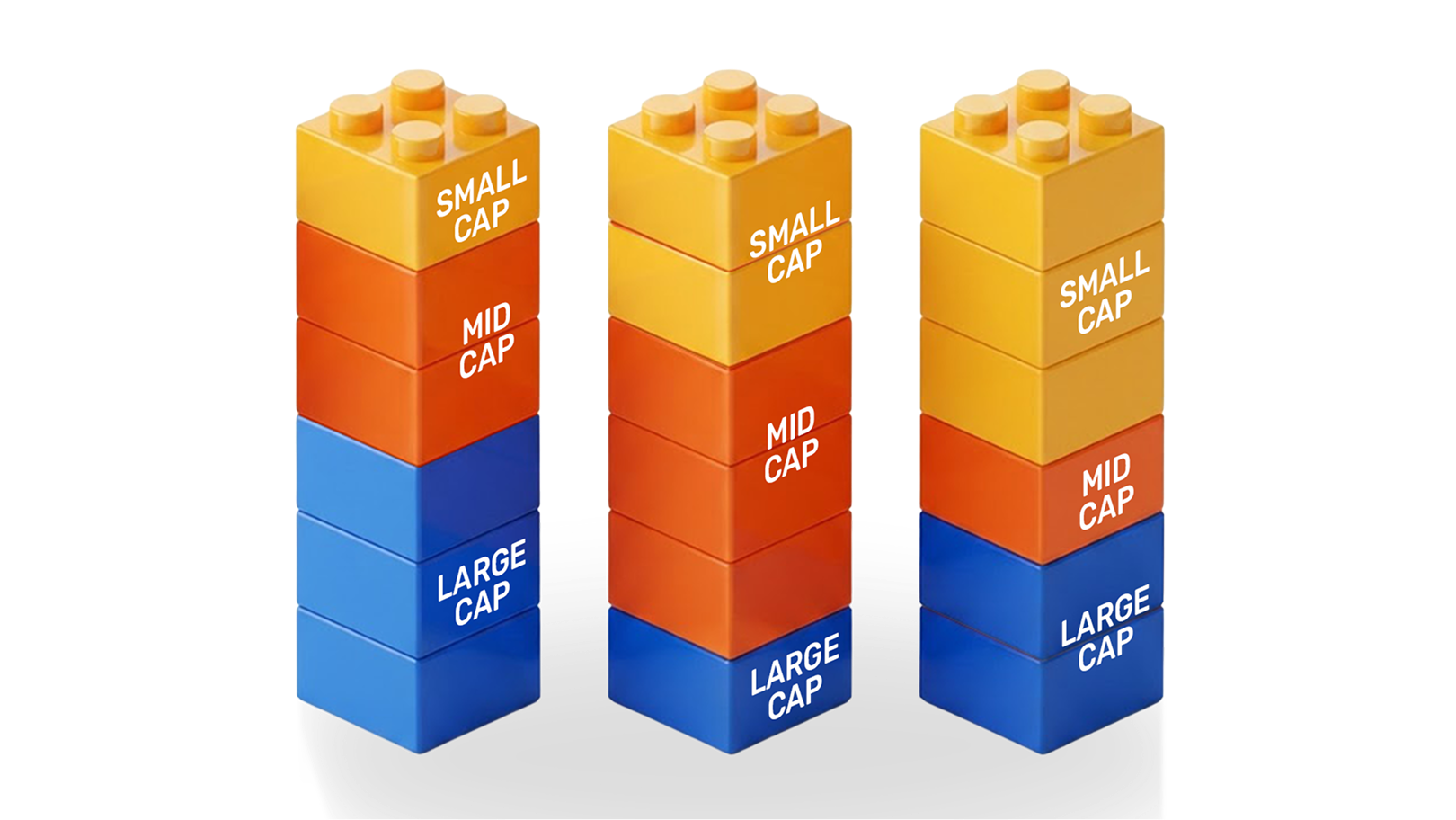
You choose a large cap fund for stability. Someone recommends mid caps for growth. Then, a headline calls small caps the next big opportunity. Soon, you’re constantly deciding how much to invest where and wondering if you’ve got the mix right. A Flexi Cap Fund makes this easier. You choose a fund that aligns with your goals and risk appetite, while the fund manager decides how to invest across large, mid and small cap companies as market conditions change.

Investing Across Market Caps

Campaign word3

What Flexi Cap Fund Offers

Campaign word3
Freedom to move

The fund manager can adjust the mix across large, mid and small cap companies as opportunities and risks change.
Campaign word3
Diversification without guesswork

Different market-cap segments can lead at different times. Diversification across all three means you do not have to bet on just one.

Campaign word3
Research behind every selection

The investment team researches companies, selects stocks and regularly reviews the portfolio.

Campaign word3
Research behind every selection

The investment team researches companies, selects stocks and regularly reviews the portfolio.

Campaign word3
Campaign word3

Watch this quick video to see how flexibility works inside a Flexi Cap Fund.

Campaign word3

Could a quick conversation make investing easier to understand?

What a Flexi Cap Fund can do:

  • Invest across large, mid and small cap companies
  • Give the fund manager flexibility to change the allocation
  • Reduce the need to manage multiple market-cap funds yourself
  • Adapt the portfolio as opportunities shift across market segments

What it cannot do:

  • Guarantee that the fund manager will always get the allocation right
  • Guarantee better returns than large, mid or small cap funds
  • Protect you from losses when markets fall
  • Guarantee frequent changes to the portfolio
  • Replace asset allocation, emergency savings or financial planning
  • Make equity suitable for a short-term goal

Flexible does not mean safe.
Flexible does not mean constantly changing.
Flexible does not mean guaranteed to outperform.

A Flexi Cap Fund has the room to invest across market caps.

What matters is how the fund manager uses that flexibility.

Before choosing a Flexi Cap Fund, ask yourself three questions

1. What is this money for?

Name the goal and the date.
“Long term” is not a goal.
Retirement in 15 years is.
A child’s education in ten years is.
A house deposit in five years is.
If you may need the money soon, an equity fund may not be appropriate.

2. Can your finances withstand a bad period?

Do not ask only whether you are “comfortable with risk.”
Ask what you would do if the investment fell significantly and stayed below its previous value for an extended period.
This is not a market question. It is a life question.
Can you still pay your EMIs?
Still fund your child’s school fees?
Still make that quiet evening call to your parents without worrying in the background?
Your answer should come from your income, emergency fund, obligations and time horizon—not from how optimistic you feel today.

3. Do you know what the fund actually owns?

The category name tells you what the fund is allowed to do. It does not tell you what the manager has done.

Read the current factsheet and Scheme Information Document. Examine:

  • The allocation to large, mid and small cap companies
  • How that allocation has changed over time
  • Portfolio concentration
  • Investment style
  • Benchmark
  • Riskometer
  • Expense ratio
  • Fund management history
  • Performance across complete market cycles—not only the latest year

The real case for a Flexi Cap Fund

It is not that the fund knows what will happen next.

It is that you do not have to pretend that you do.

A Flexi Cap Fund gives a professional investment team the freedom to search across market capitalisations while you remain focused on the part of the plan only you can define:

What the money is for.
When you will need it.
How much uncertainty you can afford.

You do not need to know which part of the market will win next.
You need an investment you understand well enough to hold when the answer changes.

How does a flexi cap fund work?

When you invest in a flexi cap fund, your money is pooled with money from other investors. You receive units in the fund. The fund manager uses this pool to build a mix of large, mid and small cap stocks. 

This mix is not fixed and it can change when the fund manager buys or sells stocks. The weights can also shift when stock prices move. Any change must stay within the investment objective and limits set out in the scheme documents. As the value of the fund’s holdings changes, so does its net asset value, or NAV.

Large, mid or small: What do these labels mean?

Large cap, mid cap and small cap are size labels for listed companies. Here, size means full market cap. It does not mean sales, profit or the price of one share. Full market cap is the share price multiplied by all outstanding shares. SEBI categorises companies by rank: 

  • Large cap: Companies ranked 1st to 100th by full market cap. 
  • Mid cap: Companies ranked 101st to 250th by full market cap. 
  • Small cap: Companies ranked 251st onwards by full market cap. 

Think of this as a ranking, not a permanent tag. AMFI refreshes the list every six months under SEBI’s rules. As a company’s market cap changes, it may move from one category to another.

What does “flexi” mean in a flexi cap fund?

In a flexi cap fund, “flexi” refers to the mix of company sizes. SEBI does not set a separate minimum for large cap, mid cap or small cap stocks. The fund manager decides how much weight to give each category and selects stocks from those categories. Both choices must follow the scheme’s investment objective and stated limits. 

The mix may change when stocks are bought or sold. It can also shift as share prices move. There is no fixed timetable. Each scheme’s SID explains the process it follows. Put simply, flexibility means room to adjust the mix. It does not mean that the mix must keep changing.

What does the flexi cap structure allow?

The structure works at two levels. First, the investment team decides how much weight to give large cap, mid cap and small cap stocks. Then it selects companies within those categories. Neither the split nor the stock list has to stay the same for the life of the fund. The three categories do not need an equal share, and the mix does not have to change on a set date. A shift can be made when the fund’s stated process calls for one, as long as the scheme’s limits are followed.

Does a flexi cap fund invest only in shares?

Equity and equity-related instruments form the core of a flexi cap fund, but they need not make up the entire portfolio. SEBI requires at least 65% of total assets to be held in equity and equity-related instruments. 

SEBI calls the part outside this core allocation the residual portion. It may remain in equity or be placed in permitted assets such as money market and other liquid instruments, gold and silver instruments, and infrastructure investment trusts (InvITs). Each asset type has its own limit, and a scheme need not use every option. The SID shows what a scheme may hold, while its latest portfolio disclosure shows what it held on the stated date.

What should you read before investing?

Start with the Key Information Memorandum, or KIM. It gives a short view of the fund’s objective, asset mix, benchmark, costs and key terms. For the full picture, turn to the Scheme Information Document, or SID. It explains what the fund may buy, the limits it must follow and the plans and options on offer. The Statement of Additional Information, or SAI, gives general details about the mutual fund and the company that manages it. 

Then check the latest factsheet and portfolio disclosure. They show what the fund held on the stated date. The SID shows what it is allowed to hold. Both matter, since the mix can change with time.

Ready to invest in a Flexi Cap Fund?

Here’s how to get started in four simple steps.
Campaign word3

Know what you’re choosing

Read the KIM and SID to understand the fund’s objective, costs and key terms.

Campaign word3

Complete your KYC

Verify your identity before investing.

Campaign word3

Choose how you invest

Invest a lump sum or start an SIP with an amount and schedule that suit you.

Campaign word3

Submit your application

Once your application and payment are processed, units are allotted at the applicable NAV, subject to cut-off rules.


Contact Us

Dear Investors

Call, chat or write to us if you need any help

Available
Mon–Fri, 9AM–6PM
Campaign word3

Toll-free number

1800-309-3900

Write to us at

service@bajajamc.com

For more information, visit

bajajamc.com

Get A Call Back

Want to know more about flexi cap funds?

Share your details and our experts will guide you

Campaign word3

By submitting my details, I agree to receive a call from
Bajaj AMC for assistance.

FAQs

What is the minimum equity allocation in a flexi cap fund?

A flexi cap fund must invest at least 65% of its total assets in equity and equity-related instruments. This is the minimum set by SEBI. The remaining assets must follow the scheme’s stated allocation limits.

No. SEBI does not set a separate minimum for large cap, mid cap or small cap stocks. The fund can change this mix while following its total equity rule and scheme limits.

The fund manager decides the market-cap mix. Each decision must follow the scheme’s investment objectivestated process and allocation limits, along with applicable SEBI rules.

No. “Dynamic” means the mix can change, not that it must change often. SEBI does not set a fixed schedule for these changes. The fund manager may retain or alter the mix in line with the scheme’s stated process.

NAV is calculated by subtracting the fund’s liabilities from the market value of its assets. The result is then divided by the number of units outstanding.

This gives the value of one unit.

Open-ended means units can be purchased from or redeemed with the fund on business days at the applicable NAV. The scheme does not issue a fixed number of units, so its unit count can change over time.

Yes. Investments in a flexi cap fund can generally be made as a lumpsum or through an SIP. The minimum amount, available SIP frequencies and other terms are set by the scheme and stated in its KIM.

Check the AMC’s official website for its latest monthly portfolio disclosure, factsheet, SID and KIM. The portfolio shows holdings on a stated date, while the SID and KIM explain the scheme’s objective, asset mix, costs and terms. SID and KIM filings are also available on SEBI’s website.

An investor education and awareness initiative by Bajaj Finserv Mutual Fund.

Visit www.bajajamc.com to know more about the process to complete a one-time Know Your Customer (KYC) requirement to invest in Mutual Funds. Investors should only deal with registered Mutual Funds, details of which can be verified on the SEBI website (www.sebi.gov.in/intermediaries.html). For any queries, complaints & grievance redressal, investors may reach out to the AMCs and / or Investor Relations Officers. Additionally, investors may also lodge complaints on https://scores.gov.in if they are unsatisfied with the resolutions given by AMCs. SCORES portal facilitates you to lodge your complaint online with SEBI and subsequently view its status. In case the investor is not satisfied with the resolution of the complaints raised directly with the AMCs or through the SCORES portal, they may file any complaint on the Smart ODR on https://smartodr.in/login. Mutual Fund investments are subject to market risks, read all scheme related documents carefully.

Login/Signup