Bajaj Finserv Business Cycle Fund is our new open-ended equity scheme seeking long-term capital appreciation through business cycle investing. Our approach combines research into megatrends with active allocation across sectors and companies as business conditions change. The New Fund Offer (NFO) opens on 20 November 2026 and closes on 4 December 2026.
Key Takeaways
- The Bajaj Finserv Business Cycle Fund NFO opens on 20 November and closes on 4 December 2026, with a minimum initial lumpsum investment of ₹500 (Plus multiples of Re.1).
- The fund seeks long-term capital appreciation through business cycle investing and a focus on companies that benefit from megatrends.
- Its allocation mandate is 80% to 100% of total assets in equity and equity-related instruments selected on the basis of business cycle.
- Its INQUBE framework combines information, quantitative analysis and behavioural insights to guide investment decisions.
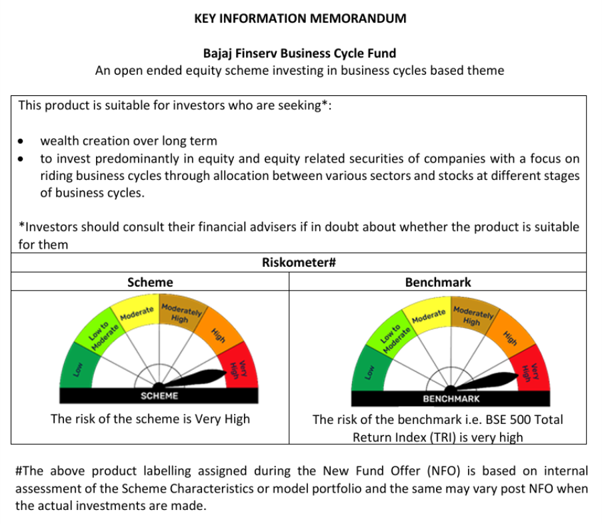
- The scheme’s NFO Riskometer classification is Very High, and neither returns nor achievement of its investment objective is guaranteed.
Why consider investing through business cycles?
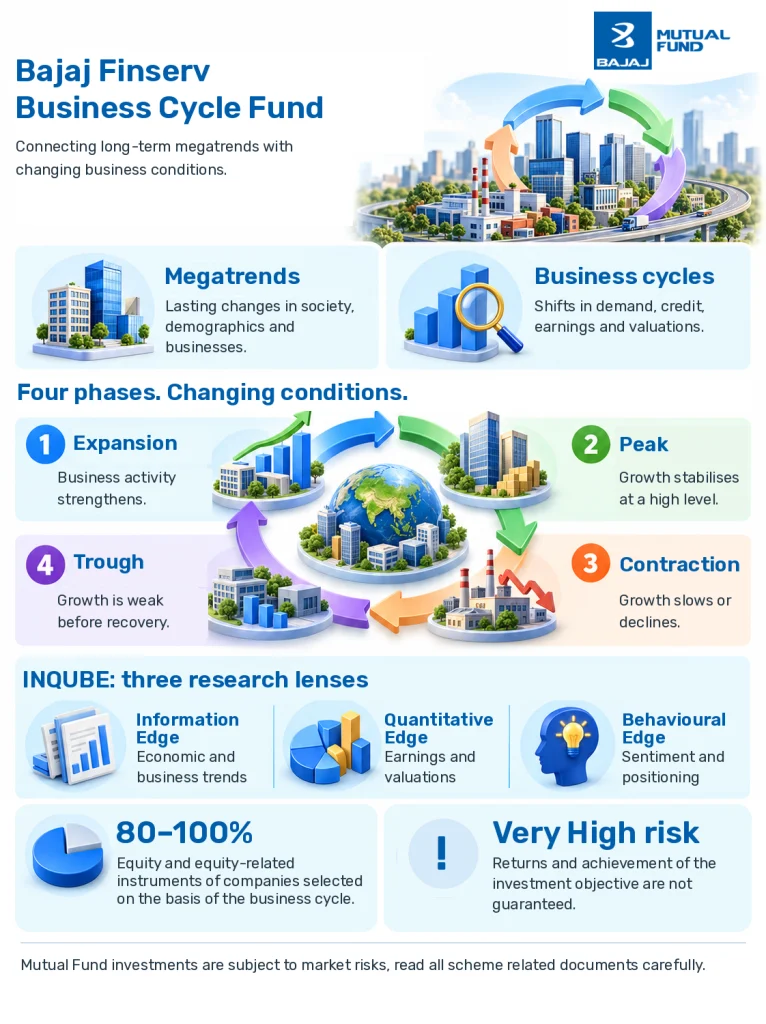
Sectors respond differently to changes in demand, borrowing conditions and earnings. Their performance can vary across the four phases of a business cycle:
- Expansion: Growth rises as business activity strengthens.
- Peak: Growth stabilises at a high level.
- Contraction: Growth slows or declines.
- Trough: Growth is weak or absent before the next recovery.
Even within one sector, passenger cars, two-wheelers and commercial vehicles, for example, can experience different demand cycles. Our fund examines these differences when assessing investment opportunities.
Please note that the reference to any industry/sector/stock is provided for illustrative purposes only. This should not be construed as a research report or a recommendation to buy or sell any security or sector.
What sets Bajaj Finserv Business Cycle Fund’s approach apart?
Our approach connects long-term changes in businesses with the conditions affecting them today:
A focus on megatrends reshaping businesses
Megatrends are broad, lasting changes that can reshape markets. The fund aims to identify companies benefiting from changes in society and the make-up of the population.
Established businesses may need to adapt to protect their market positions, while newer companies may enter existing markets or create new ones. These shifts can change where profits are earned.
Connecting megatrends with business cycles
We assess credit availability, interest rates, commodity demand and supply, consumption and capital investment. The team also reviews earnings, valuations, liquidity and investor sentiment to assess opportunities under prevailing conditions.
Research into sectors, industries and companies
Our team looks for industries in the early stages of an upcycle, when business conditions are improving. Sector analysis is combined with company research, covering the business, management, valuation, quality, growth outlook and risk.
Flexibility across company sizes and investment styles
The fund can invest across large, mid and small cap companies, using a blended approach to growth and value investing. Sector allocations will reflect the opportunities identified, without fixed sector weights. The portfolio is expected to hold around 45 to 60 stocks, although actual holdings may vary.
Decisions supported by INQUBE
Bajaj AMC’s INQUBE investment philosophy is built on understanding the fundamental forces that drive markets and draws on human nature and behavioural finance. It brings together three edges of the investment team: the Information edge, Quantitative edge and Behavioural edge. The investment process applies this philosophy through:
- Generating investment ideas: Combining top-down and bottom-up research simultaneously, while evaluating business cycles and trends, including momentum and trend reversals.
- Selecting stocks: Analysing each company’s business, management and valuation.
- Deciding allocations: Assessing the company’s size, quality, valuation, growth outlook and risk to determine its place in the portfolio.
How will the fund allocate its assets?
The scheme’s permitted allocation ranges are:
| Investment category | Percentage of total assets |
| Equity and equity-related instruments selected on the basis of business cycle | 80% to 100% |
| Equity and equity-related instruments of Companies other than above | 0% to 20% |
| Money market instruments, other liquid instruments, units of InvITs, Units of Gold ETFs and Silver ETFs, and units of Liquid, Overnight and Money Market Mutual Fund | 0% to 20% |
These are permitted ranges, not fixed portfolio weights, and remain subject to the scheme’s exposure limits. The scheme may also invest overseas and use derivatives within the limits stated in the SID.
What are the NFO dates and investment details?
Here are the key details for the Bajaj Finserv Business Cycle Fund NFO:
| Particular | Details |
| NFO opens on | Friday, 20 November 2026 |
| NFO closes on | Friday, 4 December 2026 |
| Scheme category | Thematic fund |
| NFO offer price | ₹10 per unit |
| Minimum initial lumpsum investment | ₹500, with investments in multiples of ₹1 thereafter |
| Minimum additional investment during the ongoing offer | ₹100, with investments in multiples of ₹1 thereafter |
| Plans | Direct Plan and Regular Plan |
| Options | Growth and Income Distribution cum Capital Withdrawal (IDCW) |
| Benchmark | BSE 500 Total Return Index (TRI) |
| Entry load | Nil |
| Standard exit load | 1% of applicable net asset value (NAV) for units redeemed or switched out within three months of allotment; nil after three months, subject to specified exemptions |
Sorbh Gupta and Bharat Hegde will manage the equity portion, while Siddharth Chaudhary will manage the fixed income portion.
What should you know about costs and withdrawals?
Recurring expenses for managing and operating the scheme are reflected in its NAV. The Direct Plan will have a lower expense ratio than the Regular Plan because it excludes distribution expenses and commissions. Refer to the AMC’s expense disclosures for the applicable rate.
After the scheme reopens, you can request redemption on business days, subject to the scheme’s terms. Redemption proceeds will be dispatched within three working days of receipt of the request at an authorised centre.
Who can consider this fund, and what are the risks?
Before investing, consider how the fund fits your long-term goals and the risks you are comfortable taking:
- Investment fit: The fund is intended for investors seeking long-term wealth creation through equity investments, with an approach combining megatrend research and business cycle analysis.
- Risk level: The scheme is classified as Very High risk, and the value of your investment can fall.
- Thematic and concentration risks: Its investment universe is more restricted than the broader diversified market, and the portfolio may take concentrated positions.
- Research and allocation risks: Selected companies may not benefit from trends or deliver expected earnings, and market movements may differ from the investment team’s assessment.
- No performance track record: This is a new scheme, and neither returns nor achievement of its investment objective is guaranteed.
- NFO risk assessment: The Riskometer classification is based on scheme characteristics or a model portfolio and may change once actual investments are made.
How can you participate in the NFO?
The Bajaj Finserv Business Cycle Fund NFO will be open from 20 November to 4 December 2026. You can obtain the application form and KIM from Bajaj AMC offices, investor service centres or the registrar’s branches, or download them from the Bajaj AMC website. The website also provides an online transaction facility, subject to eligibility and applicable terms.
Explore how our approach to megatrends and business cycles fits your investment goals, read the scheme documents, and choose the plan and option that suit your needs. Follow the application instructions during the NFO period and consult your financial adviser if you need help assessing suitability.
FAQs
Can I invest through an SIP?
Yes. You can invest through a Systematic Investment Plan (SIP) of ₹500 or more, with a minimum of six instalments. This facility is available during the NFO and the ongoing offer.
Can I invest after the NFO closes?
Yes. The scheme will reopen for continuous sale and repurchase within five business days of allotment. Units will then be available at NAV-based prices.
Do I need a demat account to invest?
No. The scheme allows units to be held in account statement form as well as demat form.
Does the exit-load period apply separately to each SIP instalment?
Yes. Each SIP instalment is a separate purchase, so its three-month exit-load period runs from that instalment’s allotment date. The standard load is 1% of applicable NAV for units redeemed within this period, subject to the scheme’s specified exemptions.
Will the fund copy the BSE 500 TRI portfolio?
No. The BSE 500 TRI is used to compare the fund’s performance. The scheme is actively managed, with sectors and stocks selected according to its investment approach, and some sectors may be absent from its portfolio.
Does the ₹10 NFO price make the investment cheaper?
No. The ₹10 offer price is the price per unit during the NFO; it does not establish that the investment is undervalued or will deliver higher returns. The scheme’s subsequent NAV will reflect its net assets per outstanding unit.
How do the Growth and IDCW options differ?
The Growth option is intended for investors seeking capital appreciation without periodic IDCW distributions. Under IDCW, distributions depend on available distributable surplus and trustee approval, with no guarantee of their amount or frequency. Any distribution reduces the NAV by the amount paid.
Note: The data and information in this article are relevant as on the date of publication and may change subsequently. Please refer to the latest available information before making any financial or investment-related decision.
Mutual Fund investments are subject to market risks, read all scheme related documents carefully.
This document should not be treated as endorsement of the views/opinions or as investment advice. This document should not be construed as a research report or a recommendation to buy or sell any security. This document is for information purpose only and should not be construed as a promise on minimum returns or safeguard of capital. This document alone is not sufficient and should not be used for the development or implementation of an investment strategy. The recipient should note and understand that the information provided above may not contain all the material aspects relevant for making an investment decision. Investors are advised to consult their own investment advisor before making any investment decision in light of their risk appetite, investment goals and horizon. This information is subject to change without any prior notice.
The content herein has been prepared on the basis of publicly available information believed to be reliable. However, Bajaj Asset Management Limited (formerly known as Bajaj Finserv Asset Management Limited) does not guarantee the accuracy of such information, assure its completeness or warrant such information will not be changed. The tax information (if any) in this article is based on prevailing laws at the time of publishing the article and is subject to change. Please consult a tax professional or refer to the latest regulations for up-to-date information.