
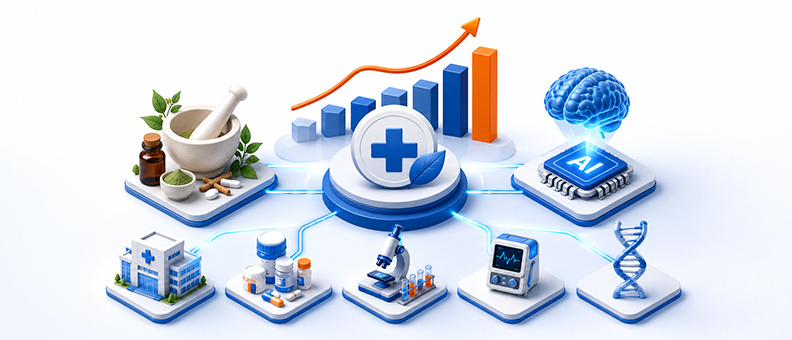
For centuries, medicine in India was rooted in Ayurveda, herbal remedies and other holistic practices. Many of these traditions still remain part of everyday life. But alongside them, a very different story is taking shape, led by robotic surgery, AI-powered diagnostics, gene therapy and precision medicine. As these two worlds begin to overlap, the sector is expanding and creating opportunities across both traditional and modern segments.
The Bajaj Finserv Healthcare Fund seeks to identify such transformations across the broader health and allied space. This thematic equity fund invests in areas such as hospitals, pharmaceuticals, health insurance, diagnostics, manufacturing and other related segments. It follows a megatrends strategy, tracking current and emerging structural shifts to identify companies with long-term growth potential.
To understand this opportunity better, it helps to look at how traditional care, modern medicine, policy, consumer behaviour and technology are beginning to come together.
A diverse landscape
The intersection of modern and traditional medicine can be seen in various sectors and spaces. Here are some examples:
Policy support for both Ayurveda and innovation
Government policies are playing a significant role in strengthening both traditional and modern healthcare sectors. On the one hand, the Ministry of AYUSH is encouraging education and research in traditional and alternative medicine systems in India. At the same time, initiatives like Make in India and production-linked incentives (PLI) for pharmaceuticals and medical devices are fuelling the growth of biotech research and medical technology.
This convergence is visible in the proposal to establish five Regional Medical Hubs in partnership with the private sector, which was announced in the Union Budget for 2026-27. Envisaged as integrated healthcare complexes, these hubs will bring together AYUSH centres, medical services, education and research, along with advanced facilities for diagnostics, post-treatment care and rehabilitation.
Source: “Government to establish Regional Medical Hubs to boost Medical Value Tourism”, Press Information Bureau
Rising income, rising healthcare demand
With increasing disposable incomes, Indians are spending more on both preventive care and advanced treatments. Simultaneously, the market for nutraceuticals, organic supplements, and Ayurvedic formulations is expanding as people look for natural wellness solutions. This dual trend is pushing healthcare spending in multiple directions.
India’s healthcare spending increased from about US$77 billion in 2013 to US$119 billion in 2023, a rise of roughly 55%. Private spending remained the larger share throughout this period, showing how much households continue to spend on healthcare from their own pockets.
Source: Source: S&P Household Income Projections; Fitch Solutions Health Expenditure
Holistic healing
Urbanisation, lifestyle diseases, and increased health awareness are leading people to adopt both modern treatments and traditional practices. More people are pairing Ayurvedic therapies with allopathic treatments, using digital platforms to consult with doctors on holistic wellness plans. This shift is influencing how companies approach healthcare. Many are now integrating technology into traditional medicine, which can create potential investment opportunities.
This is also part of a wider move from curative care towards preventive healthcare. Regular diagnostics, fitness, nutrition, mental wellness and health monitoring are increasingly becoming part of how people manage their health, expanding the opportunity set beyond hospitals and medicines. Preventive healthcare was expected to account for 40% of Indian healthcare spending in 2025, compared with 36% in 2021.
Source: Nykaa Red Herring Prospectus.
Ayurvedic and traditional medicines
Once driven purely by traditional knowledge, the Ayurvedic industry is now incorporating innovation and technology. The government is also encouraging global exports of Indian traditional medicines, creating a growing market. Companies are exploring herbal and plant-based drug formulations, combining traditional knowledge with modern research. At the same time, India continues to be a hub for global pharmaceuticals export in modern medicine.
Nutraceuticals: Fusion of nature and science
The demand for natural supplements backed by modern research is rising. Companies are blending ancient herbal wisdom with scientific advancements, creating functional foods, plant-based proteins, and supplements tailored for lifestyle diseases. Digital platforms are offering online consultations with Ayurvedic doctors and wellness practitioners on areas such as diet, sleep, stress and digestive health.
This change in consumer behaviour is also influencing companies, with many using technology to make traditional healthcare more accessible and personalised, creating potential investment opportunities. AI-powered health tracking is further personalising the way people consume these products.
India’s nutraceuticals market was estimated at US$30.37 billion in 2024 and is projected to grow at a CAGR of 13.6% from 2025 to 2030, supported by rising health awareness and growing interest in preventive healthcare.
Source: Sector Profile: Nutraceuticals, Ministry of Food Processing Industries, based on data from Grand View Research.
Technology meets lifestyle healthcare
From meditation apps offering AI-supported mindfulness guidance to Ayurveda platforms providing online consultations and personalised lifestyle advice, wellness is becoming increasingly technology-enabled. Skincare and wellness brands are also combining traditional ingredients with modern research, testing and formulation techniques. Wearables and health apps are widening access to everyday health monitoring, while some consumers use Ayurvedic remedies alongside conventional treatment, particularly for long-term health conditions. Together, these developments show how traditional wellness practices are adapting to a more digital and science-led healthcare landscape.
Megatrends driving healthcare investments
For investors, these are not isolated developments. Together, they form part of broader shifts that may shape healthcare demand for years. The Bajaj Finserv Healthcare Fund seeks to identify such shifts through its megatrends investment strategy. Megatrends are sweeping, long-term changes that can influence industries well beyond short-term market cycles. By focusing on these changes, the fund looks for businesses that may remain relevant as healthcare needs evolve. It tracks four such shifts:
Regulatory megatrends: Government policies are expanding healthcare access and encouraging local manufacturing. The USA’s Biosecure Act is estimated to double India’s contract research and manufacturing sector (CRAMS) market, which is projected to reach around US$45 billion by 2029 compared to US$23 billion in 2024.
Economic megatrends: Rising incomes, wider insurance coverage and greater healthcare spending are increasing demand for hospitals, diagnostics and medical services. Health insurance coverage rose from about 207 million people in 2013 to around 550 million in 2023.
Demographic megatrends: India is still a relatively young country, but its population is also ageing. The median age is projected to rise from 28.8 years in 2025 to 38.3 years in 2050, which may increase demand for medicines, hospitals and age-related care.
Social megatrends: Lifestyle diseases are rising, while people are becoming more conscious about fitness, nutrition and preventive care. Non-communicable diseases accounted for 60% of all deaths in India during 2022–2024, showing the growing need for diagnosis, treatment and long-term disease management. India had an estimated 89.8 million adults living with diabetes in 2024, and this number is projected to rise to nearly 157 million by 2050.
Source: “Non-communicable diseases accounted for 60% of all deaths in 2022-2024: Data” The Hindu, May 28, 2026 | International Diabetes Federation, IDF Diabetes Atlas, India country data.
A wider opportunity set
These shifts are playing out across several sectors within the broader healthcare space. As a result, the fund looks beyond conventional pharmaceutical companies to areas such as hospitals, diagnostics, CRAMS, medical equipment, health insurance and preventive care, among others.
This spread allows investors to access different parts of the healthcare value chain, from prevention and diagnosis to treatment and manufacturing. The fund’s investment process begins with a broad universe of around 1,100 stocks. A megatrends filter narrows this to roughly 340 to 380 companies, after which healthcare-related businesses are evaluated through Bajaj AMC’s InQuBe investment philosophy. After this process, the final portfolio is created.
Conclusion
India’s healthcare landscape is widening. Traditional medicine, modern treatment, preventive care, manufacturing and digital health are increasingly developing alongside one another. This is creating opportunities across several parts of the healthcare value chain, rather than in pharmaceuticals alone.
The Bajaj Finserv Healthcare Fund seeks to identify such opportunities through its megatrends-led investment approach. However, as a sectoral equity fund, the scheme carries concentration risk and is classified in the Very High Risk category. It may be suitable for investors with a higher risk appetite and an investment horizon of five years or more who are looking for a tactical addition to their broad market portfolio.
Note: The data and information in this article are relevant as on the date of publication and may change subsequently. Please refer to the latest available information before making any financial or investment-related decision.
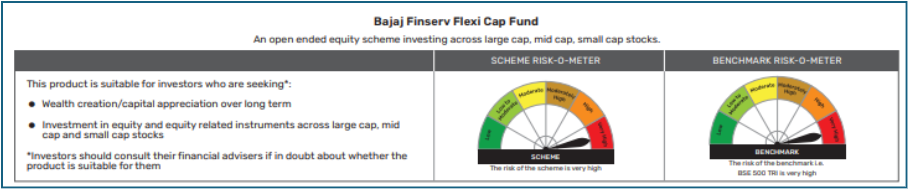
Mutual Fund investments are subject to market risks, read all scheme related documents carefully.
This document should not be treated as endorsement of the views/opinions or as investment advice. This document should not be construed as a research report or a recommendation to buy or sell any security. This document is for information purpose only and should not be construed as a promise on minimum returns or safeguard of capital. This document alone is not sufficient and should not be used for the development or implementation of an investment strategy. The recipient should note and understand that the information provided above may not contain all the material aspects relevant for making an investment decision. Investors are advised to consult their own investment advisor before making any investment decision in light of their risk appetite, investment goals and horizon. This information is subject to change without any prior notice.
The content herein has been prepared on the basis of publicly available information believed to be reliable. However, Bajaj Asset Management Limited (formerly known as Bajaj Finserv Asset Management Limited) does not guarantee the accuracy of such information, assure its completeness or warrant such information will not be changed. The tax information (if any) in this article is based on prevailing laws at the time of publishing the article and is subject to change. Please consult a tax professional or refer to the latest regulations for up-to-date information.


































