
Just a few years ago, running out of milk meant a quick trip to the neighbourhood shop. Today, one can order it on a phone and have it delivered within minutes.
Behind this everyday convenience are several interlinked changes: wider smartphone use, growing cities, digital transactions, local warehouses and faster delivery networks. Together, they show how small shifts in daily life can be driven by much larger forces.
But not every change has the same staying power. Some fade quickly, while others continue for years and gradually reshape how people and economies function. These paradigm shifts are called megatrends, and they can create new markets and opportunities for companies aligned with them.
The Bajaj Finserv Flexi Cap Fund seeks to tap into these opportunities through its unique megatrends investing strategy. Fund managers study long-term changes across technology, regulation, the economy, the environment, demographics and society, and then look for businesses that may be positioned to benefit from them.
What are megatrends and why do they matter for investors?
Megatrends are large, structural changes that can influence economies, industries and everyday behaviour over several years. Digitisation, changing demographics, financial inclusion, urbanisation and the transition towards cleaner forms of energy are some examples. Unlike short-term market trends, where a temporary rise in demand for a product may last a few months, a megatrend can reshape how an entire industry operates.
Megatrends can offer a glimpse into where the world may be heading and how people’s needs could evolve along the way. They help investors look beyond the market’s day-to-day ups and downs and focus on changes that may create opportunities over the long term. It is like noticing the direction of the tide – not every wave will carry you forward, but understanding the broader movement can help you make more informed decisions.
The significance of a megatrend is not that every business associated with it will prosper, but that it can point to where new demand, investment and potential profit pools may develop. The task is to identify companies capable of potentially translating emerging demand and opportunities into sustainable earnings.
The megatrends approach of the Bajaj Finserv Flexi Cap Fund
Such an approach requires extensive research to identify potential megatrends, understand how they may unfold and the industries they could influence, along with careful company-level evaluation to uncover the investment opportunities they may create. It also calls for continuous evaluation as technologies, consumer behaviour and competitive dynamics evolve. The Bajaj Finserv Flexi Cap Fund combines these elements by bringing together a team of investment professionals tasked with tracking megatrends and the business that may potentially benefit from it over time.
The fund is an open-ended equity scheme that can invest across large-cap, mid-cap and small-cap companies. This flexibility allows the investment team to explore how a single megatrend may create opportunities across different industries and businesses, rather than viewing it through the lens of one sector or market-cap segment.
The investment team looks at long-term structural changes shaping the economy and uses them to identify potential opportunities across sectors and market capitalisations. These opportunities are then assessed at the company level before being considered for inclusion in the portfolio.
Six TRENDS of the future
The fund organises its megatrends framework around six sources of change, represented by the word TRENDS:
Technological: Digitisation, automation, artificial intelligence and other technological developments can change how businesses produce, distribute and deliver products and services.
Regulatory: Policy changes, shifting trade relationships and initiatives supporting domestic production may influence areas such as electronics, defence, textiles, chemicals and precision manufacturing.
Economic: Financialisation, infrastructure development and the formalisation of business activity can broaden the market for banking, insurance, asset management and other organised services.
Nature: Environmental concerns and the transition towards cleaner energy may affect mobility, power generation, energy storage and industrial processes.
Demographic: Changes in age, income, household structure and migration can create different patterns of demand across healthcare, housing, travel and financial services.
Social: Urbanisation, consumer preferences and greater attention to health and wellness may alter how people spend their time and money.
These forces do not operate separately. Electric mobility, for instance, can reflect technological development, environmental priorities, policy support and changing consumer preferences at the same time. Studying their interaction can provide a more complete view of the potential opportunity.
From TREND to portfolio
Instead of beginning with a preferred market cap or industry, the investment team starts with identifying a megatrend. Then, it examines the sectors the trend may impact and then arrive at the investment universe. This distinction is important, because megatrends rarely belong to just one industry.
Consider artificial intelligence. It is naturally associated with software and computing. But greater AI adoption may also influence semiconductor demand, data-centre construction, cooling systems, electrical equipment and power generation. An investment approach confined to one sector could miss several businesses participating in the same underlying change.
The fund therefore uses megatrends as a filter across sectors. Its stated portfolio-construction process begins with a stock universe of around 1,100 companies. Applying the megatrend filter, the team narrows this down to approximately 340–380 companies, from which a portfolio of around 40–60 stocks* may be constructed.
While constructing the portfolio, stocks are evaluated based on whether:
- They are a beneficiary of the trend
- They offer an opportunity that is monetizable
- They have strong fundamentals
- They are trading at favourable valuations
* The number of stocks mentioned is tentative and for understanding purposes only; the final portfolio may hold more or fewer names depending on prevailing market conditions. Source: Internal Analysis
Spotting the idea
Let’s examine these four elements in detail.
The first is whether the company is a genuine beneficiary of the trend. A growing industry can contain businesses with very different prospects. Some may supply an important component, while others may participate only indirectly. The relationship between the trend and the company’s demand, pricing or market opportunity must therefore be clear.
The second question is whether the opportunity is monetis able. In simple terms, can the company earn money from it? A business may possess useful technology but lack customers, distribution, production capacity or pricing power. Being associated with a megatrend does not automatically result in potential earnings growth.
Financial due diligence comes next. This involves examining factors such as revenue, profitability, debt, cash generation and the capital required for expansion. Management quality also matters because a company must be able to execute its plans without placing undue strain on its finances.
Finally, the team considers valuation, or the price being paid for the company’s potential. A business may be well positioned, but its share price may already reflect very optimistic expectations. Valuation can therefore influence whether the stock is purchased, how much of it is held and whether its weight is later reduced.
This is the crux of the approach: the megatrend identifies where to look, but business quality, financial strength and valuation help determine what to buy, when to buy and when to reduce or exit a position.
How the fund has performed
Against this backdrop, the fund’s performance across different periods offers another perspective on its journey so far. The following figures compare the performance of the Bajaj Finserv Flexi Cap Fund Regular Plan – Growth with its benchmark, the BSE 500 TRI, as on June 30, 2026:
| Period | Scheme return | BSE 500 TRI return |
| Six months | 2.6% | -3.5% |
| One year | 3.4% | -2.0% |
| Two years | 5.5% | 1.5% |
| Since inception | 16.0% | 12.1% |
Six-month and 1-year returns are absolute. Returns for two years and since inception are compounded annualised. The scheme’s inception date is August 14, 2023. Past performance may or may not be sustained in future.
As the data shows, the fund has outperformed the benchmark over several periods. Importantly, this outperformance has been delivered without taking on disproportionate risk. As of June 30, 2026, the fund recorded a lower standard deviation of 13.3%, compared with 14.3% for the BSE 500 TRI, alongside a higher Sharpe ratio of 0.8 versus 0.5 for the benchmark. Its beta of 0.9 indicates lower sensitivity to broad-market movements, while a Jensen’s alpha of 4.6% since inception points to the fund’s ability to generate returns over and above those expected for the level of market risk taken. Together, these indicators point to the fund’s relatively resilient profile and the strength of its prudent portfolio construction and stock-selection approach.
Risk Free Rate of Return: 5.5% | Data as on June 30, 2026; calculated since inception | Source: Internal Analysis, MFI360, Bloomberg | Past performance may or may not be sustained in future.
Conclusion
The journey from megatrend to portfolio is not about predicting the future with certainty. It is about using long-term change as a starting point and applying a disciplined framework to distinguish an interesting theme from a potentially viable investment opportunity.
For the Bajaj Finserv Flexi Cap Fund, this means looking beyond the trend itself to assess whether a company can benefit from it, monetise the opportunity and sustain its growth, while remaining mindful of fundamentals and valuation. Ultimately, megatrends may indicate where the world is moving, but careful stock selection and continuous evaluation determine how that direction takes shape within the portfolio.
Note: The data and information in this article are relevant as of the date of publication and may change subsequently. Please refer to the latest available information before making any financial or investment-related decision.
| Plan / Benchmark | Last 1 Year Return | Value of ₹10,000 – Last 1 Year | Since Inception Return | Value of ₹10,000 – Since Inception |
| Bajaj Finserv Flexi Cap Fund – Regular Plan – Growth | 3.4% | ₹10,335 | 16.0% | ₹15,523 |
| Bajaj Finserv Flexi Cap Fund – Direct Plan – Growth | 4.7% | ₹10,469 | 17.6% | ₹15,948 |
| BSE 500 Total Return Index (Benchmark) | -2.0% | ₹9,804 | 12.1% | ₹13,882 |
| Nifty 50 Total Return Index (Additional Benchmark) | -5.4% | ₹9,458 | 8.6% | ₹12,685 |
Returns as on 30th June, 2026. Past performance may or may not be sustained in future. Different Plans i.e. Regular Plan and Direct Plan under the scheme have different expense structure. Benchmark: BSE 500 TRI. Additional Benchmark: Nifty 50 TRI. Inception Date: 14th August 2023. Period for which scheme’s performance has been provided is computed basis last day of the previous month preceding the date of this material. Returns greater than 1 year are compounded annualized. Face Value per unit: Rs. 10.
The Fund Managers of the scheme: Mr. Nimesh Chandan (Equity Portion), Mr. Sorbh Gupta (Equity Portion) and Mr. Siddharth Chaudhary (Debt Portion). or the performance of other schemes managed by the Fund Managers which have completed 1 year or more than 1 year since inception, please visit https://www.bajajamc.com/downloads?factsheet
and download the latest Factsheet or click here.
Mr. Nimesh Chandan manages equity portion of Bajaj Finserv Small Cap Fund. He also manages Bajaj Finserv Low Duration Fund.
Mr. Siddharth Chaudhary manages debt portion of Bajaj Finserv Small Cap Fund, Bajaj Finserv Equity Savings Fund and Bajaj Finserv Banking and Financial Services Fund. He also manages Bajaj Finserv Low Duration Fund.
Mr. Sorbh Gupta manages equity portion of Bajaj Finserv Small Cap Fund and Bajaj Finserv Equity Savings Fund.
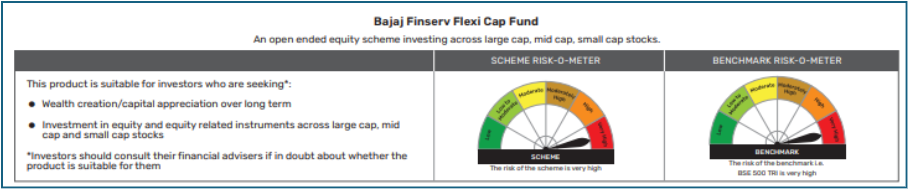
Mutual Fund investments are subject to market risks, read all scheme related documents carefully.
This document should not be treated as endorsement of the views/opinions or as investment advice. This document should not be construed as a research report or a recommendation to buy or sell any security. This document is for information purpose only and should not be construed as a promise on minimum returns or safeguard of capital. This document alone is not sufficient and should not be used for the development or implementation of an investment strategy. The recipient should note and understand that the information provided above may not contain all the material aspects relevant for making an investment decision. Investors are advised to consult their own investment advisor before making any investment decision in light of their risk appetite, investment goals and horizon. This information is subject to change without any prior notice.
The content herein has been prepared on the basis of publicly available information believed to be reliable. However, Bajaj Asset Management Limited (formerly known as Bajaj Finserv Asset Management Limited) does not guarantee the accuracy of such information, assure its completeness or warrant such information will not be changed. The tax information (if any) in this article is based on prevailing laws at the time of publishing the article and is subject to change. Please consult a tax professional or refer to the latest regulations for up-to-date information.