
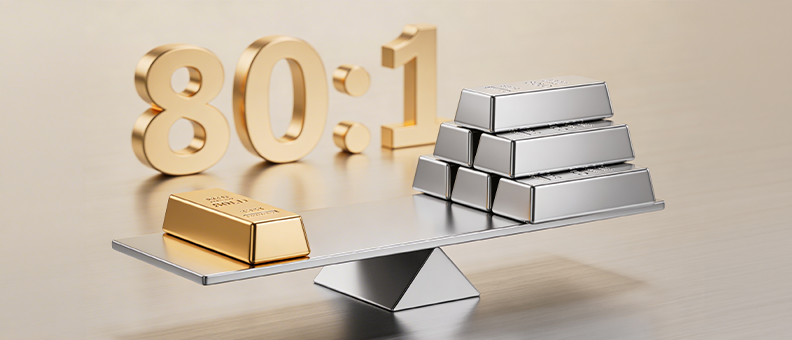

Gold and silver often feature in investor conversations, especially during phases of heightened volatility or inflation concerns. Although both are precious metals, they differ in terms of market size, industrial demand and price sensitivity. To understand how the two are positioned relative to each other at any point in time, investors often look at the gold/silver ratio — a metric that compares the price of gold to the price of silver. This article tells you more about what the gold/silver ratio is, how it’s calculated, and its relevance in commodities investing.
Table of Contents
What is the gold/silver ratio?
It is a number that tells you how the market is pricing one metal against the other. The gold and silver ratio is a simple measure to compare the relative cost of the two precious metals.
Strip away the jargon and here is the definition of gold and silver ratio: how many ounces of silver does it take to buy one ounce of gold?
Key Takeaways
- The gold-silver ratio shows how many ounces of silver would equal the price of one ounce of gold.
- It is calculated by dividing the market price of gold per ounce by the market price of silver per ounce.
- A rising ratio means gold is becoming more expensive relative to silver, while a falling ratio indicates that silver is gaining value.
- The ratio moves as investment demand, industrial use, economic conditions and the individual prices of both metals change.
- Historical comparisons can provide context, but the ratio alone cannot establish whether either metal is undervalued or predict its future price.
How is the gold/silver ratio calculated?
At its simplest, you compare the two prices directly — gold divided by silver expressed in the same units.
For instance, if gold is trading at Rs. 1.5 lakh per 10 grams and silver at Rs. 2,400 per 10 grams, the comparison works out to 62.5. This means gold is priced at 62.5 times the price of silver on a per-unit basis. In other words, one gram of gold would be equivalent in value to 62.5 grams of silver at that moment. The arithmetic itself is straightforward. The real question is whether that figure signals balance or stretch.
Gold/silver ratio in 2026 – trends
Silver and gold have seen a rally in 2025-2026 with growing investor interest in the precious metals because of increased geopolitical tensions, market volatility, and macro uncertainty pushing investors toward defensive assets. For silver, industrial demand has further fuelled the rally. Gold prices globally rose by nearly 65% in 2025, from around $2,600 per ounce to over $4,300 by year-end, according to a report by Forbes. The same report said that silver prices grew even more notably, by 150% in 2025, ending the year at around $72 per ounce.
Sources: Gold shines on, Forbes India, February 10, 2026; Commodity Markets Outlook, World Bank, October 2025.
Recent data indicates notable volatility in the gold/silver ratio across different time frames.
- Last 30 days: High – 66.23 | Low – 44.02
- Last 60 days: High – 66.23 | Low – 44.02
- Last 1 year: High – 103.95 | Low – 44.02
Source: Goldprice.org, gold/silver ratio charts; data as on February 19, 2026.
The one-year high of 103.95 (recorded in April 2025) suggests that, at its peak, gold was trading at nearly 104 times the price of silver on a per-ounce basis — a historically elevated level. In contrast, the recent low of 44.02 indicates periods where silver strengthened relative to gold, narrowing the gap significantly.
The wide range between the annual high and low reflects substantial shifts in relative performance between the two metals over the past year. Such movements are often influenced by changing macroeconomic conditions, investor demand, industrial usage trends (particularly for silver), and global risk sentiment.
Also read: Gold and Silver ETF Inflows Beat Equity Funds in January 2026: What’s Driving Investor Interest?
Current gold/silver ratio – What does it indicate?
The gold-silver ratio shows how gold is priced relative to silver at a particular point in time. A high gold-silver ratio means that gold is relatively more expensive than silver. This can happen when gold prices rise faster than silver prices or when silver prices fall more sharply than gold prices.
A low gold-silver ratio means that silver has strengthened relative to gold. This can occur when silver prices rise faster than gold prices or decline less sharply.
For example, a ratio of 80 means that the price of one unit of gold is equivalent to the price of 80 units of silver. If the ratio subsequently falls to 60, silver has strengthened relative to gold over that period.
However, a high or low ratio does not establish whether either metal is undervalued or overvalued. It also does not indicate that the ratio will necessarily return to an earlier level.
Past performance may or may not be sustained in future.
Why is the gold-silver ratio important for investors?
The gold-silver ratio can provide context on the relative movement of gold and silver. Investors and market participants may use it to:
- Compare relative performance: The ratio shows whether gold or silver has performed more strongly in relation to the other.
- Observe market sentiment: A rising ratio may coincide with relatively stronger demand for gold during periods of uncertainty.
- Understand different demand drivers: Gold is influenced by jewellery, investment and central-bank demand, while silver is also significantly affected by industrial demand.
- Review precious-metal exposure: Investors holding gold and silver may consider the ratio as one of several inputs when reviewing their allocation.
The ratio should not be treated as a standalone investment signal. It does not predict future prices or guarantee that a previous relationship between gold and silver will be restored. Inflation, interest rates, currency movements, industrial activity, risk appetite and individual financial goals should also be considered.
Gold/silver ratio in India – why it matters to Indian investors
Movements in the international gold-silver ratio can provide useful context for Indian investors. However, domestic gold and silver prices may not move exactly in line with international prices. Indian prices can also be influenced by:
- Currency movements: Gold and silver are generally quoted internationally in US dollars. A change in the rupee-dollar exchange rate can therefore affect their domestic prices.
- Import duties and taxes: Customs duties, GST and other applicable charges can affect the prices paid by Indian buyers.
- Local demand: Festival, wedding and investment demand may influence domestic premiums and retail prices.
- Supply and distribution costs: Availability, dealer margins, making charges and regional pricing differences may affect the final purchase price.
- Industrial demand for silver: Demand from areas such as electronics, solar energy and manufacturing can influence silver independently of gold.
As a result, the international ratio may differ from a ratio calculated using Indian retail prices. Investors should therefore use prices from the same market, currency, unit of measurement and observation time when making a comparison.
The form of investment also matters. Physical metals may involve making charges, storage costs and differences between buying and selling prices, while exchange-traded funds and mutual fund schemes may involve expense ratios, tracking differences and other applicable costs.
Gold vs silver: Key differences beyond the ratio
Although gold and silver are both precious metals, their demand patterns and price behaviour differ.
| Factor | Gold | Silver |
| Major demand sources | Jewellery, investment, central-bank purchases and technology | Industrial applications, jewellery, investment and silverware |
| Industrial demand | Used in electronics and other specialised applications, but industrial use forms a smaller part of overall demand | Industrial demand forms a significant part of total demand |
| Common industrial applications | Electronics, medical technology and specialised equipment | Electronics, solar energy, automotive applications and manufacturing |
| Price behaviour | Generally less volatile than silver | Can experience sharper price movements |
| Response to uncertainty | May receive relatively stronger investment demand during periods of uncertainty | Influenced by both investment sentiment and expectations for industrial activity |
| Market characteristics | Larger investment market and generally deeper liquidity | Smaller market, which can contribute to greater price sensitivity |
These differences help explain why gold and silver do not always move by the same magnitude.
During periods of economic or geopolitical uncertainty, stronger demand for gold may cause the ratio to rise. During periods of improving industrial activity, demand for silver may strengthen and contribute to a decline in the ratio. However, these outcomes are not assured because several factors may affect both metals simultaneously.
Historical trends of the gold/silver ratio
Long-term averages from historical price data show that the gold-silver ratio was around 53 in the early 1980s, rising above 80 during stress periods like 2020–21 when gold outperformed silver. By early 2026, it compressed to the mid-60s range (around 64:1) as silver gained prominence recently.
Over decades, the ratio fluctuated widely – low when silver was strong, high when gold was stronger during uncertainty. Historically, a ratio between 60–70 is typical, with bigger swings during economic shocks or sharp commodity cycles.
For example, in 2020, amid the COVID-19 pandemic, the figure surged past 125 — an unusually wide separation that left silver trading at a steep discount to gold.
Source: All Data Gold Silver Ratio History, goldprice.org, data as on February 19, 2026.
Factors affecting the gold/silver ratio
- Economic uncertainty
- Industrial demand for silver
- Geopolitical tension
- Currency strength and liquidity conditions
It is rarely one domino falling but rather the broader environment adjusting that affects the gold and silver ratio.
How investors trade using the gold/silver ratio
Some investors treat the ratio as a compass. When the figure climbs high, silver can look inexpensive next to gold, prompting allocations through Silver ETFs or mutual funds. When the gap narrows, capital sometimes rotates back toward gold.
There’s also a commonly used “80-50” approach — accumulating silver when the ratio exceeds 80 and moving toward gold near 50. However, these are informal approaches based on historical patterns, not guarantees of future performance.
More advanced traders may hedge by holding positions in both metals simultaneously. The aim is not to guess direction but to capture the relative movement.
Past performance may or may not be sustained in future.
How inflation affects the gold-silver ratio
Inflation can influence gold and silver, but it does not have a consistent or automatic effect on the ratio.
Gold may attract attention during inflationary periods because some investors view it as a potential store of value. However, gold prices are also influenced by real interest rates, currency movements, investment flows and market sentiment.
Silver can also be affected by inflation and investment demand. In addition, its widespread industrial use means that expectations for manufacturing, electronics and renewable-energy activity may influence its price.
The ratio may respond differently under different conditions:
- When inflation is accompanied by economic uncertainty, gold may strengthen relative to silver, causing the ratio to rise.
- When inflation occurs alongside strong industrial activity, silver demand may support its price and contribute to a lower ratio.
- Higher interest rates, including rate increases intended to control inflation, may affect demand for non-interest-bearing assets such as gold and silver.
- Movements in the US dollar can affect international prices of both metals.
Inflation should therefore be assessed together with real interest rates, industrial demand, economic growth, currency trends and market sentiment.
Can investors use the gold-silver ratio to make investment decisions?
Some market participants monitor the ratio in the expectation that an unusually high or low reading may eventually move closer to an earlier range.
For example, a high ratio may lead some investors to study whether silver could strengthen relative to gold. A low ratio may prompt an assessment of whether gold could perform more strongly relative to silver.
More experienced traders may also take positions in both metals to seek returns from a change in their relative prices rather than from the direction of the precious-metals market as a whole.
However, the ratio does not reliably indicate when to buy or sell either metal. A reading that appears unusually high or low can remain at that level or move further in the same direction.
Ratio-based strategies may involve the following risks:
- Historical ranges may not repeat.
- The ratio may remain elevated or depressed for an extended period.
- Both metals may decline even when their relative movement develops as expected.
- Taxes, transaction costs, bid-ask spreads and liquidity may reduce actual returns.
- Exchange-traded products may also involve expense ratios and tracking differences.
- Frequent changes in allocation can increase costs and portfolio volatility.
The ratio may therefore be used as a reference point for further analysis, but not as a mechanical trading rule or the sole basis for an investment decision.
Past performance may or may not be sustained in future.
Limitations of the gold-silver ratio
While the gold-silver ratio can offer useful insights, it is important to understand its limitations:
- It measures relative rather than absolute value: The ratio does not indicate whether gold or silver is expensive or inexpensive on its own.
- It has no universally accepted fair-value level: The observed average depends on the selected period, market, price source and calculation method.
- Extreme readings may persist: A high or low ratio does not guarantee a reversal towards a historical average.
- The metals have different demand drivers: A change in the ratio may be caused by factors affecting only gold or only silver.
- It does not capture investment costs: Taxes, storage, insurance, making charges, transaction costs, expense ratios and tracking differences may affect actual outcomes.
- It does not consider investor suitability: The ratio does not account for an investor’s financial goals, risk tolerance, liquidity requirements or investment horizon.
- Results may vary by data source: Ratios calculated using international benchmark prices, futures prices, ETF prices or Indian retail prices may differ.
The ratio is best viewed as one analytical input among several rather than as a forecast or investment recommendation.
An alternative route to gold and silver: Multi-asset allocation funds
Multi-Asset Allocation Funds are hybrid mutual funds invest across several asset classes — such as equities, debt and commodities like gold and silver — subject to minimum 10% investment in each asset class. By combining multiple assets that may respond differently to market conditions, such funds aim to deliver diversified exposure and potentially smoother risk-return outcomes.
The Bajaj Finserv Multi Asset Allocation Fund is one such scheme. The fund has taken strategic exposure to gold and silver in response to evolving metal conditions, tapping into their potential for capital appreciation in some market conditions and their role as portfolio stabilisers in others.
The fund also routinely adjusts its allocation to gold and silver based on relative performance trends between the two metals (reflected through the gold-silver ratio), indicating an active and management style that responds to evolving market conditions rather than sticking to fixed weights. To invest in the Bajaj Finserv Multi Asset Allocation Fund and to view scheme-related and statutory details, click here.
Conclusion
The gold-to-silver ratio encapsulates a shifting relationship between the prices of the precious metals, gold and silver, into a single reference point. Does it predict the future? No. Does it remove risk? Not at all. But it provides perspective — and in markets, perspective can help reduce reactive decision-making. Thus, the gold and silver ratio has endured because it simplifies something complex and helps investors find potential investment opportunities.
FAQs:
What is the 80-50 gold-silver rule?
It refers to buying silver when the ratio moves above 80 and rotating toward gold as it approaches 50, based on historical relative valuation swings.
What is considered a good gold to silver ratio?
There is no fixed level that can be considered universally “good,” as the gold/silver ratio fluctuates across market cycles. Historically, readings between 50 and 70 have occurred frequently over extended periods. When the ratio moves significantly above or below such historical ranges, it tends to attract attention from market participants assessing relative valuations. However, the ratio alone does not determine future price movements. Past performance may or may not be sustained in future.
What is the highest gold/silver ratio ever recorded?
During the COVID-19 pandemic, the ratio climbed above 125 in 2020, reflecting a substantial discount in silver relative to gold at that time.
How to use the gold-silver ratio?
Most investors use it to judge relative value of both precious metals. Instead of focusing only on whether gold or silver is rising, they compare the two and adjust exposure if the balance appears stretched.
Why is the gold and silver ratio popular?
Watching how gold and silver move in relation to each other continues to offer context to investors, even as monetary systems evolve. t is popular because it is simple to interpret and offers a quick relative comparison.


































