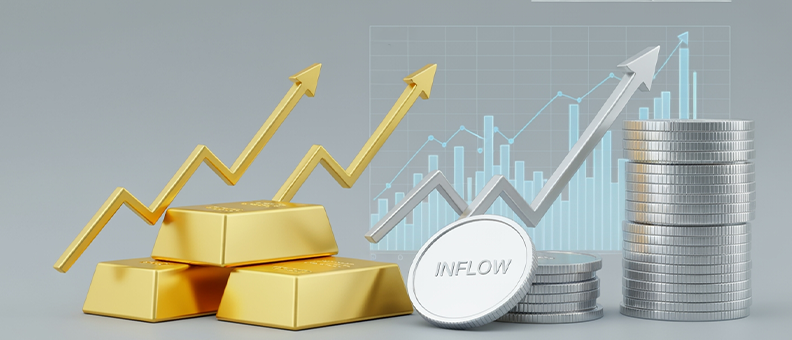
January 2026 marked an unusual phase in the Indian mutual fund industry. Data released by the Association of Mutual Funds in India, or AMFI, showed that Gold and Silver Exchange-Traded Funds (ETFs) recorded higher net inflows than equity mutual fund schemes in that month.
What triggered this tilt toward gold and silver, and does it signal a deeper shift in investor behaviour? This blog takes a closer look at what unfolded, what it may mean going forward, and how investors may access these precious metals.
Table of contents
- The numbers tell the story
- Net inflows into Gold ETF
- When momentum drives investment
- Factors leading to surge in gold and silver prices
- Strategic versus tactical positioning
- Invest in gold and silver with Bajaj Finserv Multi Asset Allocation Fund
- Understanding gold and silver ETFs
- How do ETFs work?
- How to invest in gold and silver ETFs in India
The numbers tell the story
According to AMFI data, Gold ETFs alone attracted approximately ₹24,040 crore in January 2026, a 106.4% increase from December 2025’s ₹11,647 crore. In comparison, equity mutual fund inflows stood at ₹24,029 crore for the same month.
When combined with silver ETFs, the precious metals collectively drew ₹33,503 crore in net inflows, outstripping the equity segment. This marks the first time that Gold ETFs have surpassed equity funds in monthly inflows, according to several news reports.
The magnitude of this shift becomes clearer when examining the growth trajectory: Gold ETF inflows more than doubled in just one month, while maintaining parity with the traditionally dominant equity fund category.
As AMFI said in its monthly report, “The surge in gold ETFs can be attributed to the rally in gold prices fuelled by geopolitical uncertainties and strong demand for safer assets.” Regarding Silver ETFs, the note said that the interest was “driven by robust demand from industries such as electric vehicles, semiconductors, telecom and artificial intelligence”.
Source: India’s gold ETF inflows top equity mutual funds for the first time: Reuters, February 10, 2026; Association of Mutual Funds in India Monthly Note, January 2026.
Net inflows into Gold ETF
| Net Flows (Rs. Crs) | Feb-25 | Mar-25 | Apr-25 | May-25 | Jun-25 | Jul-25 | Aug-25 | Sep-25 | Oct-25 | Nov-25 | Dec-25 | Jan-26 |
|---|---|---|---|---|---|---|---|---|---|---|---|---|
| Gold ETF | 1979.844542 | -77.20617213 | -5.8197261 | 291.9115447 | 2080.845636 | 1256.094486 | 2189.51293 | 8363.130222 | 7743.19 | 3741.79 | 11646.73965 | 24039.96047 |
| % Change (MOM) | -103.90% | -92.46% | -5115.90% | 612.83% | -39.64% | 74.31% | 281.96% | -7.41% | -51.68% | 211.26% | 106.41% |
Source: AMFI data as on January 30, 2026.
When momentum drives investment
The January 2026 surge in gold and silver ETF inflows indicates that investors are responding to strong price momentum in precious metals at a time when equity markets delivered muted returns. As on December 31, 2025, the Nifty 50 posted 1-year returns of 10.5%. BSE Sensex, meanwhile, rose by approximately 9%. Moreover, equity market performance was uneven throughout the year, marked by volatility, foreign institutional investor selling pressure, and concerns over valuations.
Source: NSE Market Pulse, January 2026; BSE Historical Data as on December 31, 2025.
In comparison, gold prices globally rose by nearly 65% in 2025, from around $2,600 per ounce to over $4,300 by year-end, according to a report by Forbes. The same report said that silver prices grew even more notably, by 150% in 2025, ending the year at around $72 per ounce.
Sources: Gold shines on, Forbes India, February 10, 2026;
| Date | Silver Spot Price for 10 gm (INR) | Gold Spot Price for 10 gm (INR) |
|---|---|---|
| 11/2/2025 | 2768.1362 | 252018 |
| 11/3/2025 | 2834.2954 | 253973 |
| 11/4/2025 | 2707.0742 | 276943 |
| 13/5/2025 | 2790.252 | 276975 |
| 11/6/2025 | 3105.1541 | 285662 |
| 11/7/2025 | 3229.1863 | 287352 |
| 11/8/2025 | 3293.7939 | 293430 |
| 11/9/2025 | 3650.2727 | 321271 |
| 10/10/2025 | 4444.8457 | 353822 |
| 11/11/2025 | 4534.1055 | 366573 |
| 11/12/2025 | 5626.918 | 381164 |
| 12/1/2026 | 7560.8496 | 413217 |
| 10/2/2026 | 7513.4395 | 459785 |
Source: Elara Capital
Factors leading to surge in gold and silver prices
The growing interest in silver and gold in 2025-2026 has been attributed to increased geopolitical tensions, market volatility, and macro uncertainty pushing investors toward defensive assets like gold and silver. For the white metal, industrial demand has further fuelled the rally. Apart from these, here are two key factors resulting in the surge in gold and silver prices.
Source: Commodity Markets Outlook, World Bank, October 2025.
The central bank gold buying: Global central banks purchased approximately 863 tonnes of gold in 2025, according to the World Gold Council, maintaining a multi-year buying spree that has altered the supply-demand dynamics of the gold market. Significantly, central bank buying accelerated in the third quarter despite record-high prices, with purchases reaching 220 tonnes, a 28% increase from the previous quarter, according to the World Gold Council’s Gold Demand Trends Q3 2025 report. This price-neutral buying behaviour demonstrated that central banks viewed gold as a strategic necessity rather than merely an investment opportunity.
Source: World Gold Council.
The industrial silver demand and short supply: Silver’s gain in 2025 was similarly supported by fundamental developments, particularly the explosion in industrial demand driven by the global energy transition and technological advancement. Unlike gold, which derives much of its value from monetary and investment demand, silver has become indispensable to the green energy revolution and digital transformation.
Solar photovoltaic applications emerged as the dominant driver of silver’s industrial demand surge. The demand for silver for photovoltaic installations now makes up 29% of total industrial demand, as compared to 11% in 2014. More significantly, the International Energy Agency (IEA) forecasts that global renewable power capacity will increase by 4, 600 gigawatts by 2030, of which Solar PV will account for roughly 80%.
Source: Silver, The Next Generation Metal, December 2025, Silver Institute; Renewables 2025 report, International Energy Agency.
Strategic versus tactical positioning
The surge in investments in Gold and Silver ETFs may be an example of recency bias, where recent performance heavily influences investment decisions, often prompting tactical allocations away from underperforming assets toward those showing strong momentum.
For those making investment decisions in 2026, one takeaway from January’s flows could be to distinguish between strategic asset allocation based on long-term fundamentals and tactical positioning based on recent momentum. While gold and silver’s 2025 standout performance was supported by genuine fundamental developments, using past returns as the primary driver of future allocation decisions carries significant risks. Past performance may or may not be sustained in future.
Strategic asset allocators typically maintain consistent precious metals allocations, regardless of recent performance, rebalancing mechanically to maintain target weights. In diversified portfolios, exposure to gold and silver is often kept at moderate levels — sufficient to provide diversification benefits and act as a potential hedge during periods of uncertainty, but not so large as to materially alter the portfolio’s overall risk profile. The appropriate allocation can vary based on an investor’s risk appetite, investment horizon, and broader asset mix.
Investors seeking a structured approach to investing in commodities may also consider multi-asset strategies that balance such exposures with other asset classes. Multi Asset Allocation Funds are a category of hybrid mutual funds that invest in a minimum of three asset classes – such as equity, debt and commodities – maintaining a minimum 10% allocation to each.
This category has already started attracting investor interest. According to AMFI’s January 2026 monthly report, net inflows into Multi Asset Allocation Funds increased by 41.20%, rising from ₹7,425.9 crore in December 2025 to ₹10,485.38 crore in January 2026. The upward momentum was visible even in the previous month. In December 2025, the category had already recorded a 40% month-on-month increase, with inflows climbing to ₹7,425 crore from ₹5,314 crore in November 2025.
Invest in gold and silver with Bajaj Finserv Multi Asset Allocation Fund
Investors seeking exposure to gold and silver within a broadly diversified portfolio may consider the Bajaj Finserv Multi Asset Allocation Fund. he commodities allocation within the portfolio is primarily centred on gold and silver, with the objective of enhancing diversification and supporting overall risk management. Allocation decisions are based on a structured assessment of multiple macro and market factors, including currency trends and the dollar–gold relationship, evolving geopolitical developments, patterns in central bank gold purchases, and relative valuation indicators.
One such valuation measure is the gold–silver ratio. Its movement below the long-term average has signalled a shift in relative valuations between the two metals, influencing positioning decisions.
Based on these considerations, the portfolio has dynamically adjusted exposure between gold and silver. Allocation to silver has been increased at times when relative valuations and demand–supply dynamics suggested a potentially more favourable risk–reward balance. This active management approach seeks to participate in emerging opportunities while preserving the traditional diversification and risk-mitigating role that precious metals can play within a multi-asset portfolio.
For more information about the scheme and to read statutory details, click here.
Understanding gold and silver ETFs
Gold and silver ETFs are exchange traded funds that invest primarily in physical gold or physical silver of prescribed purity. These ETFs are listed and traded on stock exchanges such as the NSE and BSE, and their units are bought and sold like shares through a demat and trading account.
Key features include:
- Exposure to gold or silver prices without holding physical metal
- Transparency in pricing, as units trade on exchanges
- Lower storage and purity concerns compared to physical purchase
- Expense ratio and tracking error that may impact returns
How do ETFs work?
Key operational aspects include:
- Units are bought and sold on exchanges through a demat account
- Prices fluctuate during market hours based on market demand
- NAV is declared at the end of each trading day
- Expense ratio and tracking error may impact performance
How to invest in gold and silver ETFs in India
The basic process is as follows:
- Open a demat and trading account with a broker
- Complete KYC requirements as per regulatory norms
- Search for the official scheme name of the gold ETF or silver ETF on the exchange platform
- Place a buy order for the required number of units at the prevailing market price
- Units are credited to your demat account upon settlement