A smaller snack packet. A lighter restaurant order. More attention to the nutrition label. These everyday choices may seem far removed from developments in medicine, but they help explain why a group of diabetes and weight-management therapies is attracting interest beyond healthcare.
Known broadly as GLP-1 therapies, these medicines can influence appetite. As their use grows in India, they could also influence what people put in their shopping baskets and where they spend their money.
For investors, this opens up a wider area to understand how a healthcare development could gradually affect food businesses, restaurants, fitness services and clothing brands.
Understanding GLP-1
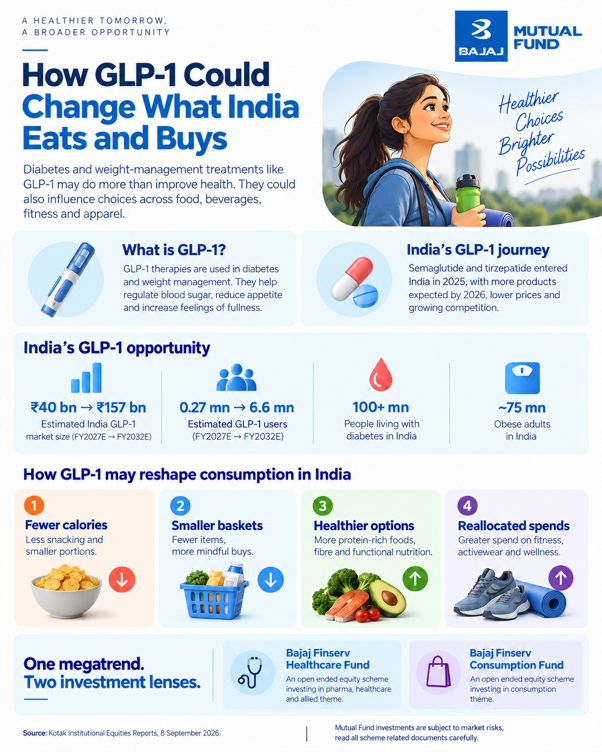
GLP-1 stands for glucagon-like peptide-1, a hormone that occurs naturally in the body and helps regulate blood sugar and appetite. Medicines that mimic its action are used in diabetes care and, in certain formulations, weight management.
You may have heard names such as semaglutide or tirzepatide. Semaglutide mimics GLP-1, while tirzepatide acts on both GLP-1 and another hormone called GIP. Both can affect appetite and food intake. These are prescription treatments, with suitability determined by a doctor.
At Bajaj AMC, we look at how long-term changes like these may influence businesses across sectors. Our Bajaj Finserv Healthcare Fund and Bajaj Finserv Consumption Fund seek to identify potential opportunities within their respective themes. GLP-1 offers an example of how developments in healthcare could also shape everyday consumption.
Source: National Institute of Diabetes and Digestive and Kidney Diseases, Prescription Medications to Treat Overweight & Obesity.
Why this matters for India
India has a substantial need for diabetes care and weight management, with more than 10 crore people living with diabetes and approximately 7.5 crore adults living with obesity. These groups can overlap, and the figures do not represent the number of people who will use these medicines.
Increasing competition and the prospect of more affordable treatment could support wider adoption. Estimates suggest the following potential growth:
- The Indian GLP-1 market could grow from ₹4,000 crore in FY2027 to ₹15,700 crore in FY2032, nearly four times its size.
- The user base could expand from an estimated 2.7 lakh to 66 lakh by FY2032.
These are estimates, not assured outcomes. The effect on consumer businesses will depend on how widely the therapies are adopted and how people’s habits develop over time.
Source: Kotak Institutional Equities Reports, 8 September 2026.
How everyday spending could change
Wider adoption of GLP-1 therapies could influence everyday spending in four ways, from the snacks people buy to the clothes they choose.
1. Less frequent snacking
Someone with a smaller appetite may reach for an extra packet of biscuits or an evening snack less often. Across a larger group of consumers, this could affect demand for indulgent snacks, bakery products and sugary drinks.
For the businesses selling these products, the change could show up gradually through fewer purchases or lower quantities bought. The effect would vary across products and customers.
2. Smaller portions and shopping baskets
A person may still enjoy ordering from a favourite restaurant but choose a smaller meal. Similarly, a household might continue buying a familiar snack in a smaller pack.
This is why the size of a purchase matters alongside the number of customers. Restaurants, food-delivery businesses and packaged-food companies may find more demand for smaller portions, single-serve packs or options that let customers choose how much they buy.
3. More attention to nutrition
Eating less may also prompt people to pay closer attention to what their meals contain. Some consumers could direct more of their food budget towards protein-rich foods, fibre, fruits and vegetables.
Spending could also shift towards hydration, supplements and products designed to meet particular nutritional needs. For businesses, this could mean a change in the mix of purchases. A smaller shopping basket could contain different products from before.
4. Different lifestyle purchases
The possible effects extend beyond food. Weight changes may lead someone to replace clothes, while a more active routine could bring spending on exercise classes, activewear or footwear.
These are possible changes in individual spending choices. They will depend on personal preferences and household budgets, including the cost of treatment.
Source: Kotak Institutional Equities Reports, 8 September 2026.
What this means for businesses and investors
A business can be affected by a development that begins outside its own industry. In this case, an appetite-related treatment could influence the products customers choose and the quantities they buy.
Companies that respond with suitable pack sizes, menus or nutritional offerings may find new opportunities. Others may need to adjust products that no longer match some customers’ preferences.
If such changes become widespread and persist for years, they can form part of a megatrend: a lasting change in how people live, spend or use products and services. GLP-1 illustrates how a development in healthcare could contribute to longer-term changes in consumption.
For investors, recognising the trend is a starting point. Understanding a company’s ability to respond, its profitability and the price paid for its shares remains essential. Growth in a product category does not automatically translate into investment returns.
How the two Bajaj AMC funds connect to this theme
Our two funds examine potential opportunities through different investment themes: healthcare developments and changes in domestic consumption.
Bajaj Finserv Healthcare Fund
The Bajaj Finserv Healthcare Fund is an open ended equity scheme investing in pharma, healthcare and allied theme. It seeks long-term capital appreciation by predominantly investing in equity and equity-related instruments of pharma, healthcare and allied companies.
Developments such as GLP-1 therapies illustrate the kind of change relevant to understanding healthcare demand and innovation. The fund’s investment scope covers the broader healthcare theme, beyond any single treatment.
Source: Bajaj AMC, Bajaj Finserv Healthcare Fund scheme page.
Bajaj Finserv Consumption Fund
The Bajaj Finserv Consumption Fund is an open -ended equity scheme investing in consumption theme. It seeks long-term capital appreciation by predominantly investing in equity and equity-related securities of companies likely to benefit directly or indirectly from domestic consumption-led demand.
Changes in food choices, purchase sizes and lifestyle spending are relevant to this theme because they can influence where consumer demand grows. GLP-1 is one example of a development that could contribute to those changes.
Source: Bajaj AMC, Bajaj Finserv Consumption Fund scheme page.
Both schemes carry a very high risk rating. Their thematic focus makes it useful to consider how they fit with an investor’s existing portfolio, time horizon and ability to accept market fluctuations. There is no assurance that either scheme’s investment objective will be achieved.
Following the change from treatment to everyday life
The wider significance of GLP-1 lies in how its effects could reach everyday decisions, from ordering a meal to choosing groceries or buying clothes. Following these connections helps investors understand why a development in healthcare can also matter to consumption businesses.
As this theme develops in India, the useful signals will be adoption, sustained changes in buying habits and how companies respond. Those signals will help distinguish an interesting possibility from a lasting business opportunity.
Note: The data and information in this article are relevant as on the date of publication and may change subsequently. Please refer to the latest available information before making any financial or investment-related decision.
Please note that the reference to any industry/sector/stock is provided for illustrative purposes only. This should not be construed as a research report or a recommendation to buy or sell any security or sector.
Mutual Fund investments are subject to market risks, read all scheme related documents carefully.
The scheme will invest at least 80% of its total assets in equity and equity related securities of companies that belong to sectors forming part of BSE Healthcare Total Return Index. (TRI)
This document should not be treated as endorsement of the views/opinions or as investment advice. This document should not be construed as a research report or a recommendation to buy or sell any security. This document is for information purpose only and should not be construed as a promise on minimum returns or safeguard of capital. This document alone is not sufficient and should not be used for the development or implementation of an investment strategy. The recipient should note and understand that the information provided above may not contain all the material aspects relevant for making an investment decision. Investors are advised to consult their own investment advisor before making any investment decision in light of their risk appetite, investment goals and horizon. This information is subject to change without any prior notice.
The content herein has been prepared on the basis of publicly available information believed to be reliable. However, Bajaj Asset Management Limited (formerly known as Bajaj Finserv Asset Management Limited) does not guarantee the accuracy of such information, assure its completeness or warrant such information will not be changed. The tax information (if any) in this article is based on prevailing laws at the time of publishing the article and is subject to change. Please consult a tax professional or refer to the latest regulations for up-to-date information.