
An IPO can attract significant attention from the outside. A known company opens its doors to public investors, the issue attracts attention, and listing day becomes a market event. But behind that moment is a longer journey. That journey is called the IPO cycle, and understanding it can make the IPO process easier to follow.
What is the IPO cycle?
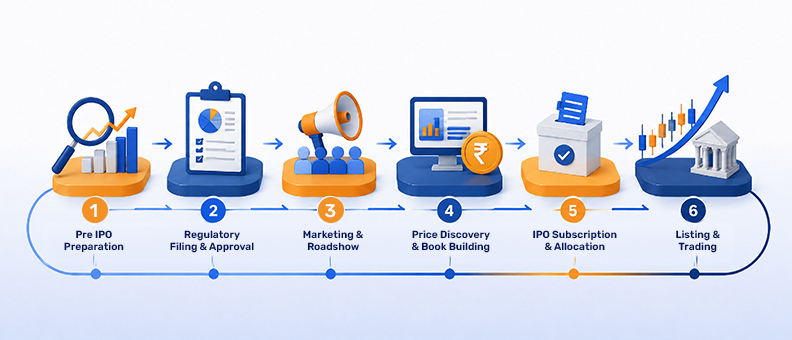
The IPO cycle is the full path a company travels while moving from private ownership to becoming publicly listed on a stock exchange. It usually starts with the decision to go public and internal preparation, followed by the appointment of intermediaries, preparation and filing of offer documents, regulatory review, pricing, public subscription, allotment and listing.
In India, public issue documents are filed and tracked through SEBI’s public issue framework, which separately covers draft offer documents, red herring documents and final offer documents. Many investors notice only the IPO application window and listing price, but the IPO cycle begins much earlier.
What are the different stages of the IPO cycle?
The IPO process generally includes the following stages:
- Decision to go public
The IPO cycle begins when a company decides to offer its shares to the public. It may seek to raise fresh capital for purposes such as expansion, debt reduction or other business requirements. An IPO may also include an offer for sale, through which existing shareholders sell some of their holdings.
- Appointment of intermediaries
The company appoints SEBI-registered merchant bankers or book-running lead managers to manage the IPO process. Other intermediaries may include legal advisers, auditors, registrars, underwriters, syndicate members and bankers to the issue.
- Due diligence and preparation of the offer document
The company and its advisers conduct due diligence and prepare the draft offer document. The document contains information about the business, financial statements, promoters, management, risk factors, objects of the issue and the proposed use of funds.
- Filing and regulatory review
For a book-built issue, the Draft Red Herring Prospectus, or DRHP, is filed with SEBI and the relevant stock exchanges. SEBI reviews the disclosures and may issue observations or seek clarifications. SEBI’s observations do not amount to an approval of the business, valuation or potential performance of the IPO.
After the issuer addresses the observations and completes the applicable stock-exchange and Registrar of Companies requirements, it may proceed with the public issue.
Source: SEBI, Public Issues Filings.
- Pricing and marketing
The company and its merchant bankers determine the issue structure, issue period and pricing method. In a book-built IPO, a price band is announced and bids are collected within that range. The company and its advisers may also present information about the issue to potential institutional investors through roadshows or other permitted communications.
- Public subscription
The IPO opens for investors to submit applications. Investors generally apply through Application Supported by Blocked Amount, or ASBA. Under this mechanism, the application amount is blocked in the investor’s bank account and is debited only to the extent of the allotment. Eligible individual investors may also use the UPI mechanism within the applicable limits.
Source: SEBI Investor, Apply in IPO Through ASBA.
- Allotment and unblocking of funds
After the issue closes, the basis of allotment is finalised in coordination with the issuer, merchant bankers, registrar and stock exchange. If the IPO is oversubscribed, an applicant may receive partial allotment or no allotment, depending on the applicable allotment method.
Shares are credited to the demat accounts of successful applicants. Funds relating to unsuccessful or partially successful applications are unblocked as applicable.
- Listing on the stock exchange
After allotment and completion of post-issue requirements, the shares are listed and begin trading on the recognised stock exchange. Under the current framework, listing is generally completed within three working days of the issue closing, commonly known as the T+3 listing timeline. Here, T refers to the issue-closing date.
Source: SEBI, T+3 Listing Framework for Public Issues.
What are the types of IPO pricing methods?
Broadly, IPO pricing can take place through the fixed price method or the book-building method.
Fixed price method
In a fixed price issue, the company states the issue price in advance. Investors apply at that specified price during the subscription period.
Book-building method
In book building, investors bid within an announced price band. Demand is recorded at different price levels, and the final issue price is determined after the bidding period, in accordance with the applicable process.
For retail investors, this can feel somewhat like estimating a household budget before the month begins. The available range is known, but the final allocation depends on demand and the basis of allotment.
Benefits of participation in the IPO cycle
The IPO cycle gives investors access to a company when its shares are first offered to the public and before regular stock-exchange trading begins. This can allow investors to examine the company’s business and issue terms before deciding whether the opportunity is suitable for their goals and risk appetite.
The offer documents contain information such as business operations, risk factors, financial statements, promoters, use of proceeds and issue terms. These disclosures can help investors conduct a more structured assessment, although they do not remove investment risk.
The IPO application route also follows a defined process. Under ASBA, the application amount remains blocked in the investor’s bank account and is debited only to the extent of shares allotted. This avoids the need to wait for a conventional refund in the event of non-allotment.
Challenges of participation in IPO cycle
Before applying, investors may consider the key challenges that can affect allotment, pricing and post-listing outcomes:
- Demand may exceed the number of shares available, so an applicant may receive partial allotment or no allotment.
- Price discovery can be difficult because a newly listed company does not have a long trading history on the stock exchange.
- The issue price and listing price may differ based on demand, liquidity, valuation and prevailing market conditions.
- High subscription levels or elevated market interest do not assure listing gains or future share-price performance.
- Offer documents can be lengthy and technical, which may make important disclosures harder to interpret.
- Investors may review risk factors, use of proceeds, financial history, promoter details, legal matters and issue terms before making an application.
- Relying only on market commentary, grey-market activity or subscription figures may provide an incomplete view of the IPO.
What happens after an IPO is listed?
Once the IPO is listed, the shares begin trading on the recognised stock exchange. The listing price may be above, below or near the issue price, depending on demand, market sentiment, valuation, liquidity and prevailing market conditions.
Listing is not the end of the assessment. After listing, the company becomes subject to the regulatory and disclosure requirements applicable to listed entities. Investors may track quarterly financial results, material developments, governance disclosures, business performance and broader market conditions.
Initial interest around an IPO may change after listing. Therefore, listing-day performance should not be treated as an indicator of the company’s future share-price movement or long-term business performance.
Past performance may or may not be sustained in future.
Factors that can influence the IPO cycle
The IPO cycle timeline and outcome may be shaped by several regulatory, market and company-specific factors:
Regulatory and disclosure requirements
The time needed to complete offer-document filings, respond to queries and incorporate disclosure changes may affect the IPO cycle timeline.
SEBI observations
SEBI may issue observations or seek clarifications on offer documents, but this should not be interpreted as an endorsement of the issuer or its securities.
Market conditions
Periods of market volatility or weaker investor demand may lead a company to delay or reconsider the timing of an IPO.
Company fundamentals
Revenue, profitability, debt, cash flow and business risks may influence investor assessment and demand during the IPO process.
Sector sentiment
Investor perception of the company’s sector may affect participation, although favourable sentiment does not assure allotment or listing performance.
Valuation
The pricing of the IPO relative to the company’s financial position and comparable businesses may influence demand across investor categories.
Institutional and retail demand
The level of interest from institutional and retail investors may affect subscription levels and the basis of allotment.
Liquidity and economic conditions
Broader liquidity, interest rates and economic conditions may influence the timing and reception of an IPO.
Tips for investors before participating in an IPO
Before applying, investors may consider the following checks to better understand the issue and its risks:
- Read the Red Herring Prospectus, especially the sections on risk factors, objects of the issue, financial information and legal proceedings.
- Check whether the IPO is a fresh issue, an offer for sale, or a combination of both, as this determines where the proceeds are directed.
- Understand that a fresh issue brings capital into the company, while an offer for sale transfers shares from existing shareholders to public investors.
- Assess the valuation in the context of the company’s revenue, profitability, debt, cash flow, risks and peer positioning, where comparable information is available.
- Avoid treating a familiar brand as an automatic indicator that the IPO is a suitable investment.
- Keep the application amount within personal financial comfort and risk capacity, as IPO allotment is uncertain.
- Do not rely only on grey-market activity, subscription numbers or short-term market commentary when assessing an IPO.
- Remember that listing gains are not assured and post-listing performance may vary based on market and company-specific factors.
Conclusion
The IPO cycle is the bridge between a private company’s fundraising plan and its entry into the public market. Understanding the IPO process helps investors look beyond the application window and listing day. The complete journey includes preparation, regulatory filings, pricing, subscription, allotment, listing and post-listing assessment. Each stage provides information that may help investors evaluate the issue while recognising that allotment and market performance remain uncertain.
FAQs
How long does the IPO cycle take?
The IPO cycle timeline can range from several months to longer, depending on document preparation, regulatory observations, stock-exchange requirements, market conditions and the issuer’s readiness. After the issue closes, listing is generally completed within three working days under the T+3 framework.
What is the role of SEBI in the IPO cycle?
SEBI regulates the public-issue disclosure framework and reviews the offer documents filed by issuers. It may issue observations or request clarifications, but its review does not represent an endorsement of the company, issue price or potential investment performance.
Can retail investors participate in every IPO?
Retail investors can generally apply to public IPOs that include a retail individual investor category, subject to the application rules, investment limits and payment requirements stated in the offer document. Eligibility and reservation categories may vary between issues.
What is the difference between the IPO cycle and the IPO process?
The IPO cycle refers to the complete journey from a company’s decision to go public through listing and post-listing activities. The IPO process refers to the individual steps completed within that broader journey.
What documents are required to apply for an IPO?
An investor generally needs a PAN, demat account and eligible bank account to apply for an IPO. The application may be submitted through ASBA or, where applicable, through a supported UPI route. A trading account is generally required to sell the allotted shares on the stock exchange after listing.
Does SEBI’s review guarantee that an IPO is suitable?
No. SEBI’s review of an offer document does not guarantee the quality, valuation, allotment or future performance of an IPO. Investors may assess the disclosures, risks, financial information and issue terms when considering whether the IPO is suitable for them.


































