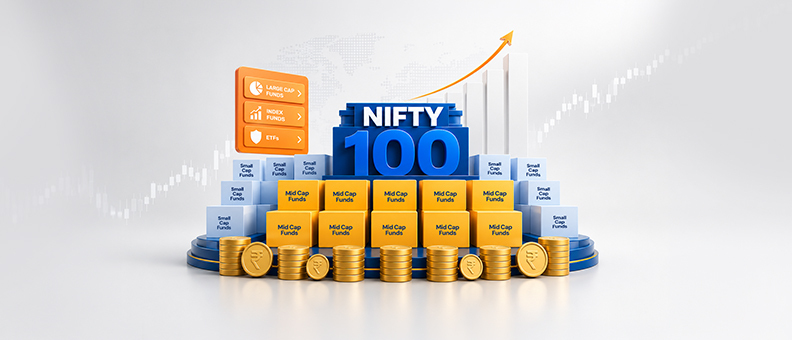


If you want to understand how some of India’s large listed companies are performing, the Nifty 100 Index can be a useful benchmark to look at. It includes 100 major companies selected from the Nifty 500 and represents several important sectors of the economy.
In simple terms, the Nifty 100 brings together the companies from two indices: Nifty 50 and Nifty Next 50. This means it gives a broader view of the large cap segment than the Nifty 50 alone. Investors, fund managers, and passive investment products such as index funds and ETFs often use this index to track the performance of a wide group of large Indian businesses across sectors.
Table of Contents
What is Nifty 100?
The Nifty 100 Index is an equity market index that represents 100 large companies selected from the Nifty 500. In simple terms, it helps you track how some of India’s large listed companies are performing in the stock market.
The index combines the companies from two well-known indices: Nifty 50 and Nifty Next 50. This means it gives a wider view of the large cap segment than the Nifty 50 alone. While the Nifty 50 covers 50 large companies, the Nifty 100 includes these companies along with the next set of large companies from the Nifty Next 50 universe.
The Nifty 100 is calculated using the free-float market capitalisation method. This means that companies with a higher market value available for public trading usually get a higher weight in the index.
The index is commonly used by investors and fund managers to compare portfolio performance. It can also be used as the underlying index for passive investment products such as index funds and ETFs, subject to tracking error. There are also variants of the index, such as the Nifty 100 Total Returns Index and the Nifty 100 Equal Weight Index.
How does Nifty 100 work?
The Nifty 100 Index consists of 100 large listed companies selected from the Nifty 500. These companies are primarily chosen based on their market capitalisation, which reflects the total market value of the company.
The index follows the free-float market capitalisation methodology. Under this approach, companies with a higher market value of publicly tradable shares carry greater weight in the index. Shares held by promoters or other locked-in investors are excluded from this calculation.
NSE Indices reviews the Nifty 100 twice a year, with cut-off dates of January 31 and July 31. During these reviews, companies may be added or removed based on their market capitalisation ranking, continued inclusion in the Nifty 500, and other eligibility criteria.
To be considered for inclusion, a company must have a minimum listing history of one month as of the cut-off date. NSE Indices provides the market with four weeks’ notice before implementing any changes.
The index is updated periodically to ensure it continues to reflect a broad cross-section of large Indian companies.
Features of Nifty 100
The Nifty 100 Index has a few key features that make it useful for understanding the broader large cap space in India:
Exposure to 100 large companies
The index includes 100 large listed companies, giving investors a wider view of the large cap market than narrower indices.
Covers major sectors
The Nifty 100 includes companies from different sectors of the economy, which helps reduce dependence on any one sector.
Based on free-float market capitalisation
The index gives higher weight to companies with a larger market value of publicly available shares.
Reviewed periodically
NSE Indices reviews and rebalances the index at regular intervals to ensure it continues to represent eligible large listed companies.
Used as a benchmark
The Nifty 100 is often used to compare the performance of mutual funds, portfolios, index funds, and ETFs.
Available through passive investment options
Investors can gain exposure to the Nifty 100 through index funds and ETFs that aim to track the index, subject to expenses and tracking error.
Top constituents of Nifty 100 by weightage
The Nifty 100 Index includes 100 companies, but each company does not have the same weight in the index. Companies with a higher free-float market capitalisation usually carry a larger weight, which means they have a bigger impact on the movement of the index.
| Company name | Weight (%) |
| HDFC Bank Ltd. | 9.14 |
| ICICI Bank Ltd. | 7.37 |
| Reliance Industries Ltd. | 6.54 |
| Bharti Airtel Ltd. | 4.21 |
| Larsen & Toubro Ltd. | 3.63 |
| State Bank of India | 3.17 |
| Axis Bank Ltd. | 2.89 |
| Infosys Ltd. | 2.62 |
| Kotak Mahindra Bank Ltd. | 2.16 |
| ITC Ltd. | 2.07 |
As seen above, financial services companies such as HDFC Bank, ICICI Bank, State Bank of India, Axis Bank, and Kotak Mahindra Bank form a significant part of the top holdings. This means that movements in large banking and financial stocks can influence the performance of the index.
However, these weights are not fixed. They may change over time based on market movements, changes in free-float market capitalisation, and index rebalancing.
Source: Nifty 100 Factsheet, NSE Indices Ltd., as of June 30, 2026.
Please note that the reference to any industry/sector/stock is provided for illustrative purposes only. This should not be construed as a research report or a recommendation to buy or sell any security or sector.
Sector representation in Nifty 100
The Nifty 100 Index includes companies from different sectors, so looking at sector weights can help investors understand which parts of the economy have a larger influence on the index:
| Sector | Weight (%) |
| Financial Services | 34.1 |
| Oil, Gas & Consumable Fuels | 9.2 |
| Automobile and Auto Components | 7.07 |
| Fast Moving Consumer Goods | 6.32 |
| Information Technology | 6.3 |
| Healthcare | 5.2 |
| Metals & Mining | 4.55 |
| Capital Goods | 4.34 |
| Telecommunication | 4.21 |
| Power | 4.15 |
| Construction | 3.63 |
| Consumer Services | 3.24 |
| Construction Materials | 2.32 |
| Consumer Durables | 2.25 |
| Services | 1.91 |
| Chemicals | 0.71 |
| Realty | 0.5 |
Financial services has the highest weight in the Nifty 100, meaning banks and financial institutions have a larger impact on the index’s movement. The index also includes exposure to sectors such as oil and gas, automobiles, FMCG, information technology, healthcare, power, and construction, offering a broad view of India’s large cap market. These sector weights may change over time due to market movements and index rebalancing.
Source: Nifty 100 Factsheet, NSE Indices Ltd., as of June 30, 2026.
Please note that the reference to any industry/sector/stock is provided for illustrative purposes only. This should not be construed as a research report or a recommendation to buy or sell any security or sector.
Historical returns of Nifty 100 Index
Looking at index returns can help investors understand how the Nifty 100 has performed across different time periods, although past performance does not guarantee future returns:
| Index return type | QTD (%) | YTD (%) | 1 year (%) | 5 years (%) | Since inception (%) |
| Price Return | 8.92 | -6.65 | -4.68 | 14.66 | 9.32 |
| Total Return | 9.39 | -6.1 | -3.64 | 10.54 | 16.25 |
The Price Return reflects only the change in index prices, while the Total Return also considers dividends or income from the index constituents. As seen above, returns can vary across short-term and long-term periods, which is why investors should avoid judging the index based only on recent performance.
Source: Nifty 100 Factsheet, NSE Indices Ltd., as of June 30, 2026.
Past performance may or may not be sustained in future.
Benefits of investing in Nifty 100
The Nifty 100 can be useful for investors who want wider exposure to large Indian companies without choosing individual stocks themselves:
Broader diversification
The index includes 100 companies, which helps spread exposure across more stocks instead of depending on only a few companies.
Exposure to large Indian businesses
The Nifty 100 gives access to some of India’s larger listed companies across different industries.
Lower company-specific risk
Since the index includes many companies, the poor performance of one stock may have a smaller impact than it would in a concentrated stock portfolio.
Suitable for passive investing
Nifty 100 index funds and ETFs can help investors track the broader large cap market without actively selecting stocks.
Sector coverage
The index includes companies from sectors such as financial services, information technology, energy, healthcare, and consumer-focused industries.
Useful for performance comparison
The Nifty 100 can be used as a benchmark to compare how actively managed equity funds or portfolios are performing.
Long-term investment potential
Since the index tracks a broad group of large listed companies, it may support potential long-term wealth creation over time, although returns are not guaranteed and market risks remain.
Risks associated with Nifty 100
While the Nifty 100 gives exposure to many large companies, it is still linked to the stock market and can move up or down:
- Investments linked to the Nifty 100 may fall during market corrections, economic slowdowns, geopolitical events, or uncertain periods.
- Even though the index has 100 companies, a few large companies may carry higher weight and influence overall performance more.
- If major sectors such as financial services, information technology, energy, or healthcare face challenges, the index may also be affected.
- The value of investments linked to the index may fluctuate in the short term, just like other equity investments.
- Index funds and ETFs that track the Nifty 100 may deliver returns that differ from the index due to expenses, cash holdings, and portfolio adjustments.
- Investments linked to the Nifty 100 do not offer fixed returns or capital protection.
- Investors who react to short-term market movements may find it difficult to stay invested during volatile periods.
The final outcome will depend on factors such as your investment horizon, risk appetite, market conditions, and overall portfolio allocation.
Who should invest in Nifty 100?
The Nifty 100 Index may be suitable for investors seeking exposure to large listed Indian companies through a passive investment approach. It may also be considered by investors looking for a core equity allocation that is broader than the Nifty 50 Index while still focused on large cap companies.
Since investments linked to the index are subject to market fluctuations, it may be more suitable for investors with a long-term investment horizon and the ability to tolerate equity market volatility.
Ways to invest in Nifty 100
Investors cannot invest directly in the index itself. However, they can gain exposure through index funds and ETFs that aim to track the Nifty 100 Index, subject to tracking error.
Both index funds and ETFs are passive investment products. Their objective is to replicate the composition and performance of the underlying index as closely as possible, after accounting for expenses and tracking differences.
Investors can choose to invest through SIPs or lump sum investments based on their financial goals, investment horizon, and cash-flow requirements.
Nifty 100 vs Nifty 50
Both Nifty 50 and Nifty 100 track large listed Indian companies, but the main difference is how wide the exposure is:
| Parameter | Nifty 50 | Nifty 100 |
| Number of companies | Tracks 50 large listed companies | Tracks 100 large listed companies |
| Index composition | Includes the companies that form the Nifty 50 Index | Includes all companies from Nifty 50 and Nifty Next 50 |
| Market exposure | Offers focused exposure to the large cap segment | Offers broader exposure within the large cap segment |
| Diversification | Relatively narrower, as it includes fewer companies | Wider, as it includes twice the number of companies |
| Sector coverage | Covers major sectors through 50 companies | Covers major sectors through a larger set of companies |
| Risk and volatility | May be relatively more focused on the largest companies | May have slightly wider movement because it includes the next 50 large companies as well |
| Suitable for | Investors who prefer exposure to a smaller set of large companies | Investors who want broader large cap exposure through one index |
Conclusion
The Nifty 100 Index offers a broad view of 100 large listed companies across key sectors of the Indian economy. By combining the constituents of the Nifty 50 and Nifty Next 50 indices, it provides wider large cap exposure than the Nifty 50 alone.
However, like all equity-linked investments, it is subject to market risks and short-term fluctuations. Investors considering Nifty 100-based index funds or ETFs may benefit from assessing their financial goals, investment horizon, risk appetite, and overall portfolio allocation before investing.
The index may be considered as part of a diversified long-term equity portfolio, depending on individual needs and circumstances.
FAQs
Is Nifty 100 a good investment option?
The Nifty 100 Index may be suitable for investors who want exposure to a broad group of large listed Indian companies through a passive investment approach. However, suitability depends on the investor’s financial goals, investment horizon, risk appetite, and overall portfolio allocation.
How is the Nifty 100 Index calculated?
The Nifty 100 Index is calculated using the free-float market capitalisation methodology. This means companies with a larger publicly tradable market value receive a higher weight in the index.
How can investors invest in Nifty 100?
Investors cannot invest directly in the Nifty 100 Index, but they can gain exposure through Nifty 100 index funds or ETFs that aim to track the index, subject to tracking error and expenses.
What is the difference between Nifty 50 and Nifty 100?
The Nifty 50 tracks 50 large listed companies, while the Nifty 100 includes those 50 companies along with 50 more companies from the Nifty Next 50 universe. This gives the Nifty 100 broader large cap market representation and sector exposure.
What are the Nifty 100 companies?
The Nifty 100 companies are the top 100 companies selected from the Nifty 500 based on market capitalisation and other eligibility criteria set by NSE Indices.
What is the Nifty 100 Index?
The Nifty 100 Index is a stock market index that tracks the performance of 100 large listed Indian companies across major sectors of the economy.
Is Nifty 50 or Nifty 100 better?
Neither index is universally better; Nifty 50 may suit investors who want focused exposure to 50 large companies, while Nifty 100 may suit those who want broader large cap exposure through 100 companies.
What is the Nifty 100 TRI Index?
The Nifty 100 TRI, or Total Returns Index, measures the performance of the Nifty 100 by including both price changes and dividends from the index constituents.
Is the Nifty 100 Index Fund good?
A Nifty 100 Index Fund may be suitable for investors seeking passive exposure to a broad set of large Indian companies, but its suitability depends on the investor’s goals, risk appetite, investment horizon, and portfolio allocation.