
A company reports one weak quarter. A worrying headline follows. Its share price falls. More investors then rush to sell. Soon, panic may begin to outweigh the facts, and the market’s reaction may become larger than the problem itself.
The opposite can happen too. A business begins to improve. Sales rise, margins recover and new management starts making progress. Yet investors remain cautious because of its past performance. The market may be slow to notice the change, and the share price may not reflect the improving outlook.
Such gaps between market views and business facts may create opportunities. Finding these gaps is a key part of the contrarian strategy used by the Bajaj Finserv Multi Cap Fund.
Contrarian investing is not just about buying what has fallen
Contrarian investing is a strategy that involves going against prevailing market trends to find potential opportunities others may have overlooked. It involves investing in stocks or sectors that are currently out of favour and may be undervalued by the market. A contrarian investor looks for a gap between how the market views a business and what that business may actually be worth.
However, a contrarian approach is not simply about going against the crowd. A stock or sector may be out of favour for valid reasons. A fall in price does not necessarily make a stock undervalued; the business may be facing deep or lasting problems.
A contrarian investor thus examines whether the market’s negative view is justified, whether the business remains fundamentally sound, and what could help its value become recognised over time. This is known as a trigger – a turning point that may help close the gap between a stock’s market price and intrinsic value based on its fundamentals.
The trigger could be:
- A rise in demand
- A change in policy
- New management
- Better finances
In other words, going against the crowd is only one part of the approach. The business case and its valuation must also make sense.
Where the fund looks for contrarian opportunities
The Bajaj Finserv Multi Cap Fund adopts this contrarian approach and looks at four broad situations where prices may not reflect the full picture:
- Business cycles: Changes in commodity prices, credit or capital spending may leave some sectors out of favour just as conditions start to turn.
- Regulatory shifts: A policy reset, rate change or compliance deadline may put short-term pressure on a viable business.
- Behavioural overreaction: One weak quarter or a bad headline may cause more selling than the facts appear to justify.
- Short-term market gaps: Some firms may get less attention due to low research coverage, a complex business model or their absence from an index.
None of these situations is an automatic signal to buy, but they point to directions where deeper research by the fund management team may reveal insights.
How the fund studies overreaction and underreaction
The fund looks at two ways in which market views may move away from business facts.
Overreaction
Overreaction occurs when investors respond too strongly to news or market conditions. Excessive optimism may push a share price above its underlying value. Excessive pessimism may push it down. This pessimism may create an opportunity to tap into mispriced assets caused by emotion-driven market behaviour.
The Bajaj Finserv Multi Cap Fund looks for potential opportunities created by panic-led selling, recession fears or regulatory setbacks. It may also consider reducing or selling a position when market optimism appears to have taken the price far beyond the business fundamentals.
Underreaction
Underreaction occurs when the market is slow to respond to important positive or negative developments. For example, investors may not fully recognise improving finances, innovation or favourable trends within a sector.
The fund seeks to identify such changes before they are widely reflected in the share price. It also watches for negative developments that the market may not have priced in, as these could increase the risk of a further fall.
In both cases, the aim is to understand what the current price already reflects and what the market may still be missing.
Examples from the fund
Let’s take a look at how the fund has sought out opportunities created by under- or overreaction.
Overreaction case study: Healthcare
Healthcare sentiment had weakened due to US tariff threats on pharmaceutical imports, continued pricing pressure in the US generics market and wider trade-policy uncertainty. These concerns may have caused investors to focus more on the immediate risks than on the sector’s longer-term strengths.
The fund examined whether this negative reaction was disproportionate. Its research looked at structural growth drivers in contract research and manufacturing services (CRAMS), hospitals, diagnostics and wellness. It also considered India’s position as one of the world’s lowest-cost drug manufacturing bases.
The contrarian case was therefore not based on healthcare stocks being unpopular. It was based on whether India’s cost advantage and the sector’s long-term growth drivers could remain intact despite the near-term pressure.
In line with this, the portfolio invested in a global generics company with an integrated model spanning active pharmaceutical ingredients and finished formulations. The company was also expanding into higher-value products such as injectables, oncology treatments and biosimilars. Its manufacturing scale, product mix and planned capacity expansion supported the fund’s view that its long-term business prospects may have been more resilient than the weak market sentiment suggested. The stock in question has given 37% returns in the last year.
Underreaction case studies: Banking, capital goods and telecom
The fund’s bank exposure offers a different example, one of underreaction. A private bank had underperformed before a change in leadership. Although a turnaround had begun, the fund believed the market was slow to recognise the improvement. The team increased its position as the bank’s financial performance began to support this view.
The wider banking environment also shaped the analysis. As of June 30, 2026, credit was growing at 17.65%, a two-year high, while deposits grew by 12.21%. The repo rate was 5.25%, near what the team saw as a possible shift in the interest-rate cycle. This, along with other observations about lending rates and credit growth projections made an investment case for the fund.
With this background, the fund investment in the private bank where a new leadership had initiated an overhaul and fundamentals were strengthening. The stock has given 55% returns in the last year.
In the capital goods sector, the shares of a high-precision engineering company serving critical industries rose by 446% over the 10 months ended June 30, 2026. This came at a time when the market had priced in a slower capital-spending and data-centre cycle. The fund believed that order pipelines and profit margins were being underestimated, while demand was growing faster than the market had expected. Additionally, in the telecom services space, an optical networking business benefiting from AI-driven data demand, gave 494% returns even as the sector is not receiving adequate attention from a market that has underestimated subscriber growth, pricing power and average revenue per user.
Source: Internal Analysis. Trendlyne, MFI360; Data as on 30 June 2026. Past performance may or may not be sustained in future. Please note that the reference to any company is provided for illustrative purposes only. This should not be construed as a research report or a recommendation to buy or sell any stock.
Why the multi cap structure supports this approach
Contrarian ideas may appear in firms of any size – large cap, mid cap or small cap. A multi cap fund can tap into potential opportunities across all three groups.
Under current SEBI rules, a multi cap fund must invest at least 25% each in large cap, mid cap and small cap companies. The Bajaj Finserv Multi Cap Fund has maintained disciplined and balanced allocation to all three categories and does not tilt heavily towards large caps.
As of June 30, 2026, the Bajaj Finserv Multi Cap Fund held:
- 35.32% in large cap stocks
- 26% in mid cap stocks
- 37.08% in small cap stocks
In comparison, the composition of the benchmark, Nifty500 Multicap 50:25:25 TRI was 50% in large cap, 25% in mid cap and 25% in small cap stocks.
Sources: Internal Analysis and MFI360. Portfolio data as on June 30, 2026. Allocation values rebased to 100.
How the fund has performed
This approach has helped the fund outperform the benchmark in the past year as well as since inception. Here’s a look at the returns:
Bajaj Finserv Multi Cap Fund – Direct Plan
| Performance | Since inception | One year |
| Fund returns | 16.04% | 5.34% |
| Benchmark returns | 13.22% | -0.61% |
| Alpha | 2.82% | 5.95% |
Bajaj Finserv Multi Cap Fund – Growth Plan
| Performance | Since inception | One year |
| Fund returns | 14.27% | 3.78% |
| Benchmark returns | 13.22% | -0.61% |
| Alpha* | 1.05% | 4.39% |
Alpha shown here is the difference between the fund return and benchmark return.
Data as on June 30, 2026. Benchmark: Nifty 500 Multicap 50:25:25 TRI. Past performance may or may not be sustained in future.
Why should investors consider Bajaj Finserv Multi Cap Fund?
The Bajaj Finserv Multi Cap Fund combines behavioural insights with balanced exposure across market caps to offer investors the following potential benefits:
- Disciplined exposure across market caps: The fund maintains balanced exposure to all three market-cap segments instead of depending heavily on one part of the market.
- Behavioural finance focus: It studies how fear, optimism and other behavioural biases may cause stock prices to move away from business fundamentals, in line with the company’s in-house investment philosophy, InQuBe.
- Early identification of themes: The fund aims to identify overlooked companies or trends before they become widely recognised by the market, resulting in the potential for better long-term returns.
- Search across market cycles: It looks for potential opportunities across different sectors, company sizes and phases of the market cycle.
The fund may be considered by investors who want equity exposure across market caps and have an investment horizon of five years or more. However, a very high risk appetite is needed as market risk and volatility can affect fund performance, especially in the short term.
Note: The data and information in this article are relevant as of the date of publication and may change subsequently. Please refer to the latest available information before making any financial or investment-related decision.
Performance details
| Plan / Benchmark | Return (1 year) | Value of ₹10,000 investment –1 Year | Return (since inception) | Value of ₹10,000 investment – Since inception |
| Bajaj Finserv Multi Cap Fund – Regular Plan – Growth | 3.78% | ₹10,378 | 14.27% | ₹11,952 |
| Bajaj Finserv Multi Cap Fund – Direct Plan – Growth | 5.34% | ₹10,534 | 16.04% | ₹12,200 |
| Benchmark Return (Nifty 500 Multicap 50:25:25 TRI) | -0.61% | ₹9,939 | 13.22% | ₹11,805 |
| Additional Benchmark Return (Nifty 50 TRI) | -5.42% | ₹9,458 | 5.62% | ₹10,758 |
Returns as on 30th June 2026.
Past performance may or may not be sustained in future. Different plans, i.e. Regular Plan and Direct Plan, under the scheme have different expense structures.
Benchmark: Nifty 500 Multicap 50:25:25 TRI
Additional benchmark: Nifty 50 TRI
Inception date: 27th February 2025
The period for which the scheme’s performance has been provided is computed based on the last day of the previous month preceding the date of this material. Returns greater than one year are compounded annualised.
Face value per unit: Rs. 10
The fund managers of the scheme are Mr. Nimesh Chandan (Equity Portion), Mr. Sorbh Gupta (Equity Portion) and Mr. Siddharth Chaudhary (Debt Portion). For the performance of other schemes managed by the fund managers that have completed one year or more since inception, please visit https://www.bajajamc.com/downloads?factsheet and download the latest Factsheet or click here.
Mr. Nimesh Chandan manages the equity portion of Bajaj Finserv Small Cap Fund. He also manages Bajaj Finserv Low Duration Fund.
Mr. Siddharth Chaudhary manages the debt portion of Bajaj Finserv Small Cap Fund, Bajaj Finserv Equity Savings Fund and Bajaj Finserv Banking and Financial Services Fund. He also manages Bajaj Finserv Low Duration Fund.
Mr. Sorbh Gupta manages the equity portion of Bajaj Finserv Small Cap Fund and Bajaj Finserv Equity Savings Fund.
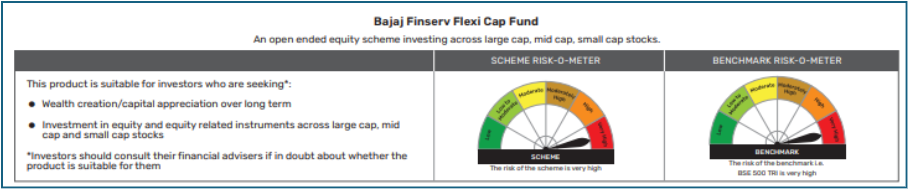
Mutual Fund investments are subject to market risks, read all scheme related documents carefully.
This document should not be treated as endorsement of the views/opinions or as investment advice. This document should not be construed as a research report or a recommendation to buy or sell any security. This document is for information purpose only and should not be construed as a promise on minimum returns or safeguard of capital. This document alone is not sufficient and should not be used for the development or implementation of an investment strategy. The recipient should note and understand that the information provided above may not contain all the material aspects relevant for making an investment decision. Investors are advised to consult their own investment advisor before making any investment decision in light of their risk appetite, investment goals and horizon. This information is subject to change without any prior notice.
The content herein has been prepared on the basis of publicly available information believed to be reliable. However, Bajaj Asset Management Limited (formerly known as Bajaj Finserv Asset Management Limited) does not guarantee the accuracy of such information, assure its completeness or warrant such information will not be changed. The tax information (if any) in this article is based on prevailing laws at the time of publishing the article and is subject to change. Please consult a tax professional or refer to the latest regulations for up-to-date information.