
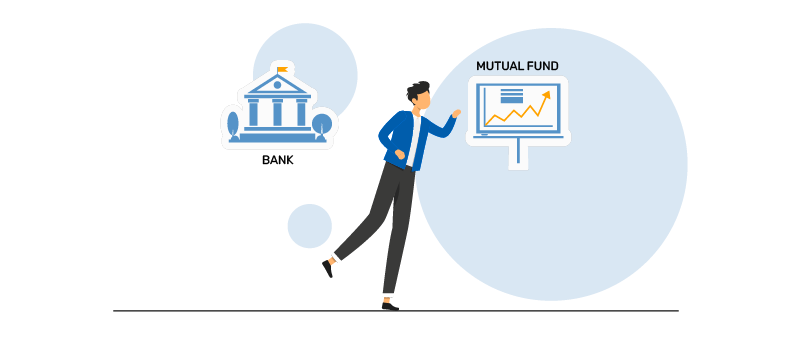
Systematic investment plans (SIPs) and recurring deposits (RDs) both involve regular contributions, but they work differently. An SIP invests in a selected mutual fund scheme, while an RD deposits a fixed amount with a bank for a predetermined tenure at a specified interest rate.
The difference between an SIP and a recurring deposit lies primarily in their return potential, risk, flexibility, liquidity and taxation. The more suitable option depends on the investor’s financial goal, time horizon and risk tolerance.
Key Takeaways
- An SIP is a method of investing regularly in a mutual fund scheme, while an RD is a bank term-deposit product.
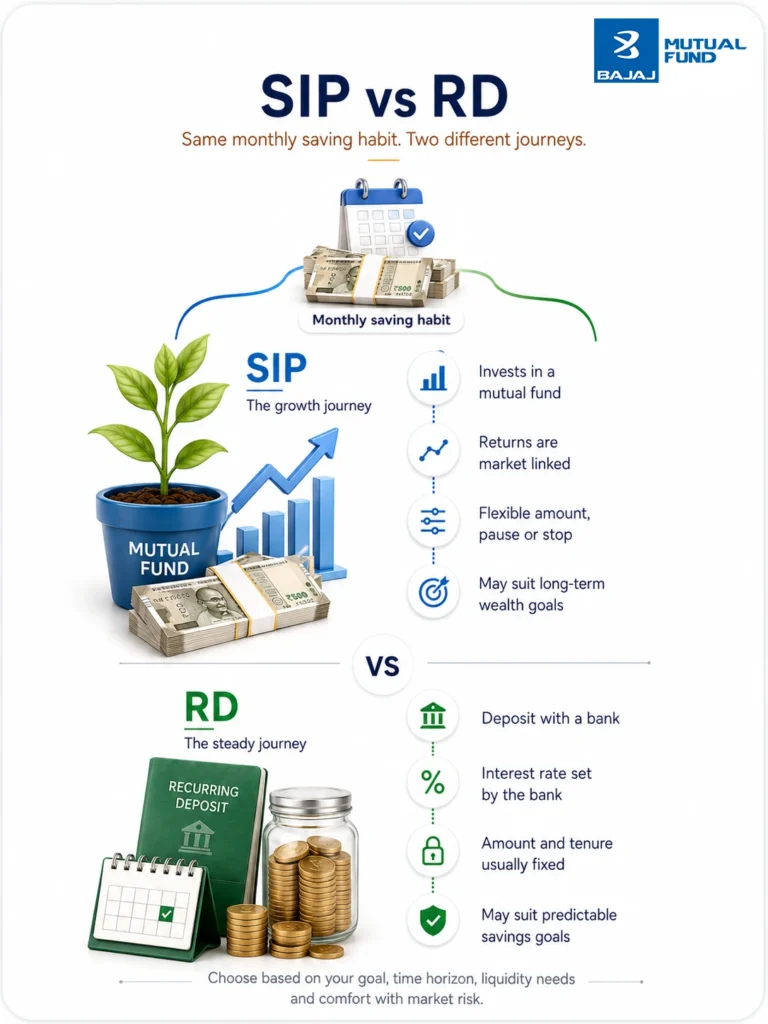
- SIP returns are market-linked and depend on the selected scheme, whereas RD interest is specified by the bank.
- The risk of an SIP depends on its underlying mutual fund scheme, while an RD generally provides a predictable maturity value when held according to its terms.
- Most open-ended mutual fund units can be redeemed, subject to scheme conditions, while premature closure of an RD may result in reduced interest or a penalty.
- The SIP vs RD decision should consider the investor’s financial goal, time horizon, risk tolerance, liquidity needs and post-tax return expectations.
Table of Contents
What is a systematic investment plan (SIP)?
A systematic investment plan is a facility for investing a fixed amount in a selected mutual fund scheme at regular intervals, such as monthly or quarterly. An SIP is an investment method, not a separate mutual fund category.
Each instalment purchases units at the scheme’s applicable net asset value (NAV). When the NAV is lower, the contribution buys more units; when it is higher, it buys fewer. This is known as rupee-cost averaging.
The risk and return potential depend on the underlying scheme. For example, SIPs in equity, debt, liquid and hybrid funds have different risk profiles.
Source: Based on SEBI Investor’s mutual fund guidance, as on August 5, 2026.
Benefits of SIPs
SIPs can encourage disciplined investing and offer the following potential benefits:
- Regular investing: Automated contributions can help maintain investment discipline.
- Rupee-cost averaging: Fixed contributions purchase different numbers of units as the NAV changes.
- Choice of schemes: Investors can choose a mutual fund category based on their goals, time horizon and risk tolerance.
- Contribution flexibility: SIPs can generally be modified, paused or cancelled, subject to the asset management company’s terms.
- Compounding potential: Returns that remain invested may generate additional returns over time.
- Partial redemption: Units in most open-ended schemes can be redeemed without stopping future SIP instalments, subject to scheme conditions.
Drawbacks of SIPs
The limitations and risks of an SIP arise mainly from the underlying mutual fund scheme:
- Market-linked returns: Returns are not fixed, and the investment value may decline.
- Scheme-specific risk: The level and type of risk depend on the selected mutual fund scheme.
- No assured benefit from rupee-cost averaging: Investing at different NAVs does not guarantee a profit.
- Exit loads and lock-ins: Some redemptions may attract an exit load, while certain schemes have mandatory lock-in periods.
- Tax on gains: Redemption can result in taxable capital gains.
- Scheme selection: Investors must choose and periodically review an appropriate scheme.
What is a recurring deposit (RD)?
A recurring deposit is a bank term deposit into which a predetermined amount is contributed at regular intervals for a fixed tenure. Interest is calculated using the rate and compounding method specified by the bank.
An RD is not directly linked to securities-market performance. Its maturity value is generally predictable if instalments are paid on time and the deposit is held until maturity.
Premature closure may result in a lower interest rate or penalty. Banks may also impose conditions or charges for delayed and missed instalments.
Eligible RDs with an insured bank are covered by the Deposit Insurance and Credit Guarantee Corporation (DICGC). The coverage limit is ₹5 lakh per depositor per bank in the same capacity and right. This limit includes principal and interest across all eligible deposits held with that bank.
Source: Based on the RBI’s deposit-interest directions and DICGC’s deposit-insurance guidance, as on August 5, 2026.
Benefits of RDs
Recurring deposits can be useful for individuals seeking predictability and a regular saving arrangement:
- Predetermined interest rate: The applicable rate is ordinarily specified when the RD is opened.
- Predictable maturity value: The maturity amount can generally be calculated in advance.
- No direct market exposure: The deposit value does not fluctuate with securities-market prices.
- Regular saving: Fixed instalments can help individuals save towards a defined expense.
- Deposit insurance: Eligible deposits receive DICGC coverage within the applicable aggregate limit.
- Simple structure: Depositors do not need to select mutual fund schemes or securities.
Drawbacks of RDs
The principal limitations of recurring deposits include:
- Limited flexibility: The instalment amount and tenure are generally fixed at the outset.
- Premature-closure consequences: Early closure may result in reduced interest or a penalty.
- Missed-instalment conditions: Delayed contributions may attract charges or other consequences.
- Inflation risk: Post-tax interest may not keep pace with inflation.
- Taxable interest: RD interest is added to the depositor’s taxable income.
- Limited insurance: DICGC coverage is subject to an aggregate limit of ₹5 lakh per depositor per insured bank in the same capacity and right.
- Reinvestment risk: Interest rates available when the RD matures may be lower.
SIP vs RD: Key differences
The following table summarises the key points in the SIP vs recurring deposit comparison:
| Factor | SIP | Recurring deposit |
| Nature | A method of investing regularly in a mutual fund scheme | A bank term-deposit product |
| Where the money goes | Into the selected mutual fund scheme’s portfolio | Into a deposit maintained with the bank |
| Returns | Market-linked and variable | Based on the interest rate specified by the bank |
| Risk | Depends on the underlying mutual fund scheme | Primarily associated with the bank, subject to limited DICGC coverage |
| Capital value | Can rise or fall | Does not ordinarily fluctuate with market prices |
| Contribution frequency | Available frequencies depend on the AMC and scheme | Usually monthly, subject to the bank’s terms |
| Contribution flexibility | Can generally be registered, modified, paused or cancelled, subject to operational rules | Amount and tenure are normally selected at the outset |
| Liquidity | Units of most open-ended schemes can be redeemed, subject to exit loads, cut-off rules and lock-ins | Premature closure may be permitted, subject to adjusted interest or a penalty |
| Investment period | Can continue for a selected period or until cancelled | Has a predetermined tenure |
| Return drivers | Performance of the underlying portfolio after expenses | Interest rate, deposit tenure and contribution schedule |
| Tax treatment | Depends on the mutual fund category, holding period and applicable law | Interest is generally taxable under the applicable provisions |
| Deposit insurance | Not covered by DICGC | Eligible deposits are covered within the applicable DICGC limit |
| Potential use | Regular market-linked investing aligned with an investor’s horizon and risk tolerance | Regular saving where predictability is a priority |
Actual SIP and RD terms can vary across mutual fund schemes and banks.
Returns on fixed deposits/savings accounts are fixed, however, returns on mutual funds are subject to market risks.
SIP vs RD: Which may be more suitable for you?
An SIP may be considered by investors seeking market-linked return potential who can accept fluctuations in the value of the selected mutual fund scheme. The investment horizon should match the scheme category.
An RD may be considered when a predictable maturity value and limited exposure to market fluctuations are priorities.
The decision should account for:
- Risk tolerance: Whether fluctuations in investment value are acceptable.
- Return expectations: Whether market-linked potential or predictable interest is preferred.
- Time horizon: Whether the product and, for an SIP, the scheme category suit the intended holding period.
- Liquidity: The applicable redemption, lock-in and premature-closure conditions.
- Taxation: The expected return after tax.
- Inflation: Whether the post-tax outcome may support the intended goal after accounting for rising prices.
- Product terms: The scheme documents or bank deposit conditions.
SIPs and RDs may also be used for different goals. For example, an RD may suit an expense requiring a predictable maturity amount, while an SIP may suit a longer-term market-linked objective.
Taxation of SIPs and recurring deposits
The taxation of an SIP depends on the mutual fund scheme in which the SIP invests. Tax generally arises when units are redeemed rather than when an instalment is invested. For an equity-oriented mutual fund:
- Gains on units held for up to 12 months are generally treated as short-term capital gains and taxed at 20%.
- Gains on units held for more than 12 months are treated as long-term capital gains.
- Long-term capital gains exceeding ₹1.25 lakh in a financial year are generally taxed at 12.5%.
Each SIP instalment is treated as a separate investment with its own acquisition cost and holding period. A redemption can therefore include both short-term and long-term gains. Mutual fund redemptions generally follow the first-in, first-out method, under which the units purchased earliest are treated as redeemed first.
Different rules may apply to debt-oriented and other mutual fund schemes. Gains from specified debt-oriented mutual funds acquired on or after April 1, 2023 are generally treated as short-term capital gains and taxed at the investor’s applicable slab rate, irrespective of the holding period.
RD interest is added to the depositor’s taxable income and taxed at the applicable slab rate. Tax applies to the interest earned, not the entire maturity amount.
For resident depositors, banks generally deduct TDS at 10% when aggregate eligible interest exceeds ₹50,000 in a financial year. The threshold is ₹1 lakh for senior citizens. These thresholds apply to aggregate eligible interest paid by the bank, not separately to each RD.
TDS is an advance collection of tax and may differ from the depositor’s final liability.
Source: Based on the applicable Income-tax provisions and Income Tax Department guidance, as on August 5, 2026.
The tax information in this article is based on prevailing laws at the time of publishing the article and is subject to change. Please consult a tax professional or refer to the latest regulations for up-to-date information.
How should SIP and RD returns be compared?
An RD can generally be evaluated using its stated interest rate and maturity amount, provided all instalments are paid as scheduled.
SIP investments involve multiple cash flows on different dates. Extended internal rate of return (XIRR) is therefore generally used to calculate the investor’s annualised return.
Compound annual growth rate (CAGR) is more appropriate for an investment with a single starting value and ending value. It may not accurately represent returns from multiple SIP instalments.
Conclusion
An SIP provides regular exposure to a selected mutual fund scheme and generates market-linked returns. An RD accepts regular bank deposits for a fixed tenure at a specified interest rate and generally provides a predictable maturity value.
The choice depends on whether the investor prioritises market-linked return potential and flexibility or predictability and limited exposure to market fluctuations. Financial goals, time horizon, risk tolerance, liquidity and post-tax returns should guide the decision.
A SIP calculator can illustrate potential outcomes based on an assumed return rate, but actual results will depend on the performance of the selected scheme.
The calculator is an aid, not a prediction tool. It may provide only an indicative picture.
FAQs
Which offers higher return potential: an SIP or an RD?
An SIP may offer higher return potential because it invests in a market-linked mutual fund scheme, but its value can also decline. An RD provides a predetermined interest rate and a more predictable maturity amount.
Which is safer: an SIP or an RD?
An RD generally has lower investment-value volatility because it is not directly linked to securities markets. An SIP’s risk depends on the underlying mutual fund scheme, while eligible bank deposits receive DICGC coverage only within the applicable aggregate limit.
Is an SIP more liquid than an RD?
Not always. Most open-ended mutual fund units can be redeemed, although exit loads, settlement periods or lock-ins may apply. Accessing an RD before maturity may require premature closure and could reduce the interest earned.
What is the minimum amount required for an SIP or RD?
Minimum contributions vary among mutual fund schemes, banks and products. Investors should check the current terms of the selected scheme or RD before starting.
Can SIPs and RDs be used together?
Yes. An RD may be used for a goal requiring a predictable maturity amount, while an SIP may be used for a market-linked objective that matches the investor’s time horizon and risk tolerance.
Is an SIP suitable for short-term goals?
Suitability depends on the underlying mutual fund scheme, not the SIP facility itself. Equity-oriented schemes may be unsuitable for short-term goals, while certain lower-duration debt or liquid schemes have different risk and liquidity characteristics.
Is an RD interest-free or tax-free?
No. Interest earned on an RD is generally added to the depositor’s taxable income and taxed at the applicable slab rate. TDS may also apply when aggregate eligible interest exceeds the statutory threshold.
How are SIP returns compared with RD interest?
SIP returns are generally measured using XIRR because instalments are invested on different dates. RD returns can usually be assessed using the stated interest rate and maturity amount.
Our Funds


































