
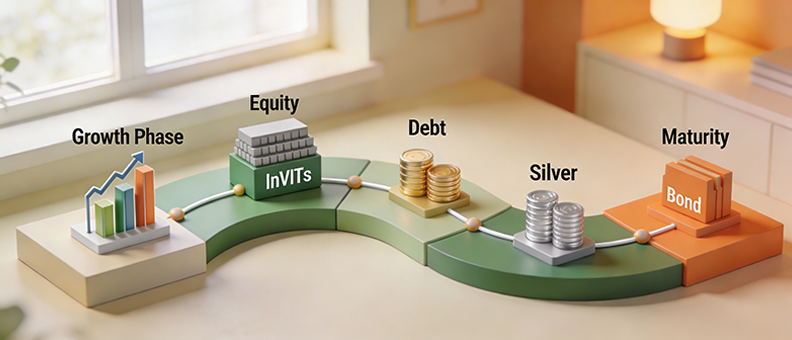
A life cycle fund is an open-ended mutual fund with a predetermined maturity and a glide path for goal-based investing. Its asset allocation changes according to the time remaining until maturity, generally moving from higher directional equity exposure towards a more conservative mix.
The Securities and Exchange Board of India (SEBI) formally introduced Life Cycle Funds as a mutual fund category on February 26, 2026. These schemes can invest across equity, debt, infrastructure investment trusts (InvITs), exchange-traded commodity derivatives (ETCDs), and gold and silver ETFs.
The structure can reduce the need for investors to rebalance their portfolios manually. It cannot guarantee that a financial goal will be met or that a specified amount will be available at maturity.
Source: SEBI circular on categorisation and rationalisation of mutual fund schemes, February 26, 2026.
Table of Contents
What is a life cycle fund?
A life cycle fund changes its allocation across permitted asset classes according to the number of years remaining until its target maturity.
A longer-dated fund may begin with substantial equity exposure. As maturity approaches, the permitted equity range falls and the debt allocation generally rises. The scheme may also allocate up to 10% to gold and silver ETFs, gold- or silver-based ETCDs, and InvITs.
The maturity year must appear in the scheme’s name, such as “Life Cycle Fund 2055”. This helps an investor identify the time frame around which the scheme’s glide path has been designed.
The changing allocation across the life cycle of a mutual fund portfolio is intended to reduce reliance on investors making their own asset-allocation changes at different stages of a goal.
Key Takeaways
- A Life Cycle Fund follows a predetermined maturity and a glide path that changes its asset allocation over time.
- SEBI permits Life Cycle Funds with tenures of five to 30 years, offered in multiples of five years.
- Directional equity exposure generally reduces as maturity approaches, while the allocation to debt increases.
- A maturity year close to an investor’s goal does not automatically make the fund suitable for that investor.
- Life Cycle Funds remain exposed to market, credit, interest-rate, liquidity and asset-allocation risks.
How do life cycle funds work?
A life cycle fund follows an asset-allocation schedule known as a glide path. This schedule sets the permitted allocation ranges according to the time left until maturity. Under SEBI’s framework, the broad ranges are:
| Years remaining to maturity | Equity | Debt | Gold and silver ETFs, ETCDs and InvITs |
| 15 to 30 years | 65% to 95% | 5% to 25% | 0% to 10% |
| 10 to 15 years | 65% to 80% | 5% to 25% | 0% to 10% |
| 5 to 10 years | 50% to 65% | 5% to 25% | 0% to 10% |
| 3 to 5 years | 35% to 50% | 25% to 50% | 0% to 10% |
| 1 to 3 years | 20% to 35% | 25% to 65% | 0% to 10% |
| Less than 1 year | 5% to 20% | 25% to 65% | 0% to 10% |
The stages available to a scheme depend on its original tenure. A 10-year fund, for example, begins with the allocation range applicable when five to 10 years remain. It does not pass through the ranges designed for longer-dated schemes.
When fewer than five years remain, Life Cycle Funds may take equity-arbitrage exposure of up to 50% in addition to the specified equity range. Total investment in equity and equity-related instruments must remain between 65% and 75% during this period.
For the stages with three years or less remaining, debt exposure must be limited to instruments rated AA or above. Their residual maturity must also be shorter than the target maturity of the scheme. ETCD exposure is restricted to gold and silver.
Source: SEBI circular on categorisation and rationalisation of mutual fund schemes, Annexure B.
Key features of life cycle funds
The defining features of life cycle mutual funds include:
- Predetermined maturity: Each scheme is built around a specified maturity year.
- Prescribed glide path: Asset allocation changes within defined ranges as maturity approaches.
- Multiple asset classes: The scheme can invest in equity, debt, InvITs, gold and silver ETFs, and permitted ETCDs.
- Automatic portfolio adjustment: The fund manager adjusts the allocation according to the scheme’s glide path.
- Defined tenure: Permitted tenures range from five to 30 years in multiples of five years.
- Open-ended structure: Investors may purchase or redeem units subject to the scheme’s terms and applicable exit load.
- Goal-based orientation: The maturity year allows the scheme to be considered for a goal with a broadly similar time frame.
- Limited product range: An AMC may have no more than six Life Cycle Funds active for subscription at one time.
Example of life cycle fund allocation
Consider Ankur, who is investing for a financial goal approximately 20 years away. He selects a Life Cycle Fund with a maturity year close to the date on which he expects to need the money. Its allocation could move through the following stages:
- 15 to 20 years remaining: Equity may account for 65% to 95%, debt for 5% to 25%, and the remaining permitted assets for up to 10%.
- 10 to 15 years remaining: The equity range may reduce to 65% to 80%.
- 5 to 10 years remaining: Equity may account for 50% to 65%, with the balance spread across debt and other permitted assets.
- 3 to 5 years remaining: Equity may fall to 35% to 50%, while debt may rise to 25% to 50%.
- 1 to 3 years remaining: Directional equity may reduce to 20% to 35%, subject to the separate provision for equity-arbitrage exposure.
- Less than 1 year remaining: Directional equity may fall to 5% to 20%, while debt may account for 25% to 65%.
These changes are based on the scheme’s glide path rather than Ankur’s age or personal circumstances. If his goal, finances or risk appetite changes, he must reassess whether the scheme remains suitable.
The figures shown are for illustrative purpose only
Benefits of investing in life cycle funds
Life cycle funds can support goal-based investing in the following ways:
Automatic asset-allocation changes
The scheme handles scheduled allocation changes within its prescribed glide path. Investors do not need to move manually between equity and debt funds at every stage.
Reduced dependence on equity near maturity
The permitted directional equity range falls as maturity approaches. This can make the portfolio less dependent on equity-market performance shortly before the target date, although losses remain possible.
Exposure to more than one asset class
The scheme can combine equity and debt with limited exposure to permitted assets such as gold and silver ETFs, ETCDs and InvITs.
Alignment with a defined time frame
The maturity year can help investors match the investment broadly with a goal that has a reasonably clear date, such as retirement or higher education.
Fewer allocation decisions for the investor
A predefined glide path reduces the need to make repeated asset-allocation decisions in response to short-term market movements.
Limitations and risks of life cycle funds
A glide path provides structure, but it does not remove investment risk or account for every investor’s circumstances:
- Returns are not guaranteed: The value of equity, debt, commodities and InvITs may rise or fall.
- The glide path is not personalised: Every investor in the same scheme follows the scheme-level allocation framework.
- The maturity year may not match the actual goal: The investor may need the money earlier or later than initially expected.
- Losses can occur near maturity: Debt is exposed to interest-rate, credit and liquidity risks, while some equity exposure continues.
- The wider portfolio may become unbalanced: The fund’s allocation must be considered alongside the investor’s other investments and sources of income.
- Costs reduce returns: The expense ratio and portfolio transaction costs affect the value received by investors.
- Early redemption attracts an exit load: SEBI has prescribed an exit load of 3% for an exit within one year, 2% within the first two years and 1% within the first three years.
- The glide path may become too conservative or remain too aggressive: Its suitability depends on the investor’s goal, risk appetite and other financial resources.
Past performance may or may not be sustained in future
Who may consider investing in life cycle funds?
A life cycle fund may be considered by investors who:
- Have a financial goal with a reasonably defined target year
- Prefer an allocation that changes automatically over time
- Have an investment horizon of at least five years
- Are comfortable following the scheme’s predefined glide path
- Understand that the maturity date does not guarantee a target amount
- Can accept the applicable exit load if they redeem during the first three years
The category may be less suitable for investors who need frequent access to their money, want a highly personalised asset allocation or prefer to manage different asset classes separately.
How to choose a life cycle fund
The maturity year should not be the only consideration. Investors should also examine:
- The time remaining before the financial goal
- The scheme’s current equity and debt allocation
- How the glide path changes over the remaining period
- The credit quality and maturity profile of its debt holdings
- Its exposure to gold, silver, InvITs and other permitted assets
- The scheme’s Riskometer
- Expense ratio and exit-load structure
- The treatment of the scheme as it approaches maturity
- The investor’s existing investments, liabilities and liquidity needs
A fund with a maturity year close to the goal date may still carry more or less risk than the investor is willing or able to accept.
How to invest in life cycle funds
Investors should first check whether a Life Cycle Fund with a suitable maturity year is available for subscription. Its Scheme Information Document, Key Information Memorandum, asset allocation and Riskometer should be reviewed before investing.
A lumpsum investment or an SIP may be used if the scheme offers the relevant facility. The contribution should reflect the amount required for the goal, the time available and the investor’s financial capacity.
SEBI’s framework permits AMCs to launch Life Cycle Funds, but the availability of specific maturity years depends on the schemes offered by each AMC.
Life cycle funds versus traditional mutual funds
A life cycle fund is itself a mutual fund. Its distinguishing feature is the way its asset allocation changes as the predetermined maturity approaches:
| Basis | Life cycle fund | Traditional mutual fund scheme |
| Allocation approach | Follows a glide path linked to the remaining tenure | Follows the allocation defined for its scheme category and strategy |
| Maturity | Has a predetermined maturity year | Usually has no goal-linked maturity year |
| Change in equity exposure | Permitted directional equity range generally reduces over time | Does not necessarily reduce as the investor’s goal approaches |
| Asset classes | May invest across the assets permitted under the Life Cycle Fund framework | Depends on the scheme category |
| Personalisation | The same glide path applies to every investor in the scheme | The same scheme strategy generally applies to every investor |
| Investor involvement | Reduces the need for manual allocation changes | The investor may need to rebalance across schemes |
| Returns | Market-linked and not assured | Market-linked and not assured |
Common misconceptions about life cycle funds
Understanding these common misconceptions can help investors assess what a life cycle fund can and cannot do:
- The maturity year guarantees the goal amount: It identifies the end of the glide path, not the amount an investor will receive.
- The fund becomes risk-free near maturity: Its underlying assets continue to carry market and investment risks.
- The glide path is customised for each investor: It is fixed at the scheme level and applies to all investors in that scheme.
- No further portfolio review is required: Investors must still assess whether the fund remains aligned with their goal and finances.
- The investment is locked in until maturity: Life Cycle Funds are open-ended, although early redemptions attract the prescribed exit load.
- A later maturity year is always preferable: A longer-dated fund may carry more equity exposure than the investor’s goal or risk appetite permits.
Explore mutual fund options from Bajaj AMC
Under SEBI’s framework, a Life Cycle Fund is an open-ended scheme with a predetermined maturity and a prescribed glide path for goal-based investing. The maturity year must appear in the scheme name.
Investors can explore mutual fund schemes from Bajaj AMC across equity, debt, hybrid and index fund categories. These include the Bajaj Finserv Multi Asset Allocation Fund and Bajaj Finserv Balanced Advantage Fund. Both are hybrid schemes and do not follow the SEBI framework prescribed for Life Cycle Funds.
Before investing, review the scheme’s investment objective, asset allocation, Riskometer, costs and suggested investment horizon. A scheme’s suitability depends on the investor’s financial goal, time horizon and risk appetite.
Conclusion
A life cycle fund combines a predetermined maturity with a glide path that changes the scheme’s asset allocation over time. Longer-dated schemes can begin with higher equity exposure, while the later stages place greater emphasis on debt and controlled directional equity exposure.
The structure can reduce the work involved in rebalancing a goal-based portfolio. Investors must still select a suitable maturity year, examine the glide path and assess how the scheme fits with their risk appetite, finances and other investments.
FAQs
What is the meaning of a life cycle fund?
A life cycle fund is an open-ended mutual fund with a predetermined maturity and a glide path that changes its allocation across equity, debt and other permitted assets over time.
What is a glide path in a life cycle fund?
A glide path is the schedule used to change the fund’s asset allocation as maturity approaches. The permitted directional equity range generally falls while the allocation to debt increases.
What are the permitted tenures for Life Cycle Funds in India?
SEBI permits Life Cycle Funds with tenures from five to 30 years. They may be launched only in multiples of five years.
Are life cycle funds safe?
Life cycle funds are market-linked and are not risk-free. Their value can be affected by equity markets, interest rates, credit events, commodity prices, liquidity and the performance of other portfolio assets.
Do life cycle funds guarantee retirement income?
No. A Life Cycle Fund does not guarantee a specific corpus, return or level of income at maturity.
Are life cycle funds only meant for retirement?
No. They may be considered for any suitable financial goal with a reasonably defined time frame, provided the maturity year, glide path and risk level align with the investor’s requirements.
Can investors redeem from a life cycle fund before maturity?
Yes. Life Cycle Funds are open-ended, but exits during the first three years are subject to the exit-load framework prescribed by SEBI.
What happens when a life cycle fund approaches maturity?
When less than one year remains, the scheme may be merged with the nearest-maturity Life Cycle Fund after obtaining positive consent from its unitholders.
Are life cycle funds more aggressive at the beginning?
Longer-dated Life Cycle Funds generally begin with a higher permitted equity allocation. A scheme with 15 to 30 years remaining may invest 65% to 95% in equity.
How many Life Cycle Funds can an AMC offer?
An AMC may have a maximum of six Life Cycle Funds active for subscription at any given time.
Is a life cycle fund the same as a balanced advantage fund?
No. A Life Cycle Fund follows a maturity-linked glide path prescribed for its category. A balanced advantage fund dynamically manages equity and debt exposure according to its investment strategy rather than a predetermined maturity schedule.