Two investors with the same income and age may respond very differently to a market decline. One may remain invested without concern, while the other may feel compelled to redeem. Their financial ability to absorb a loss may differ too.
Risk profiling brings these financial and behavioural factors together. It helps an investor understand how much investment risk they can afford and are willing to accept. This assessment can then support decisions about asset allocation and investment suitability.
A risk profile is a useful guide, not a permanent label. It should be reviewed as an investor’s goals, finances and circumstances change.
Key Takeaways
- Risk profiling assesses both an investor’s financial capacity to take risk and their willingness to accept uncertainty or losses.
- Income, liabilities, dependants, investment horizon, financial goals and reactions to market volatility can all affect an investor’s risk profile.
- Labels such as conservative, moderate and aggressive are broad descriptions rather than universally standardised investor categories.
- An investor’s risk profile is different from a mutual fund scheme’s Riskometer, which indicates the risk associated with the scheme.
- Risk profiles should be reviewed periodically and whenever there is a material change in goals or financial circumstances.
Table of Contents
What is risk profiling?
What is risk profiling? It is the process of assessing an investor’s ability and willingness to take investment risk. The assessment considers financial facts, such as income, liabilities and time horizon, alongside behavioural factors, such as the investor’s response to market fluctuations and potential losses.
The risk profile meaning becomes clearer when its two central elements are considered:
- Risk capacity: The investor’s financial ability to withstand a loss or a period of weak returns without jeopardising essential expenses and important goals.
- Risk tolerance: The degree of uncertainty, volatility or potential loss that the investor is emotionally comfortable accepting.
Some assessments also consider the risk required to pursue a particular financial goal. However, the return needed for a goal should not be used to justify taking more risk than the investor can financially or emotionally bear. If the required return appears unrealistic, the goal amount, investment period or contribution may need to be reconsidered.
Why is risk profiling important?
A portfolio may be unsuitable even when it contains well-regarded investments. The problem arises when its risk is inconsistent with the investor’s circumstances or behaviour. Risk profiling can help an investor:
- Choose an asset allocation that reflects their financial capacity and comfort with market fluctuations.
- Avoid taking so much risk that a temporary decline prompts an unplanned exit.
- Recognise when an excessively cautious approach may make a long-term goal harder to pursue.
- Evaluate investments in the context of specific goals and time horizons.
- Discuss investment suitability more clearly with a registered investment adviser.
SEBI requires registered investment advisers to complete a client’s risk profile and assess suitability before providing investment advice. The adviser must base the profile on information supplied by the client and obtain the client’s consent to the completed assessment. SEBI’s February 2026 Master Circular for Investment Advisers identifies factors such as income, age and securities-market experience as relevant to this process.
Source: Securities and Exchange Board of India, Master Circular for Investment Advisers dated February 6, 2026.
Types of risk profiles
Investor risk profiles are often described using broad categories. The terminology and number of categories can vary between questionnaires, platforms and advisers, so these descriptions should not be treated as regulatory classifications.
Conservative risk profile
A conservative investor generally gives greater priority to limiting fluctuations and preserving capital than to pursuing higher return potential. This profile may reflect a short investment horizon, limited capacity to absorb losses or a low tolerance for volatility.
Conservative does not mean risk-free. Debt and money-market investments can still carry interest-rate, credit, liquidity and reinvestment risks.
Moderate risk profile
A moderate investor is generally willing and financially able to accept some fluctuation in pursuit of long-term growth. The portfolio may contain a mix of growth-oriented and relatively lower-volatility assets.
The allocation should still depend on the goal and investment period. A single moderate label does not mean that every goal should have the same asset mix.
Aggressive risk profile
An aggressive investor generally has a greater ability and willingness to withstand substantial market fluctuations and possible losses. A longer investment horizon may support this profile, but time alone does not establish suitability.
Even an investor with high risk tolerance may need a more conservative allocation for money required in the near term.
Factors affecting your risk profile
Several personal, financial and investment-related factors shape an investor’s risk profile:
Financial position
Income stability, regular expenses, debt obligations, emergency savings and the number of financial dependants affect the amount of loss an investor can absorb. A high income does not automatically imply high risk capacity if liabilities and commitments are also substantial.
Investment goals
The purpose of an investment matters. Funds intended for a near-term payment generally have less time to recover from market declines than money invested for a distant goal.
Investment horizon
A longer horizon may provide more time to withstand market fluctuations, but it does not eliminate risk. The investment must still be appropriate for the goal and the investor’s wider financial position.
Risk tolerance
Risk tolerance reflects how an investor is likely to respond when investments lose value. A questionnaire should examine reactions to realistic loss scenarios rather than relying only on a question such as “How much risk are you willing to take?”
Investment knowledge and experience
An investor who understands volatility, liquidity constraints and the possibility of loss may make different decisions from someone encountering market-linked investments for the first time. Familiarity, however, should not be mistaken for financial capacity.
Life and financial changes
Marriage, dependants, career changes, a home purchase, retirement or a change in income can alter an investor’s risk capacity. A major change may justify reassessing the profile instead of waiting for a routine review.
What is the process of risk profiling?
A practical risk-profiling exercise generally follows these steps:
- Collect financial information: Record income, expenses, assets, liabilities, emergency savings and financial commitments.
- Define individual goals: Identify the amount required, target date and relative priority of each goal.
- Assess risk capacity: Consider how much loss or volatility can be absorbed without affecting essential spending or near-term goals.
- Assess risk tolerance: Use questions and realistic scenarios to understand the investor’s emotional response to uncertainty and losses.
- Consider knowledge and experience: Review the investor’s familiarity with relevant products and market behaviour.
- Resolve inconsistencies: If stated risk tolerance conflicts with financial capacity or questionnaire responses, the inconsistency should be discussed rather than averaged into a score.
- Establish an asset-allocation range: Use the completed assessment to guide the broad mix of assets suitable for each goal.
- Review the assessment: Revisit it periodically and after material changes in the investor’s finances or circumstances.
For regulated investment advice, SEBI requires the adviser to complete risk profiling and suitability analysis before providing services and to communicate the assessed profile to the client.
Source: Securities and Exchange Board of India, Master Circular for Investment Advisers dated February 6, 2026.
What is a risk profile questionnaire?
A risk profile questionnaire is a structured tool used to collect information about an investor’s finances, objectives, experience and attitude towards risk. Questions may cover:
- Income stability and financial obligations.
- Existing assets, liabilities and emergency savings.
- Investment goals and time horizons.
- Previous experience with market-linked products.
- Expected responses to hypothetical portfolio declines.
- Liquidity requirements and the possible need for early withdrawals.
The result should not be accepted mechanically. Answers can be influenced by recent market performance, vague wording or an investor’s perception of how they ought to respond. A sound assessment considers the responses together and investigates contradictions.
A questionnaire completed on a general website can provide an indicative result. It is not automatically equivalent to the suitability assessment performed by a SEBI-registered investment adviser.
Understanding the risk profile of a mutual fund
An investor’s risk profile and a scheme’s risk level describe different things. The investor profile concerns the individual. The Riskometer concerns the mutual fund scheme.
In the context of a risk profile in mutual fund investing, the two should be considered together:
| Investor risk profile | Mutual fund scheme risk level |
| Assesses the investor’s capacity and willingness to take risk | Indicates the risk associated with the scheme’s portfolio |
| Influenced by finances, goals, horizon and behaviour | Determined using factors relevant to the scheme’s underlying investments |
| Can differ between investors | Applies to all investors in that scheme |
| Should be reassessed when personal circumstances change | Can change as the scheme’s portfolio and risk characteristics change |
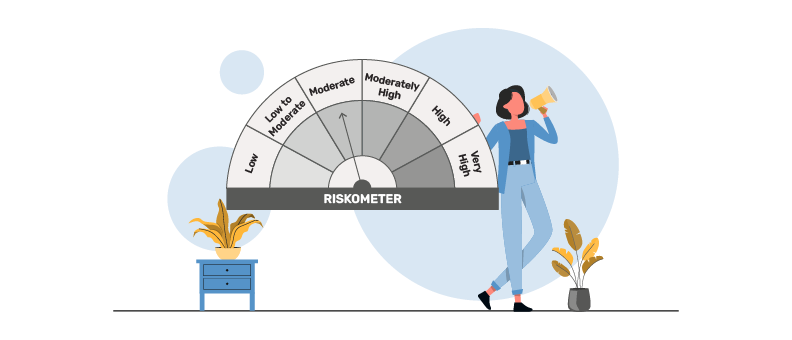
SEBI’s Riskometer has six levels:
- Low
- Low to moderate
- Moderate
- Moderately high
- High
- Very high
Mutual funds must display the scheme’s Riskometer in prescribed disclosures. If the Riskometer changes, the revised and previous levels must be communicated to the scheme’s unitholders through a notice-cum-addendum and email or SMS.
Source: Securities and Exchange Board of India, Circular on disclosure of expenses, returns, yield and Risk-o-meter of mutual fund schemes dated November 5, 2024. The six-level colour framework has applied since December 5, 2024.
How to use risk profiling when selecting mutual funds
Risk profiling should be used as an initial suitability check, not as a formula that automatically identifies a particular scheme. An investor can use it to:
- Decide on a broad asset allocation for each financial goal.
- Compare the investor’s ability to absorb risk with the scheme’s Riskometer.
- Examine whether the scheme’s investment objective and portfolio are consistent with the intended holding period.
- Review liquidity, concentration, credit, interest-rate and market risks where relevant.
- Reassess the allocation after a material change in finances or goals.
Matching broad labels is not enough. A “moderate” investor does not necessarily need only schemes carrying a moderate Riskometer, nor is every equity scheme automatically suitable for an aggressive investor. The goal, time horizon, total portfolio and nature of the scheme must also be considered.
The Riskometer is a useful disclosure, but it should be read with the Scheme Information Document, Key Information Memorandum and current portfolio disclosures. It does not predict returns or guarantee that losses will remain within a particular range.
Limitations of risk profiling
Risk profiling improves the structure of investment decisions, but it has limitations:
- Investor responses can change with market sentiment.
- A single profile may not reflect the different horizons of multiple goals.
- Broad categories can hide meaningful differences between investors.
- A questionnaire cannot predict future income, expenses or behaviour.
- A scheme’s risk classification may change over time.
- Risk profiling cannot remove the possibility of investment loss.
The assessment is most useful when treated as an ongoing process supported by accurate information and periodic review.
Conclusion
Risk profiling connects an investor’s financial capacity, behavioural tolerance and investment goals. It can help establish a suitable asset allocation and identify investments that may expose the investor to more risk than they can reasonably bear.
The investor’s profile should not be confused with the risk profile of a mutual fund. The latter is represented through the scheme’s Riskometer and must be considered alongside the scheme’s objective, portfolio, documents and the investor’s intended holding period.
FAQs
How can I determine my risk profile?
Start by reviewing your income, expenses, liabilities, emergency savings, financial goals, investment horizons and response to possible losses. A structured questionnaire can provide an indicative result. For personalised advice, consider consulting a SEBI-registered investment adviser.
Can my risk profile change over time?
Yes. Changes in income, liabilities, dependants, goals, investment horizon or attitude towards market declines can alter your risk capacity or tolerance. Reassessment is particularly useful after a material financial or life event.
What is investor profiling?
Investor profiling is the broader process of understanding an investor’s finances, objectives, experience, preferences and constraints. Risk profiling is a central part of that process, but the terms are sometimes used interchangeably.
Is a risk profile questionnaire enough to choose a mutual fund?
No. The questionnaire provides a starting point. Scheme selection should also consider the investment objective, Riskometer, portfolio, time horizon, liquidity requirements, costs and role of the scheme within the investor’s total portfolio.
What is the difference between risk tolerance and risk capacity?
Risk tolerance is the investor’s emotional willingness to accept uncertainty and losses. Risk capacity is the financial ability to absorb those losses without undermining essential needs or important goals.
Can one investor have different risk approaches for different goals?
Yes. A distant goal and a payment due within a year have different time horizons and liquidity requirements. Their asset allocations may therefore differ even though they belong to the same investor.
Our Funds