A company’s borrowing can help it grow, but the amount alone tells you little. How does that borrowing compare with the money belonging to shareholders? The debt-to-equity ratio answers that question. Learn the D/E ratio formula, calculate it from a balance sheet and see how to read the result.
Table of Contents
What is the debt-to-equity ratio?
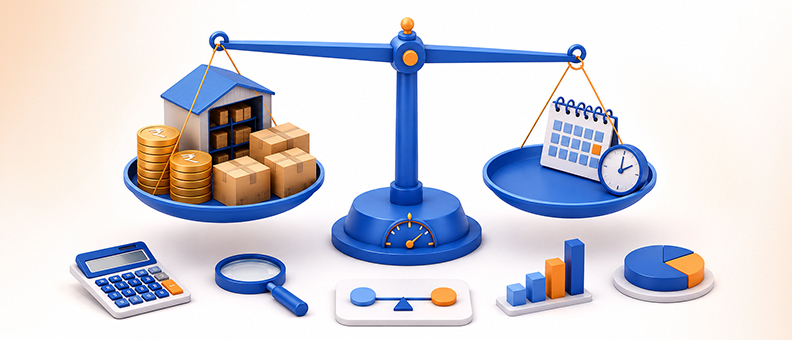
The debt-to-equity ratio, or D/E ratio, measures how much a company has borrowed relative to the funds belonging to its shareholders. You may also see it written as the DE ratio. It is one way to understand how a company finances its business.
Suppose a company has ₹60 crore in borrowings and ₹100 crore in shareholders’ equity. Its D/E ratio is 0.6. That means it has borrowed ₹0.60 for every ₹1 of equity. The figure gives you a starting point for looking at the company’s finances, especially when you compare it with similar businesses or track how it changes over time. SEBI includes the debt-to-equity ratio among the measures used in fundamental analysis.
Source: National Institute of Securities Markets (NISM), “What are Financial Ratios? Meaning, Types & Importance
Key Takeaways
- The debt-to-equity ratio compares a company’s borrowings with its shareholders’ equity.
- Divide total borrowings by shareholders’ equity to calculate the D/E ratio.
- A D/E ratio of 0.5 means the company has ₹0.50 of borrowings for every ₹1 of shareholders’ equity.
- A ratio is most useful when compared with similar companies and with the same company’s earlier figures.
- The D/E ratio does not show, by itself, whether a company earns enough to meet its repayments.
Debt-to-equity ratio formula
Debt-to-equity ratio = Total borrowings / Shareholders’ equity
The answer is usually written as a number, such as 0.6 or 1.2, or expressed as 0.6:1 or 1.2:1. It tells you how many rupees the company has borrowed for each ₹1 of equity.
What counts as debt?
For this calculation, total borrowings generally include both current borrowings, due in the nearer term, and non-current borrowings, which are due later. Companies may explain the precise basis used for a reported ratio in the notes to their financial results. For example, an NSE-hosted company disclosure defines its gross debt-equity ratio using current plus non-current borrowings divided by total shareholders’ equity.
Borrowings and total liabilities are not always the same. Total liabilities can include items such as trade payables and provisions. If one source uses borrowings and another uses all liabilities, their results may differ even when they start with the same balance sheet. Check the definition before comparing ratios.
What is shareholders’ equity?
Shareholders’ equity is the amount shown in a company’s accounts as belonging to its owners after liabilities are deducted from assets. It generally includes share capital and accumulated reserves. You can find the reported figure in the balance sheet; you do not need to add up every asset yourself.
How to calculate the debt-to-equity ratio
Take the borrowing and equity figures from the same balance-sheet date. Then follow these steps:
- Find current and non-current borrowings in the company’s financial statements.
- Add them to arrive at total borrowings.
- Find total shareholders’ equity.
- Divide total borrowings by shareholders’ equity.
Here is an illustrative example:
| Balance-sheet item | Amount |
| Current borrowings | ₹20 crore |
| Non-current borrowings | ₹40 crore |
| Total borrowings | ₹60 crore |
| Shareholders’ equity | ₹100 crore |
D/E ratio = ₹60 crore / ₹100 crore = 0.6
For every ₹1 of shareholders’ equity, this company has ₹0.60 of borrowings. That describes its funding mix. To judge the figure, you would still need to know more about the business and its ability to meet its payments.
The figures shown are for illustrative purpose only
How to interpret the debt-to-equity ratio
Reading a D/E ratio begins with what the number actually says:
| D/E ratio | What it means |
| 0 | The company has no borrowings included in this calculation. |
| 0.5 | It has ₹0.50 of borrowings for every ₹1 of shareholders’ equity. |
| 1 | Its borrowings and shareholders’ equity are equal. |
| 2 | It has ₹2 of borrowings for every ₹1 of shareholders’ equity. |
A higher figure means more borrowing relative to equity. It can also mean that equity has fallen, perhaps following losses. A lower figure means less borrowing relative to equity. Neither result tells the full story: a company can borrow to fund a useful expansion, while a company with little debt can face challenges for other reasons.
Is there an ideal debt-to-equity ratio?
There is no single D/E ratio that suits every company. Businesses need different amounts of funding. A company building factories, for instance, may use more borrowing than one whose work requires fewer physical assets.
Start by comparing companies in the same line of business, using ratios calculated on a similar basis. Then look at the company’s own ratio over several reporting periods. If it has risen, check whether borrowings increased, equity fell, or both. This tells you more than treating a particular number as an automatic sign of strength or concern.
Why do investors use the D/E ratio?
The ratio gives investors a quick way to see the balance between borrowed funds and shareholders’ funds. It can help them:
- compare how similar companies finance their operations;
- follow changes in a company’s borrowings over time; and
- identify when a change in equity, as well as debt, needs a closer look.
It is especially useful as a prompt to read further. A rising ratio might accompany an expansion funded by borrowing. It might also reflect a reduction in shareholders’ equity. The accounts and their notes help explain which happened.
Source: SEBI Investor, “Technical Analysis vs. Fundamental Analysis.
What are the limitations of the debt-to-equity ratio?
The D/E ratio uses figures from a balance sheet at a particular date. It does not measure the cash a company will generate to pay interest or repay loans. It also does not tell you whether money raised through borrowing has been used well.
Comparisons need care for two further reasons. First, businesses in different sectors have different funding needs. Second, published ratios may use different definitions of debt. A figure based on total borrowings cannot be compared directly with one based on total liabilities.
Debt-to-equity ratio vs debt ratio and equity ratio
These three ratios answer related, but different, questions:
| Ratio | Formula | What it compares |
| Debt-to-equity ratio | Total borrowings / shareholders’ equity | Borrowing with equity |
| Debt ratio | Total borrowings / total assets | Borrowing with assets |
| Equity ratio | Shareholders’ equity / total assets | Equity with assets |
Check what a source includes under debt before comparing its figures. For example, a company disclosure hosted by NSE separately reports debt-equity and total-debts-to-total-assets ratios, and states the formulas it uses for each.
How to use the D/E ratio when assessing a company
Begin with the company’s reported ratio and its calculation notes. Compare it with earlier periods and with similar companies. If the number has changed substantially, look at both sides of the formula: what happened to borrowings, and what happened to equity?
Then consider whether the company generates enough income and cash to handle its obligations. An interest coverage ratio can add context about interest payments, while a current ratio looks at short-term assets and liabilities. Together, these measures give you a clearer picture than the D/E ratio alone.
Conclusion
The debt-to-equity ratio shows a company’s borrowings relative to its shareholders’ equity. Its formula is straightforward: divide total borrowings by shareholders’ equity. The result tells you how much the company has borrowed for every ₹1 of equity.
The more useful question is why the D/E ratio stands where it does. Compare it with similar companies and earlier reporting periods, check which items the company includes as debt, and look at its ability to meet interest and repayments. That context makes the ratio more useful than any single “good” or “bad” threshold.
FAQs
What does a debt-to-equity ratio of 0.5 mean?
A D/E ratio of 0.5 means a company has ₹0.50 of borrowings for every ₹1 of shareholders’ equity. It shows the relationship between the two figures, but you need industry and company context to assess it.
Can the debt-to-equity ratio be negative?
Yes. If borrowings are positive but shareholders’ equity is negative, the calculated D/E ratio will be negative. This is not a sign of unusually low borrowing. It means the equity figure needs closer examination, including why it became negative.
Is a zero debt-to-equity ratio always good?
No. A zero D/E ratio means the company has no borrowings included in that calculation. It does not tell you whether the business is profitable, uses its funds effectively or has other financial obligations.
Why can a company’s debt-to-equity ratio rise?
A D/E ratio can rise because borrowings increase, shareholders’ equity falls, or both happen at once. Check the company’s financial statements to understand the reason before interpreting the change.
Is the debt-to-equity ratio the same as the debt ratio?
No. The D/E ratio compares borrowing with shareholders’ equity, while the debt ratio compares borrowing with total assets. Always check which items the reported calculation includes under debt.
Related Searches