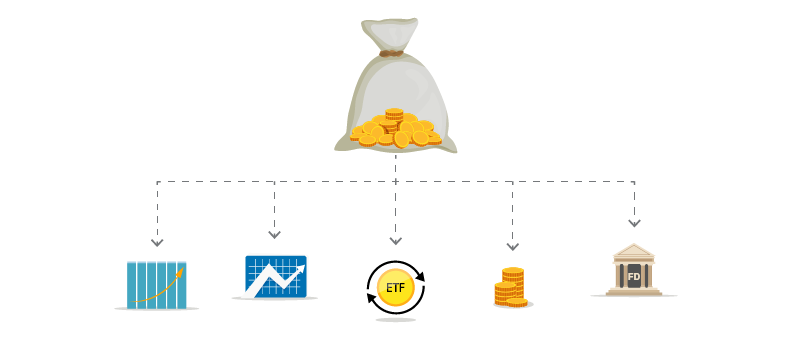
A mutual fund may hold dozens of securities, but that does not automatically make your overall mutual fund portfolio diversified. Two schemes can invest in many of the same companies, sectors or market segments, leaving the portfolio more concentrated than it appears.
Effective portfolio diversification involves deciding how much to allocate across asset classes and then checking whether the selected schemes provide genuinely different exposures. It cannot prevent losses, but it may reduce the effect that one security, sector or market segment has on the complete portfolio. Knowing what to diversify, and where to stop, can make the difference between a balanced portfolio and a collection of overlapping funds.
Key Takeaways
- Portfolio diversification spreads investments across asset classes, market segments, sectors and investment styles to reduce dependence on any single exposure.
- Holding several mutual fund schemes does not necessarily create a diversified portfolio because their underlying securities may overlap.
- Asset allocation should be based on the investor’s financial goals, investment horizon, liquidity needs and ability to tolerate losses.
- Diversification may reduce security-specific and concentration risks, but it cannot remove market risk or assure potential returns.
- A mutual fund portfolio should be reviewed periodically and rebalanced when its allocation moves materially away from the intended mix.
What is portfolio diversification in mutual funds?
Mutual fund diversification means spreading investments across different exposures so that the portfolio is not excessively dependent on one asset class, fund category, company, sector, issuer or investment style.
Diversification may take place at two levels:
- Within a mutual fund scheme: A scheme may invest across multiple securities according to its investment objective and regulatory requirements.
- Across the investor’s portfolio: An investor may combine schemes offering different asset classes, market-cap segments, sectors, maturities or investment approaches.
Portfolio diversification and asset allocation are related but not identical. Asset allocation determines how money is divided across broad asset classes such as equity, debt and gold. Diversification then spreads the allocation within and across those asset classes.
For example, an investor may allocate money to both equity and debt. Within the equity allocation, exposure may be spread across large-cap, mid-cap and small-cap companies. Within debt, schemes with different maturities, issuers and credit profiles may be considered.
Why is diversification important in a mutual fund portfolio?
Different investments do not always respond to market conditions in the same way. Changes in economic growth, interest rates, inflation or investor sentiment may affect asset classes and market segments differently.
A diversified portfolio seeks to prevent the outcome of one investment from dominating the entire portfolio. If one segment performs weakly, a different segment may behave differently. However, other holdings will not necessarily rise whenever one falls.
Diversification is mainly intended to manage:
- Security-specific risk: The risk associated with a particular company or issuer.
- Sector risk: The effect of developments affecting one industry.
- Concentration risk: Excessive dependence on a limited number of holdings or themes.
- Style risk: Dependence on one investment approach, such as growth or value investing.
- Asset-class risk: Overexposure to movements in equity, debt, commodities or another asset class.
Diversification cannot eliminate systematic risks that affect a large part of the market. A broad market decline can still reduce the value of several investments at the same time.
How to diversify your mutual fund portfolio
Building a diversified mutual fund portfolio requires more than choosing funds from different categories. The following steps can help create a clearer structure:
1. Identify your financial goals
Begin by defining what the money is intended for. Retirement, education expenses, a home purchase and an emergency requirement can have different timelines and liquidity needs.
Separating short-, medium- and long-term goals can make it easier to decide how much risk each part of the portfolio may reasonably take.
2. Assess your risk capacity and risk tolerance
Risk tolerance describes how comfortable an investor feels with fluctuations. Risk capacity considers whether the investor’s financial position and goal timeline can absorb a decline.
An investor may feel comfortable taking risk but have limited capacity to do so if the money is required soon. Both factors should be considered when forming the portfolio.
3. Decide the asset allocation
Determine how the portfolio will be divided across suitable asset classes. Equity, debt and gold can play different roles, but the allocation should reflect the investor’s goals rather than a standard formula.
The following factors may influence the mix:
- The time remaining until the goal.
- The need for liquidity.
- The ability to bear temporary or permanent losses.
- Existing savings and investments.
- Income stability and financial commitments.
- The investment’s tax treatment and costs.
Asset allocation does not assure protection during a market decline because correlations between asset classes can change.
4. Diversify within each asset class
The allocation within an asset class also matters. An equity portfolio concentrated entirely in one sector remains exposed to sector-specific risk, even if it owns several companies.
Within equity mutual funds, diversification may involve different market-cap segments, sectors or investment styles. Within debt funds, investors may examine maturity, duration, issuer type and credit quality. These distinctions carry separate risks and should not be treated as interchangeable.
5. Select complementary fund categories
Each scheme should have a clear role in the portfolio. One fund may provide broad equity exposure, another may address a debt allocation and a third may offer exposure to another asset class.
Before adding a scheme, consider whether it introduces a different exposure or merely duplicates existing holdings. Category names alone are not enough because schemes within the same category can have different portfolios, and schemes in different categories may still overlap.
6. Check portfolio overlap
Portfolio overlap occurs when two or more schemes own many of the same securities. Some overlap is normal, especially among diversified equity funds that invest in large companies. Excessive overlap, however, may create unintended concentration.
Investors can review:
- Common securities across schemes.
- The weight assigned to overlapping holdings.
- Sector allocation.
- Market-cap allocation.
- The number of unique holdings.
- Similarity between investment styles and benchmarks.
The overlap percentage should not be viewed in isolation. A small number of shared holdings with high weights may matter more than many holdings with very small allocations.
7. Review the Riskometer and scheme documents
The Riskometer gives a standardised representation of a mutual fund scheme’s risk level, ranging from low to very high. It considers factors relevant to the underlying portfolio, but it should not be used as the only basis for selecting a scheme.
Review the scheme information document, factsheet, portfolio disclosures, investment objective, benchmark and principal risk factors before investing.
Source: SEBI Investor guidance on the mutual fund Riskometer.
8. Compare costs and exit conditions
Holding more schemes may increase administrative complexity. Investors should compare expense ratios, exit loads, transaction-related costs and applicable taxes.
Costs should be assessed among comparable schemes and alongside the fund’s mandate. A lower expense ratio does not by itself make a fund suitable for a particular portfolio.
9. Invest according to the planned allocation
An SIP can be used to invest regularly in selected mutual fund schemes, while a lumpsum investment deploys money at once. Neither method creates diversification by itself.
Diversification depends on where the money is invested and in what proportions. Separate SIPs into several similar funds can still produce a concentrated portfolio.
10. Review and rebalance periodically
Market movements can change the portfolio’s asset allocation. If equity rises faster than debt, for example, equity may eventually represent a larger proportion than originally intended.
Rebalancing involves bringing the portfolio closer to its planned allocation. This may be done by directing new investments towards underrepresented areas or, where appropriate, switching or redeeming investments. Exit loads and tax consequences should be considered before making transactions.
Reviewing the portfolio periodically or following a material change in goals or circumstances may be more useful than reacting to every short-term market movement.
Ways to diversify a mutual fund portfolio
Diversification can be approached across several dimensions:
Diversification across asset classes
Equity, debt, gold and other asset classes have different risk and return characteristics. Combining them may reduce dependence on the performance of one asset class.
Owning a multi-asset or hybrid fund can provide exposure to more than one asset class through a single scheme. However, investors should examine the scheme’s permitted allocation range because the actual mix can change.
Diversification across market capitalisations
Large-cap, mid-cap and small-cap companies can respond differently to economic and market conditions. They also carry different liquidity, volatility and business risks.
Holding exposure across market-cap segments can broaden an equity portfolio, but every segment need not be represented through a separate fund. A diversified or flexi-cap scheme may already invest across more than one segment.
Diversification across sectors
Sector diversification reduces dependence on the performance of one industry. A broadly diversified equity fund may invest across financial services, technology, consumer businesses, healthcare and other areas.
Sectoral and thematic funds are intentionally concentrated and can be more sensitive to developments affecting their chosen theme or industry. Adding several such schemes may increase concentration rather than improve diversification.
Diversification across investment styles
Fund managers may follow different approaches, such as growth, value, quality or a blend of styles. A style can underperform for an extended period as market preferences change.
Combining complementary styles may reduce reliance on one approach. However, labels should be verified against the scheme’s mandate and actual portfolio.
Diversification within debt funds
Debt funds are not risk-free or uniform. They can differ in interest-rate sensitivity, maturity profile, issuer type, credit quality and liquidity.
Diversification within debt may involve balancing duration and credit exposure according to the investment objective. Spreading money across several debt funds does not remove credit or interest-rate risk if they hold similar securities or follow similar duration strategies.
Geographic diversification
Some mutual funds provide exposure to securities outside India. International exposure may reduce dependence on the domestic market and provide access to different industries or economies.
It also introduces risks such as currency movements, overseas market conditions, geopolitical events, taxation and restrictions affecting fresh investments or redemptions.
Equity, debt and hybrid funds in a diversified portfolio
These fund categories may perform different roles, depending on their underlying portfolios:
Equity mutual funds
Equity mutual funds invest predominantly in equity and equity-related instruments according to their category and scheme mandate. Their value can fluctuate considerably and they are generally more exposed to market risk.
Equity schemes may differ by market capitalisation, sector, theme, investment style or strategy. Two equity funds should not be assumed to provide different exposure merely because their names differ.
Debt mutual funds
Debt mutual funds invest in instruments such as government securities, corporate bonds, treasury bills, commercial paper and certificates of deposit.
Their risk depends on factors such as duration, interest-rate movements, credit quality and liquidity. Debt funds can experience losses and should not automatically be described as suitable for every short-term goal or conservative investor.
Hybrid mutual funds
Hybrid funds invest across more than one asset class, commonly equity and debt. Their risk can vary considerably depending on the allocation permitted under the scheme category.
A hybrid fund can simplify asset allocation within one scheme but holding it alongside separate equity and debt funds may create overlapping exposures. The complete portfolio should therefore be assessed together.
Benefits and advantages of mutual fund diversification
A thoughtfully diversified portfolio may provide the following benefits:
- Lower concentration risk: The portfolio is less dependent on one company, sector, issuer or fund category.
- Broader market exposure: Investors can participate across different areas of the market rather than relying on a narrow segment.
- More balanced risk distribution: Different holdings contribute different types and levels of risk to the portfolio.
- Alignment with multiple goals: Separate allocations can be structured around different investment horizons and liquidity requirements.
- Reduced dependence on one manager or style: Complementary schemes may limit reliance on a single investment approach.
These benefits depend on the selected funds and their underlying portfolios. Simply increasing the number of schemes does not assure better diversification.
Risks and limitations of portfolio diversification
Diversification is useful, but it has practical limitations:
- Market-wide losses can still occur: Diversification cannot protect the portfolio from every broad decline.
- Asset correlations can change: Investments that usually behave differently may fall together during stressed markets.
- Returns from outperforming holdings may be diluted: Gains from one investment have a smaller effect when capital is spread widely.
- Hidden overlap can remain: Different funds may hold similar securities or follow comparable strategies.
- The portfolio can become difficult to manage: More schemes mean more holdings, documents, transactions and performance records to monitor.
- Costs and taxes may arise: Rebalancing through redemptions or switches may involve exit loads, tax consequences or other costs.
Diversification should therefore be treated as a way to distribute risk, not as an assurance against losses or a method for increasing returns.
What is over-diversification in mutual funds?
Over-diversification occurs when additional funds add complexity without introducing meaningful new exposure or materially improving risk distribution.
Common signs include:
- Several schemes from the same category with similar portfolios.
- Repeated exposure to the same leading securities.
- Multiple sectoral or thematic funds whose underlying businesses overlap.
- Small allocations spread across too many schemes.
- No clear role for individual funds.
- Difficulty monitoring the complete portfolio.
There is no universal number of funds that becomes excessive. A portfolio with a few complementary schemes may be more diversified than one containing many overlapping schemes.
Instead of targeting a fixed fund count, investors can ask whether each scheme serves a distinct purpose and whether that purpose is still relevant.
Common mistakes when diversifying a mutual fund portfolio
Diversification may become less effective when investors:
- Choose funds only by past returns: Recent performance may encourage exposure to a category after it has already risen considerably.
- Confuse more funds with more diversification: Additional schemes may simply repeat existing holdings.
- Ignore the underlying portfolio: Fund names and categories do not reveal the complete exposure.
- Add too many sectoral funds: Concentrated funds can increase dependence on selected industries or themes.
- Overlook existing investments: Provident funds, deposits, shares and other assets may already affect the overall allocation.
- Rebalance too frequently: Repeated changes can increase costs, taxes and the influence of short-term market movements.
- Ignore changes in circumstances: An allocation created years earlier may no longer match the investor’s goals, income or time horizon.
How to review a diversified portfolio
A portfolio review should examine whether the allocation still supports the investor’s goals rather than simply identify the fund with the highest or lowest recent return.
Useful checks include:
- Whether the asset allocation has moved away from its intended range.
- Whether a financial goal or investment horizon has changed.
- Whether schemes have substantial portfolio overlap.
- Whether concentration in a sector, issuer or market segment has increased.
- Whether the scheme continues to follow its stated objective.
- Whether the risk level, expenses or fund-management approach has changed.
- Whether any fund no longer has a clear role in the portfolio.
Short-term underperformance alone may not justify replacing a fund. Performance should be assessed over relevant periods, against an appropriate benchmark and category, and alongside changes in risk and portfolio characteristics.
Past performance may or may not be sustained in future.
Conclusion
A diversified mutual fund portfolio is built by combining exposures that play different roles, not by collecting a large number of schemes. Goals, risk capacity and investment horizon can guide the broad asset allocation, while portfolio holdings, sector weights, market-cap mix and investment styles reveal whether the selected funds genuinely complement one another.
Portfolio diversification may reduce concentration and security-specific risks, but it cannot remove market risk or guarantee potential returns. Periodic reviews and measured rebalancing can help keep the portfolio aligned with its intended purpose as markets and personal circumstances change.
FAQs
What is a diversified mutual fund portfolio?
A diversified mutual fund portfolio spreads investments across complementary asset classes, securities, sectors, issuers or investment styles so that it is not excessively dependent on one exposure.
Why is diversification important in mutual funds?
Diversification may reduce the effect of weak performance in one company, issuer, sector or market segment on the complete portfolio. It cannot eliminate market risk or prevent losses.
How can I diversify my mutual fund portfolio?
Begin with a goal-based asset allocation, choose schemes offering complementary exposures, check their underlying holdings and periodically rebalance the portfolio when its allocation changes materially.
How many mutual funds should be held in a portfolio?
There is no universally suitable number. The portfolio should contain only as many schemes as are required to provide distinct exposures and fulfil clearly defined roles without unnecessary overlap.
Does investing in multiple mutual funds ensure diversification?
No. Multiple schemes may hold the same securities, favour the same sectors or follow similar strategies. Diversification depends on the underlying exposures rather than the number of funds.
What is portfolio overlap in mutual funds?
Portfolio overlap is the extent to which two or more mutual fund schemes hold the same securities. High overlap can create unintended concentration even when the investor owns several funds.
Can diversification prevent losses in mutual funds?
No. Diversification may reduce concentration and security-specific risks, but a broad market decline can affect several parts of the portfolio at the same time.
Can a single mutual fund provide diversification?
A broadly diversified mutual fund can provide exposure to several securities within its mandate. However, it may not provide diversification across asset classes, and its suitability depends on the role it is expected to play.
What is over-diversification in mutual funds?
Over-diversification occurs when additional schemes introduce overlap and complexity without adding meaningful new exposure or improving risk distribution.
How often should a mutual fund portfolio be reviewed?
A portfolio may be reviewed periodically and after important changes in goals, income, liabilities or investment horizon. Frequent changes based only on short-term market movements may increase costs and disrupt the planned allocation.
Read Also