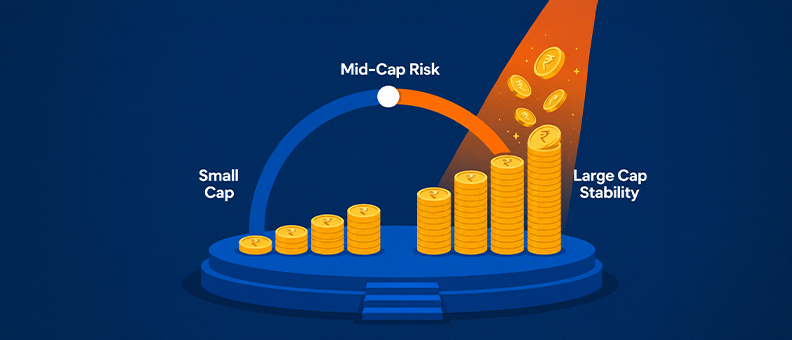
If you are exploring the mid cap segment of the equity market, the Nifty Midcap 50 Index is one way to understand how a selected group of medium-sized listed companies are performing. The index comprises mid cap companies, which are generally more established than small cap companies but have more potential for expansion compared to large caps.
The mid cap segment is often viewed as an important part of the market because it includes companies that may be at different stages of business growth. For investors looking to diversify beyond large cap companies, exposure to the mid cap segment may form part of a long-term equity allocation, depending on their financial goals, risk appetite, and investment horizon.
Table of Contents
What is Nifty Midcap 50?
The Nifty Midcap 50 Index comprises 50 companies selected from the broader mid cap universe. To be eligible, stocks must be part of the Nifty Midcap 150 Index and rank within the top 100 based on market capitalisation and turnover. From this eligible universe, stocks with higher 6-month average free-float market capitalisation are selected, with preference given to those available in the Futures and Options segment on NSE.
The Nifty Midcap 50 index thus provides a focused view of a segment of the mid cap market. It is also used as a benchmark for Exchange-Traded Funds and index funds. These are passive funds that have portfolios mirroring the index and seek to replicate its performance, subject to tracking error (the difference between the index’s performance and that of the fund).
How does Nifty Midcap 50 work?
The index follows a free-float market capitalisation methodology. This means it considers only the market value of shares that are available for public trading. Companies with a higher free-float market capitalisation generally receive a higher weight in the index.
The constituents are reviewed periodically to ensure that the index continues to represent the intended segment of the market. As companies grow, shrink, or no longer meet the eligibility criteria, changes may be made to the index composition.
According to NSE Indices, the review is undertaken semi-annually based on six months of data ending January and July. Changes are implemented from the last trading day of March and September respectively.
Features of Nifty Midcap 50
Here are some key features of this index:
| Feature | Description |
| Number of stocks | 50 |
| Market segment | Mid cap listed companies |
| Weighting method | Free-float market capitalisation |
| Review cycle | Semi-annual rebalancing and reconstitution |
| Main use | Understanding the market, benchmark for passive funds |
Benefits of investing in Nifty Midcap 50
Investors cannot invest directly in the Nifty Midcap 50 Index. However, they can gain exposure to the index through index funds and ETFs.
- Growth potential: For investors seeking long-term potential wealth creation, the index provides access to a segment of the market that comprises companies that are not as volatile as those in their nascent stages but still have room for further expansion.
- Diversification: Since the index includes companies from different sectors, investors gain exposure to a broader range of businesses rather than relying on the performance of a single company.
- Rules-based selection: The index is built using a fixed set of eligibility criteria and guidelines regarding market capitalisation, turnover and free-float market capitalisation rather than random stock selection.
- Periodic review: The index is reviewed from time to time. This helps ensure that the companies included in the index continue to meet the required criteria. If a company no longer fits the rules, it may be replaced during the review.
- Simple access through passive funds: Investors can gain exposure to the index through index funds or ETFs that track it. These products try to follow the index rather than actively pick stocks, which can make them simpler to understand.
Risks associated with Nifty Midcap 50
Like most equity indices, the Nifty Midcap 50 also carries risks. Being aware of these is important for investors to make informed choices.
Volatility: Volatility is one of the key risks associated with the Nifty Midcap 50 Index. Mid cap stocks may experience larger price fluctuations than many large cap stocks, particularly during periods of market uncertainty or reduced liquidity.
Short-term fluctuations: Investment values may rise or fall sharply over shorter periods. Investors should be prepared for fluctuations in portfolio value and avoid making decisions solely based on short-term market movements.
Company-specific challenges: Not all mid cap companies grow into larger businesses. Some may face operational challenges, industry-specific pressures, or slower earnings growth.
Tracking error and expenses: Investments through index funds and ETFs may be affected by tracking error, expenses, and execution-related factors.
Need for higher risk appetite: Investors may need a long-term investment horizon and a very high risk appetite when considering exposure to this segment.
Who should invest in Nifty Midcap 50?
Owing to the market risk involved, the Nifty Midcap 50 Index may not be suitable for every investor. Here is a simple way to understand who it may and may not suit.
May be suitable for investors who:
- Have a long investment horizon
- Are seeking potential wealth creation over time
- Are comfortable with short-term fluctuations in portfolio value
- Want to use mid cap exposure as part of a diversified equity allocation
- Have a very high risk appetite
May not be suitable for investors who:
- Are uncomfortable with short-term fluctuations in portfolio value
- Have a low risk appetite
- Have short-term financial goals
- Prefer relatively stable or lower-volatility investments
Ways to invest in Nifty Midcap 50
Investors can gain exposure to Nifty Midcap 50’s constituents in the following ways:
- Index funds
Investors can invest through index funds that aim to track the Nifty Midcap 50 Index. These funds usually try to replicate the index portfolio and generate returns similar to the index, subject to tracking error and fund expenses.
- Exchange-traded funds
Investors can also access the index through exchange-traded funds (ETFs) that aim to track its performance. ETFs are listed and traded on stock exchanges, so investors generally need a demat and trading account to invest in them.
- Direct equities
Investors who prefer more control over their investments may choose to invest directly Nifty Midcap 50 stocks and replicate its composition. However, managing such a portfolio and maintaining alignment with the index may be challenging and time consuming.
Which companies are in Nifty Midcap 50?
The table below shows the top constituents of the Nifty Midcap 50 Index by weightage.
| Company | Weight (%) |
| BSE Ltd. | 7.58 |
| Multi Commodity Exchange of India Ltd. | 3.37 |
| Federal Bank Ltd. | 3.18 |
| Suzlon Energy Ltd. | 3.09 |
| Hero MotoCorp Ltd. | 2.85 |
| Bharat Heavy Electricals Ltd. | 2.72 |
| IndusInd Bank Ltd. | 2.69 |
| PB Fintech Ltd. | 2.59 |
| Indus Towers Ltd. | 2.56 |
| Persistent Systems Ltd. | 2.53 |
Nifty Midcap 50 vs Nifty 50
The Nifty 50 and Nifty Midcap 50 represent different parts of the equity market. While one focuses on large, established companies, the other tracks selected mid cap businesses that may be at a different stage of growth.
| Parameter | Nifty 50 Index | Nifty Midcap 50 Index |
| Coverage | Tracks the top 50 largest listed companies in India by market cap | Tracks 50 businesses from the mid cap segment |
| Growth potential | Large cap companies may offer relatively stable growth compared to many mid cap companies | Mid cap companies may offer higher long-term growth potential |
| Volatility | Tend to be relatively less volatile than many mid cap indices, although all equity investments carry market risk | May experience greater volatility because mid cap companies can be more sensitive to market conditions |
| Portfolio role | May be used to gain exposure to large, established companies | May be used to gain exposure to selected mid cap companies with potential for business expansion |
Conclusion
The Nifty Midcap 50 Index provides exposure to a segment of the market that includes companies at various stages of business expansion. It allows investors to track the performance of selected mid cap companies that may be expanding their operations and market presence over time. At the same time, the index is subject to the risks associated with equity investing, including market volatility and company-specific risks.
Investors considering exposure to this segment may benefit from evaluating their financial goals, risk appetite, and investment horizon before making investment decisions. The index may be considered as part of a diversified long-term equity allocation, depending on individual circumstances.
FAQs
Is Nifty Midcap 50 a good investment option?
It may be suitable for investors with a long-term investment horizon and a very high risk appetite who are seeking exposure to the mid cap segment.
What is the objective of NIFTY Midcap 50?
The objective of the index is to measure the performance of selected mid cap companies in India and provide a benchmark for investors, fund managers, and passive investment products.
How can investors invest in Nifty Midcap 50?
Investors can gain exposure through index funds and ETFs that aim to track the Nifty Midcap 50 Index, subject to tracking error and expenses.
What is the difference between Nifty 50 and Nifty Midcap 50?
The Nifty 50 Index tracks some of the largest listed companies in India, while the Nifty Midcap 50 Index focuses on selected mid cap companies. The mid cap index has historically exhibited higher volatility and may offer higher long-term growth potential, although future performance is uncertain.