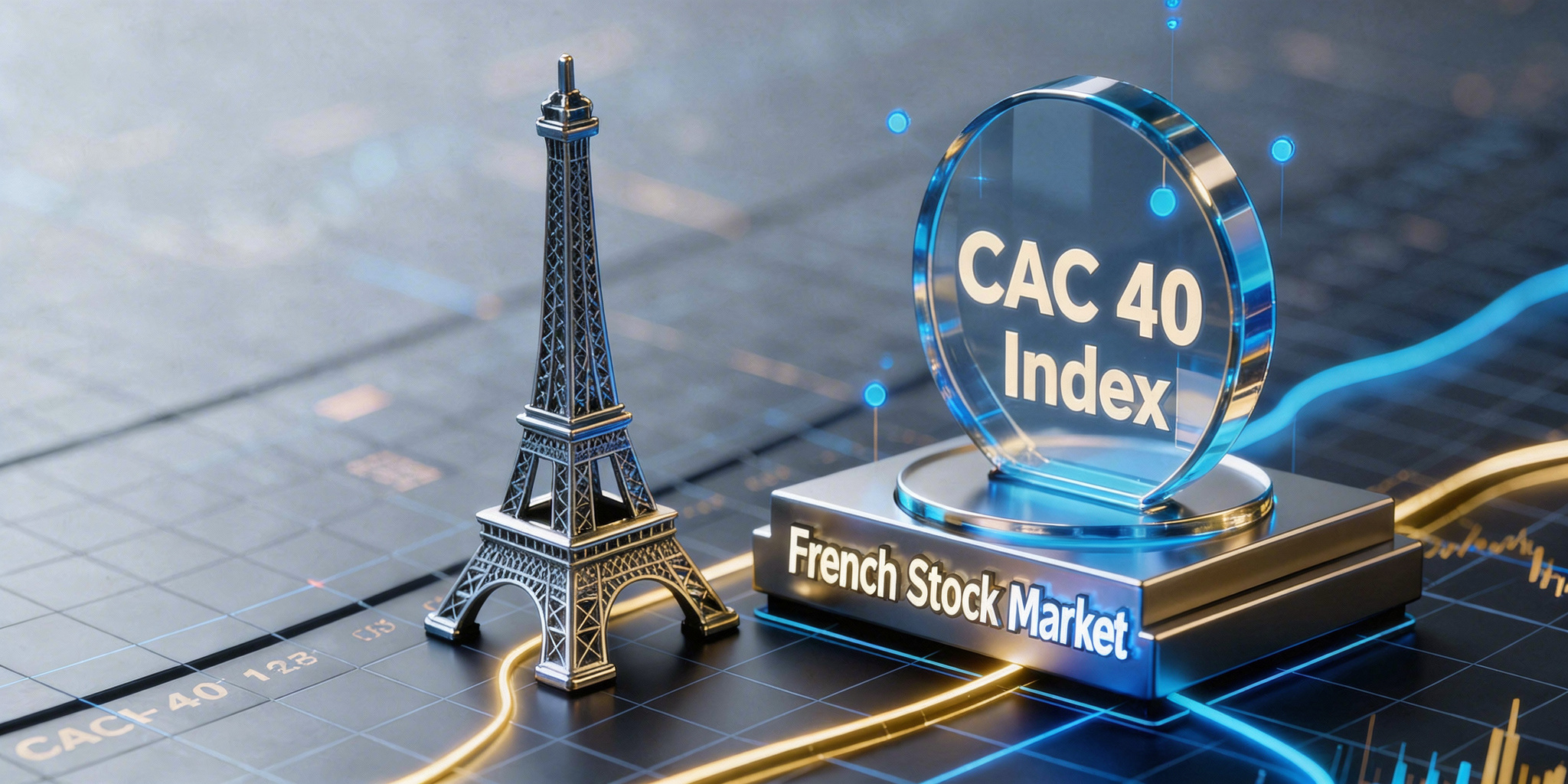
Due to globalisation and the increasing connection between economies, investors sometimes explore opportunities beyond their domestic markets. In this context, understanding international stock indices may help investors study how different markets operate. For those interested in the French equity market, the CAC 40 index – one of the most widely followed stock market indices in France – is commonly used as a reference point.
In this article, we will examine the CAC 40 index, how it works, the types of companies included in it, how it compares with other global indices, and how investors may gain exposure to it.
Table of Contents
What is the CAC 40 Index?
The CAC 40 is a stock market index that tracks 40 large and actively traded companies listed on Euronext Paris, the French stock exchange operated by Euronext. These companies are selected mainly based on their free float market capitalisation and liquidity.
Because the index includes some of the largest listed companies in France in terms of market capitalization, it is widely used as a benchmark representing the French equity market. It reflects the performance of major companies across different sectors of the economy.
The CAC 40 is considered the primary stock market index in France and is among the major equity indices in Europe. Like other stock indices, it is used by investors, analysts and market participants to monitor market trends and evaluate overall market movements.
Why consider the CAC 40 Index?
Investors and analysts may follow the CAC 40 index for several reasons:
- Diversification: Exposure to companies listed in the French equity market may support broader portfolio diversification when investors study international markets.
- European market exposure: The index reflects companies operating within one of the larger economies in the eurozone.
- Developed market allocation: France is part of the developed European economy, and the CAC 40 includes companies that operate across global markets.
The CAC 40 is also known for relatively high trading activity among its constituent companies. High liquidity means that shares of these companies are traded frequently, which may support smoother price discovery in the market.
France contributes a meaningful share to the eurozone economy, and developments in the French corporate sector may influence broader European market sentiment. As a result, the CAC 40 is often tracked by global investors studying European markets.
Also Read: What is the Nifty CPSE index?
How does the CAC Index work?
The CAC 40 tracks the performance of 40 major companies listed on Euronext Paris. These companies are selected from among the largest and most actively traded companies on the exchange.
The index follows a free float market capitalisation weighted methodology. This means companies with higher free float market capitalisation have a greater influence on the movement of the index.
An independent Index Steering Committee reviews the composition of the CAC 40 every three months. During each review, the committee evaluates companies listed on Euronext Paris based on factors such as:
- Free float market capitalisation
- Liquidity and trading activity
Typically, the committee reviews a larger universe of leading listed companies before determining which 40 companies will remain in or enter the index. If a company has more than one class of listed shares, only the share class with higher trading activity is generally considered for inclusion.
Companies included in the CAC Index
The CAC 40 index includes companies from different sectors of the French economy. Here are the top 10 companies by market cap listed on the index:
| LVMH |
| SCHNEIDER ELECTRIC |
| AIRBUS |
| TOTALENERGIES |
| SANOFI |
| SAFRAN |
| AIR LIQUIDE |
| L’OREAL |
| ESSILORLUXOTTICA |
| BNP PARIBAS ACT.A |
The index comprises companies from various sectors including consumer non-durables, electronics, finance, health technology and more. The composition of the index may change over time as companies are added or removed during periodic reviews.
*Source: CAC 40 Factsheet, Euronext Indices. Data as on December 31, 2025. Please refer the exchange website for the exhaustive list of CAC 40 companies. Please note that the reference to any industry/sector/stock is provided for illustrative purposes only. This should not be construed as a research report or a recommendation to buy or sell any security or sector.
CAC Index selection criteria
The CAC 40 index is reviewed every three months by an independent Index Steering Committee. The committee evaluates companies listed on Euronext Paris using two key factors.
- Free float market capitalisation: This refers to the total market value of shares available for public trading, excluding shares held by promoters, governments or other strategic investors.
- Liquidity: Liquidity refers to how actively the company’s shares are bought and sold in the market.
Role of Euronext in managing the CAC Index
Euronext operates stock exchanges across several European countries, including France, the Netherlands, Belgium, Portugal, Ireland, Norway and Italy. Euronext Paris is the exchange where companies included in the CAC 40 are listed.
Euronext manages the index infrastructure, trading platform and market operations associated with the exchange. The CAC 40 serves as one of the key indices tracked within the Euronext ecosystem.
Thousands of companies are listed across Euronext exchanges, representing companies from a wide range of industries and sectors across Europe.
Also Read: Market Index: Definition, Types, Examples and How it Works?
CAC index performance over time
Like other equity indices, the CAC 40 experiences fluctuations over time. Its movements reflect changes in company earnings, global economic developments, interest rate expectations and investor sentiment.
Because many companies in the CAC 40 operate internationally, developments in global markets may influence the index. Currency movements, trade developments and economic conditions across Europe and other regions may also affect market performance.
For this reason, investors often analyse long-term trends in the index rather than focusing only on short-term price movements.
CAC 40 Index vs other global indices (S&P 500, FTSE 100, DAX)
Several countries maintain benchmark indices that track leading companies listed in their respective markets.
- S&P 500 (United States): Tracks 500 large companies listed on major United States stock exchanges and is widely followed as a benchmark for the US equity market.
- FTSE 100 (United Kingdom): Tracks 100 large companies listed on the London Stock Exchange.
- DAX (Germany): Tracks 40 large companies listed on the Frankfurt Stock Exchange.
Sector allocation in the CAC Index
The companies included in the CAC 40 represent several sectors of the economy. They are not assigned equal weight within the index.
Because the index follows a free-float market capitalisation weighting methodology, companies with larger market capitalisation tend to have a higher weight in the index.
Sector weights may change over time depending on market capitalisation and stock price movements of the companies included in the index. Industries such as consumer goods, industrials, healthcare, energy and financial services are commonly represented.
Also Read: BSE Midcap Index – Market Performance & Details
Benefits of investing in the CAC Index
Investing in the CAC Index can provide investors with broad market exposure, liquidity and a reliable benchmark for tracking the performance of the French equity market:
- Exposure to a diversified group of companies: The index includes companies from multiple sectors of the French economy.
- Relatively high liquidity: Many companies included in the CAC 40 are widely traded in the market.
- Market benchmark: The index is commonly used by analysts and investors as a reference point for the French equity market.
Risks and limitations of the CAC Index
Understanding the risks and limitations of the CAC Index can help investors make more informed decisions and better assess its role within a portfolio:
- Market volatility: Equity markets may experience fluctuations based on economic conditions and investor sentiment.
- Currency fluctuations: Investors outside the eurozone may be exposed to changes in currency exchange rates.
- Sector concentration: Certain sectors may carry higher weights in the index depending on the market capitalisation of constituent companies.
- Global economic sensitivity: Because many CAC 40 companies operate internationally, global economic developments may influence the index.
Who should consider investing in the CAC Index?
Exposure to the CAC 40 may be considered by investors who are studying international diversification and who have a long-term investment horizon. Since the index represents equity markets, investors generally need to be comfortable with equity market fluctuations.
International equity exposure may involve additional factors such as currency risk and global market volatility. As a result, investors may evaluate such investments within the context of their broader portfolio allocation and risk appetite.
How to invest in the CAC 40 Index
The CAC 40 itself is a benchmark index and cannot be invested in directly. However, investors may gain exposure through financial products that track the index.
Common avenues include:
- Exchange traded funds (ETFs) that track the CAC 40
- Index mutual funds that allocate to European equity markets
- International brokerage accounts that provide access to European exchanges
Conclusion
The CAC 40 index represents leading companies listed on Euronext Paris and serves as a widely followed benchmark of the French equity market. It provides insight into the performance of major companies across different sectors of the French economy. Like other stock market indices, the CAC 40 may be studied to understand market trends, sector movements and broader economic developments over time.
FAQs
What is the CAC Index and what does it represent?
The CAC 40 is France’s benchmark stock market index. It tracks 40 large and actively traded companies listed on Euronext Paris and is commonly used as a reference point for the French equity market.
Which companies are included in the CAC Index?
Examples of companies included in the CAC 40 index include LVMH, L’Oréal, Hermès, TotalEnergies and Sanofi.
How is the CAC Index calculated?
The CAC 40 index follows a free float market capitalisation weighted methodology, meaning companies with higher free float market capitalisation have a greater influence on index movements.
How can investors invest in the CAC Index?
Investors may gain exposure through exchange traded funds (ETFs), international index mutual funds or brokerage platforms that provide access to European markets.
What is the difference between the CAC Index and other European indices?
The CAC 40 tracks companies listed in France, while indices such as Germany’s DAX or the United Kingdom’s FTSE 100 track companies listed in their respective markets.
Is the CAC Index a good indicator of the French stock market?
The CAC 40 is widely used as a benchmark representing large companies listed in France. However, it mainly reflects large cap companies and does not include all listed companies in the French market.
What are the risks of investing in CAC Index funds or ETFs?
- Market volatility
- Currency fluctuations
- Sector concentration
- Sensitivity to global economic conditions\