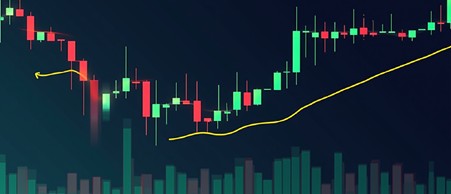
Price action trading is an approach where traders study price movements on a chart to identify potential buying or selling opportunities. Instead of relying mainly on technical indicators, price action traders focus on candlestick patterns, support and resistance levels, trendlines, and market structure to understand how prices may move.
In this article, we’ll take a closer look at price action trading, including what it means, how it works, its potential benefits, and simple price action trading strategies that traders commonly use.
Table of Contents
What is price action trading?
In simple terms, price action trading means making trading decisions based primarily on the price movements of stocks. Traders using price action watch how the price moves, such as highs, lows, patterns, and make trading decisions based on what these movements may suggest could happen next.
When you choose price action trading, you may rely on:
- Candlestick patterns
- Trend lines
- Support and resistance levels
- Price movement patterns (like breakouts or reversals)
Price action trading is based on the idea that market prices reflect the balance between demand and supply. When buying interest is stronger than selling pressure, prices tend to rise; when selling pressure is stronger, prices tend to fall. These movements also reflect market psychology, as traders often react to similar price levels such as support and resistance zones.
What is price action in the stock market?
In the stock market, price action is simply how a stock’s price moves up and down during a trading day or over weeks and months. When a stock’s price moves, it creates patterns or signals. By understanding these signals, traders seek to assess whether the price might move up or down.
For example:
- If a stock’s price tends to go down after it reaches a level of Rs. 500, traders see Rs. 500 as the resistance level. After this level is reached, the price tends to stall or reverse as selling pressure may increase.
- If the price tends not to fall below Rs. 450, that’s called a support level. This is the price level where buying interest tends to begin and prices may bounce back.
By watching how price behaves around these levels, traders may decide when to buy or sell.
The figures shown are for illustrative purposes only.
Who uses price action trading?
Price action trading is used by different types of market participants including:
- Day traders: Use price action to identify quick intraday entry and exit opportunities.
- Swing traders: Use it to capture short- to medium-term price movements over a few days or weeks.
- Positional traders: Use price action to understand broader trends, support and resistance levels, and potential reversals.
- Forex and commodity traders: Use it to assess momentum, trend direction and key trading zones in highly active markets.
- Options traders: Use price action to assess direction and timing before selecting an options strategy.
- Professional and institutional traders: May use price action along with volume, order flow, indicators or broader market data.
- Long-term investors: May refer to price action to time entries, exits or portfolio adjustments more effectively.
However, price action trading requires experience, discipline and risk management and should be used along with a clear trading plan and proper stop-loss strategy.
How price action trading works
Price action trading works by analysing how prices move on charts and using those movements to make trading decisions. Instead of relying on multiple indicators, traders focus directly on price behaviour to understand market trends and potential opportunities. Here’s how it typically works:
1. Observing price movements
Traders start by studying how a stock’s price moves over time using charts, especially candlestick charts. These charts show important details such as opening price, closing price, highs, and lows, helping traders understand market behaviour.
2. Identifying the trend
The next step is to determine the direction in which the market is moving. Prices generally move in:
- Uptrend (higher highs and higher lows)
- Downtrend (lower highs and lower lows)
- Sideways trend (moving within a range)
Understanding the trend may help traders make decisions that align with the broader market direction.
3. Marking support and resistance levels
Traders identify key price levels where the stock tends to stop or reverse:
- Support: A level where prices may stop falling and start rising
- Resistance: A level where prices may stop rising and start falling
These levels often act as important decision points for buying or selling.
4. Analysing patterns
Price action traders look for recurring patterns in price movements, such as:
- Breakouts (price moving beyond a key level)
- Reversals (change in direction)
- Candlestick patterns (like hammer or engulfing patterns).
These patterns may provide signals about potential future price movement, although they are not guaranteed.
5. Making trading decisions
Based on trends, levels, and patterns, traders decide when to enter or exit a trade. These decisions are based on how price is behaving at a given moment rather than relying on complex calculations or indicators.
6. Managing risk
Since market movements are uncertain, traders may use risk management techniques such as setting stop-loss levels and limiting the amount invested in a single trade. This helps reduce potential losses.
7. Looking for confluence in trading
Price action traders may see whether multiple signals support the same view. For example, a price level may act as support, while a bullish candlestick pattern and upward trendline appear around the same area. When such signals come together, traders may view the setup as stronger.
Determining a market’s trend using price action
One of the core principles of price action trading is identifying the prevailing market trend by studying price movements directly. Price action traders usually look at the sequence of highs and lows on a chart:
- Uptrend: The price forms higher highs and higher lows, indicating that buyers may be in control.
- Downtrend: The price forms lower highs and lower lows, suggesting that sellers may be in control.
- Sideways market: The price moves within a range without forming a clear upward or downward trend.
Traders may also look at support and resistance levels, swing highs and swing lows, breakouts, and price movement across multiple time frames before assessing the trend. For example, if a stock repeatedly forms higher lows and breaks above previous swing highs, traders may view it as an upward trend.
However, trends can change over time. Therefore, many traders study multiple time frames before drawing conclusions about market direction.
Common price action patterns traders watch
Price action traders often look for recurring patterns in price movements that may help them identify potential entry or exit points:
Inside bar pattern
An inside bar pattern is a two-candle formation where the second candle remains within the high and low range of the previous candle, also known as the mother bar. This pattern may indicate a period of consolidation before a potential breakout in trending markets. It can also act as a reversal signal when it forms near key support or resistance levels.
Pin bar pattern
A pin bar is a single candlestick with a long wick or tail that indicates price rejection. For example, a long lower tail shows that the price fell during the period but recovered before the candle closed. Traders may interpret this as rejection of lower prices.
The anticipated movement is generally away from the tail, rather than in the direction of it. A pin bar carries more context when it forms near an established support or resistance area, but confirmation is still required.
Fakey pattern
A fakey pattern occurs when there is a false breakout from an inside bar pattern, followed by a quick reversal back into the original range. This pattern may signal that the initial breakout lacked strength and that price could move in the opposite direction. Traders often observe fakey patterns in both trending and range-bound markets, particularly near key levels.
Difference between price action, technical analysis, and indicators
Price action is a method within technical analysis. Indicators are mathematical tools that technical traders may add to a chart. The distinction is mainly about which information receives the most attention.
| Aspect | Price action | Technical analysis | Technical indicators |
| Definition | Studies price behaviour and market structure directly | Studies historical market data using charts, patterns, volume and other tools* | Uses mathematical calculations based on data such as price or volume |
| Main focus | Trends, swing highs and lows, support, resistance and candlestick behaviour | Price patterns, trends, volume and indicator signals | Momentum, trend, volatility or trading activity |
| Common tools | Candlestick charts, trendlines and horizontal price levels | Charts, patterns, volume, RSI, moving averages and other indicators | MACD, Bollinger Bands, moving averages and RSI |
| Interpretation | Can be subjective and requires practice | Varies according to the method and combination of tools used | Depends on settings, timeframe and market conditions |
| Chart style | Usually has fewer overlays | May use price patterns alone or combine several tools | Indicators may appear over the chart or in separate panels |
*Past performance may or may not be sustained in future.
What are some price action trading strategies?
Traders use several price action trading strategies to interpret trends, levels and possible changes in market direction. No price action strategy works in every market condition. Each setup requires confirmation, a defined invalidation level and suitable risk management.
1. Support and resistance trading
- Mark areas where the price has previously stalled, reversed or consolidated.
- Observe how the price behaves when it returns to the area.
- A bullish reaction near support or a bearish reaction near resistance may form part of a trading setup.
- Repeated reactions can make a level more visible to market participants. However, repeated tests can also weaken a level, so the number of touches should not be used as confirmation on its own.
2. Breakout strategy
- A breakout occurs when the price moves beyond a recognised support or resistance area.
- Traders may look for a candle close beyond the level, stronger trading activity or a successful retest before treating the move as confirmed.
- A move above resistance may indicate bullish momentum, while a move below support may indicate bearish momentum.
- Some breakouts fail and return to the previous range. Stop-loss placement and position sizing remain necessary.
3. Trendline trading
- An upward trendline can be drawn by connecting significant higher lows. A downward trendline connects significant lower highs.
- A reaction near a trendline may help identify a continuation or reversal setup.
- A trendline touch alone is not a reliable signal. Traders may also consider market structure, candlestick behaviour and nearby support or resistance.
- Trendlines should be treated as areas rather than exact prices because minor breaks and overshoots are common.
4. Candlestick patterns
- Commonly observed formations include the hammer, doji and engulfing pattern.
- These patterns may indicate rejection, indecision or a possible change in momentum.
- Their meaning depends on where they occur. A pattern near an established level may carry more context than the same pattern appearing in the middle of a range.
- Candlestick formations provide visual clues, but they should be assessed alongside the broader trend and risk-reward profile.
5. Sequence of highs and lows
- Look for whether the price is forming higher highs and higher lows, or lower highs and lower lows.
- Higher highs and higher lows may indicate an uptrend.
- Lower highs and lower lows may indicate a downtrend.
- Use this pattern to understand the overall market direction before identifying potential entry or exit points.
6. Trend after retracement
- A retracement is a temporary move against the prevailing trend.
- In an uptrend, traders may watch how price behaves near previous support, a trendline or an earlier breakout area.
- In a downtrend, they may observe a temporary rise towards resistance.
- Confirmation is necessary because a pullback can develop into a full trend reversal. Traders should define the price level that would invalidate the setup before entering a trade.
Price action trading strategies for beginners
For beginners, price action trading is often approached with a focus on simplicity and consistency rather than complexity. Adopting structured and disciplined methods may help in building a stronger understanding over time:
- Use of higher timeframes: Many beginners prefer observing higher timeframes, such as daily or multi-hour charts, as price movements may appear less erratic and broader trends or patterns can be easier to interpret.
- Emphasis on basic concepts: Foundational elements such as support and resistance levels, trendlines, and commonly observed candlestick formations are often studied first before exploring more complex tools.
- Structured trade planning: Price action discussions typically emphasise the importance of having a predefined framework, including identifying potential entry and exit levels and assessing the balance between potential risk and reward, rather than relying solely on patterns.
What tools does a trader need to analyse price action?
Price action analysis can be carried out with a relatively uncluttered chart. Common tools include:
- Candlestick charts: Display the opening, high, low and closing prices for each period.
- Trendlines: Help visualise the direction and structure of a trend.
- Horizontal lines or zones: Mark possible support and resistance areas.
- Multiple timeframes: Provide broader trend context and a closer view of potential setups.
- Volume data: May help traders assess the participation behind a breakout or reversal.
- Fibonacci retracements: Some traders use these as a supplementary method for identifying possible reaction areas.
Candlestick charts and price levels form the core of most price action analysis. However, volume and Fibonacci retracements are generally optional tools, and investors may note that their signals require interpretation rather than mechanical use.
How to read price action on a chart
Suppose a stock has been moving upward and forming higher highs and higher lows. This may indicate that the stock is in an uptrend. After rising for some time, the price pulls back near a previous support level, say ₹1000.
Around this level, the stock forms a bullish candlestick pattern, such as a hammer or bullish engulfing pattern. A price action trader may read this as a sign that buying interest is returning near the support zone. If the broader trend is still positive, the trader may treat this as a possible continuation signal.
However, the trader would usually not rely on this signal alone. They may also check whether the support level has held earlier, whether the trend remains intact, and whether the risk-reward ratio is favourable. Based on this, the trader may decide an entry level, stop-loss. and target before taking the trade.
This shows how price action trading is not just about spotting one pattern but reading the overall trend, key price levels, candlestick behaviour and risk before making a trading decision.
The figures shown are for illustrative purposes only.
Benefits of price action in trading
Potential benefits of price action trading include:
- Cleaner charts: Price action traders generally use fewer indicators, which can make the underlying price structure easier to see.
- Direct focus on market behaviour: The analysis begins with the actual traded price rather than a signal calculated from earlier price data.
- Flexible application: Price action concepts can be studied across different markets and timeframes, although their interpretation can vary.
- Clearer trade planning: Support, resistance and market structure can help traders define a possible entry, invalidation level and target before taking a position.
- Compatibility with other methods: Traders may combine price action with volume, indicators or fundamental information when the combination suits their process.
Investors may note, however, that reading charts well takes practice, and every setup carries the possibility of loss.
Common price action trading mistakes and how to avoid them
Price action signals can be misread when they are viewed without enough context. Common mistakes include:
Trading every visible pattern
A candlestick pattern is not a complete trading signal. Traders should also consider its location, the broader trend and nearby support or resistance levels.
Entering before the candle closes
A candlestick can change shape before the period ends. Waiting for it to close gives traders a clearer view of whether the pattern is valid.
Treating support and resistance as exact prices
Support and resistance usually work as zones, not precise price points. Minor moves beyond a level may not represent a confirmed breakout.
Ignoring the broader trend
A bullish setup on a short-term chart may occur within a larger downtrend. Checking a higher timeframe can provide useful context.
Acting on an unconfirmed breakout
Prices may briefly cross a key level and then return to the earlier range. A candle close, retest or supporting volume may help confirm a breakout, although false signals can still occur.
Risking too much on one trade
Even a convincing setup can fail. Traders should decide their position size, stop-loss and possible exit before entering a trade.
Moving the stop-loss
Moving a stop-loss farther away increases the possible loss. It should be placed at a level that invalidates the original setup and changed only for a reason defined in the trading plan.
Mutual funds: An alternative to stock trading
Price action trading requires time, chart-reading ability, regular monitoring and active risk management. Investors who prefer professional portfolio management may consider mutual funds, subject to their goals, investment horizon and risk appetite.
A mutual fund pools money from investors and invests it according to the scheme’s stated objective. Its portfolio is managed by a fund management team, but returns are not fixed or guaranteed. Mutual funds remain exposed to market and scheme-specific risks, so investors should read the relevant scheme documents before investing.
Conclusion
Price action trading is a simple approach to understanding markets and making trading decisions. Its main advantage is simplicity. You don’t need advanced software or complicated mathematics to apply it. By understanding price action, beginners in the stock market may be able to make more informed trading decisions with greater clarity. However, like any trading approach, it requires practice, discipline, and careful risk management, as market movements are not always predictable. Over time, consistent learning and a structured approach may help improve one’s ability to interpret price movements.
FAQs
Is price action a good strategy?
Price action can be a useful trading strategy for traders who understand chart patterns, market structure, support and resistance levels, and risk management. It helps traders focus on actual price movement instead of relying only on indicators. However, price action is not foolproof and does not guarantee profits. Its effectiveness depends on the trader’s experience, discipline, market conditions and ability to manage risk.
What are the limitations of price action?
Price action trading may not always be accurate, especially during periods of sudden news or extreme market volatility. It also requires practice and discipline to master.
How can one read price action?
You read price action by looking closely at candlestick charts, observing key patterns, and noting support and resistance levels or breakouts.
Is price action good for swing trading?
Price action may be suitable for swing trading because it can help traders study short-term trends, pullbacks and potential reversal areas. Its usefulness depends on the market, timeframe, trading rules and the trader’s ability to manage risk. It does not guarantee successful swing trades.
Can beginners use price action trading effectively?
Yes, but beginners are generally encouraged to treat price action trading as a skill that develops over time. Many start by practising on demo platforms, focusing on simple setups, and applying cautious risk limits, rather than engaging in frequent or high-intensity intraday trading. Outcomes can vary, and results depend on individual learning, discipline, and market conditions.
What are the best tools for price action trading?
There are no universally “best” tools for price action trading. However, commonly used tools include clean candlestick charts, horizontal support and resistance levels, trendlines, and volume analysis. Some traders also use simple moving averages to help visualise the prevailing trend, while generally avoiding overly cluttered or indicator-heavy charts.
How does price action trading differ from fundamental analysis?
Price action, a method within technical analysis, primarily studies historical price behaviour to assess trends and time possible entries or exits (past performance may or may not be sustained in future). Some traders also use volume as confirmation. Fundamental analysis examines factors such as earnings, cash flows, financial position, industry conditions and economic factors to assess the value and prospects of an investment.
What is the role of candlestick patterns in price action?
Candlestick patterns reflect whether buyers or sellers appear to be in control over a given period. Signals such as bullish engulfing, hammer, or shooting star, when observed near key support or resistance zones, may indicate potential reversals or continuations. These patterns are generally used as part of a broader price action assessment rather than on their own.
Are price action patterns reliable?
Price action patterns may help provide insights into potential market behaviour, but they are not always reliable or guaranteed to work. Their effectiveness can depend on market conditions, timeframe, and how they are interpreted by the trader. For this reason, many traders combine patterns with risk management and confirmation techniques before making decisions.